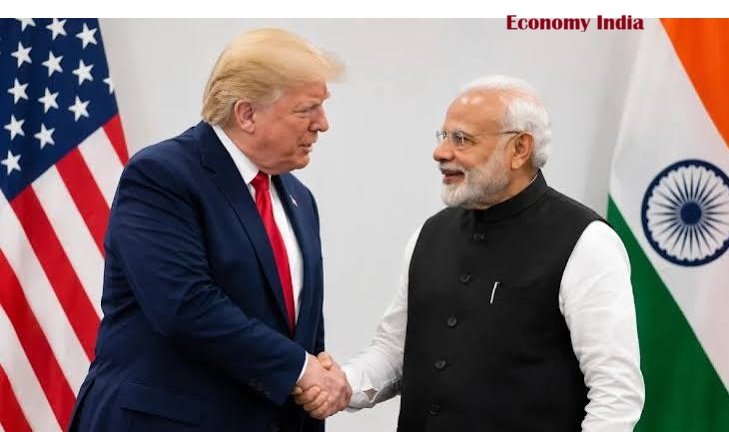

US President Donald Trump says IMEEC can support alternative energy and trade routes as West Asia faces continuing geopolitical and shipping disruptions.
United Nations (Economy India): US President Donald Trump has voiced strong support for the India-Middle East-Europe Economic Corridor (IMEEC), linking the strategic connectivity project to the need for more diversified energy infrastructure and trade routes in the Middle East.
Trump made the remarks while addressing a multilateral meeting with the Gulf Cooperation Council (GCC) on the sidelines of the high-level session of the United Nations General Assembly.
The US president said attacks on commercial shipping in the region had demonstrated the need to move Middle East energy infrastructure away from routes vulnerable to Iranian checkpoints.
“Iran’s terrorist attacks on commercial shipping in neighbouring countries have shown the need to shift Middle East energy infrastructure away from the Iranian checkpoints,” Trump said.
He added that his administration strongly supports the India-Middle East-Europe Economic Corridor, along with other routes and infrastructure projects designed to facilitate the movement of oil and other energy supplies.
Trump Links IMEEC With Energy Security
Trump said the region needs alternative infrastructure for transporting energy, including pipelines and other systems, as geopolitical tensions continue to affect established trade and shipping routes.
“That’s why my administration strongly supports the India-Middle East-Europe Economic Corridor and other places… the form of getting oil out, whether it’s pipelines or anything else,” he said.
The comments come amid heightened security and energy concerns in West Asia, where disruptions to shipping and energy infrastructure have raised questions over the resilience of regional supply routes.
What Is the India-Middle East-Europe Economic Corridor?
The India-Middle East-Europe Economic Corridor, or IMEEC, is designed to strengthen connectivity between India, the Gulf region and Europe through a combination of transport and infrastructure links.
The proposed corridor envisages an eastern connection between India and the Gulf and a northern connection linking the Gulf with Europe. It is intended to facilitate the movement of goods and improve connectivity through ports, rail networks, energy infrastructure and digital links.
The corridor has also been discussed as a broader economic-connectivity initiative involving trade, logistics, energy and digital infrastructure.
Strategic Importance for India
For India, IMEEC represents a proposed alternative connectivity route to European markets and a framework for deeper economic engagement with Gulf countries.
The corridor’s development could have implications for logistics, supply chains, energy connectivity and trade flows between India, the Middle East and Europe.
Trump’s latest comments place renewed attention on the project at a time when energy security and the reliability of regional transport routes are major concerns.
West Asia Tensions Put Energy Routes in Focus
The discussion around alternative energy infrastructure comes amid continuing disruption and geopolitical tensions in West Asia.
The Strait of Hormuz and other regional shipping routes remain strategically important to global energy markets. Recent developments have also prompted efforts to diversify routes and reduce dependence on vulnerable chokepoints. Reuters has reported that US officials have been considering ways to reduce Gulf energy infrastructure’s dependence on the Strait of Hormuz.
Trump’s remarks therefore connect the IMEEC initiative not only with trade and connectivity but also with the wider question of energy-route resilience.
IMEEC Gains Fresh Attention
Trump’s endorsement gives fresh political attention to the India-Middle East-Europe corridor as the US and regional countries examine ways to strengthen economic connectivity and energy security.
The comments also highlight the potential strategic significance of infrastructure that can provide additional routes for trade and energy flows between India, the Gulf and Europe.
(Economy India)