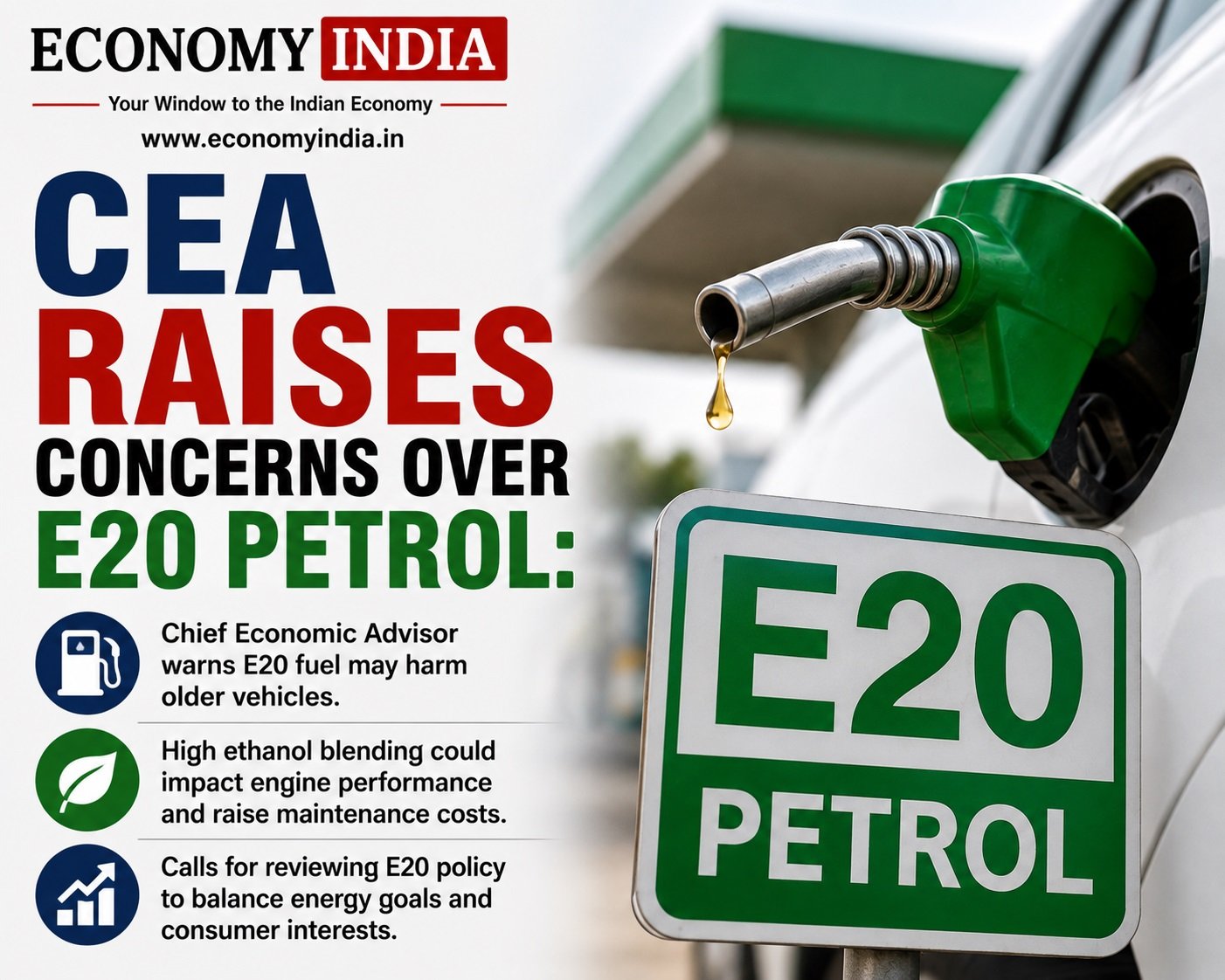
Chief Economic Adviser V. Anantha Nageswaran Says Around 8 Crore Older Two-Wheelers May Face Compatibility Issues; Higher Ethanol Blending Could Also Put Pressure on Food Prices
New Delhi (Economy India): India’s ethanol-blending programme has helped reduce dependence on imported crude oil and generate significant savings, but the country’s rapid transition to higher ethanol blends could create new challenges for older vehicles and food prices.
Chief Economic Adviser V. Anantha Nageswaran has raised concerns over the impact of E20 petrol, which contains 20% ethanol, on older two-wheelers equipped with carburettor-based engines.
In an article published in The Indian Express, Nageswaran suggested that E10 petrol should continue to be made available at fuel stations for older vehicles until they are modified or replaced.
Around 8 Crore Older Two-Wheelers Could Be Affected
According to Nageswaran, India has around 8 crore older motorcycles and scooters that use carburettor technology.

Many of these vehicles were manufactured before the introduction of newer emission standards and were not designed specifically for higher ethanol-blended fuels.
The transition to E20 could therefore create compatibility concerns for a section of the country’s existing vehicle fleet.
What Is the Concern With E20?
Ethanol has different fuel properties from conventional petrol. Older engines and fuel systems may not be calibrated to handle a higher proportion of ethanol.
According to the concerns highlighted by the CEA, older carburettor-based vehicles could potentially experience:
- Higher engine operating temperatures
- Difficulty in adjusting the air-fuel mixture
- Faster deterioration of certain rubber components
- Wear or damage to fuel-system parts
- Reduced performance or fuel efficiency in some vehicles
The extent of the impact can vary depending on the vehicle’s age, design, maintenance and compatibility with ethanol-blended fuel.
CEA Suggests Continuing E10 for Older Vehicles
Nageswaran has suggested that E10 petrol should remain available alongside E20 until older vehicles can be appropriately modified.
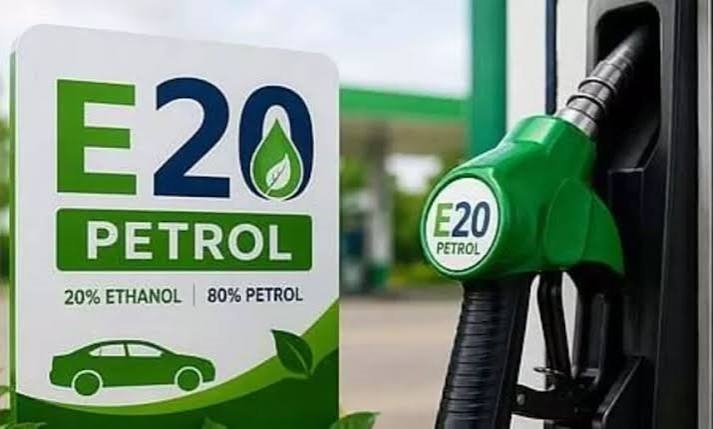
E10 contains 10% ethanol and was more widely used before the country’s transition toward higher ethanol blending.
Making E10 available would give owners of older vehicles an alternative while allowing the broader transition toward higher ethanol blends to continue.
The proposal is particularly relevant for owners of older motorcycles and scooters that may not have been engineered for E20 fuel.
Ethanol Blending Has Delivered Major Economic Benefits
India’s ethanol-blending programme has been driven partly by the objective of reducing the country’s dependence on imported crude oil.
India imports a large share of its crude oil requirements, making the country vulnerable to international oil prices, geopolitical disruptions and fluctuations in foreign exchange.
Increasing ethanol blending in petrol allows a portion of petroleum demand to be substituted with domestically produced ethanol.
This has helped reduce crude oil consumption and has generated substantial savings on oil imports, according to the government’s assessment.
However, Nageswaran’s concerns suggest that the economic benefits of ethanol blending must now be evaluated alongside its broader impact on vehicles, agriculture and food prices.
Food Security Emerges as a New Concern
One of the most significant issues highlighted by the CEA is the potential competition between fuel production and food consumption.
Ethanol can be produced from several agricultural commodities, including:
- Sugarcane
- Maize
- Rice
- Other agricultural feedstocks
As demand for ethanol increases, more agricultural output could potentially be diverted toward fuel production.
This could become a concern if demand for ethanol feedstocks grows faster than agricultural production.
Why Maize Prices Matter
Maize is particularly important because it is not only used for ethanol production but is also an important source of animal feed.
The poultry and dairy industries depend heavily on feed inputs.
If ethanol manufacturers begin paying significantly higher prices for maize, they could compete with poultry and dairy producers for the same agricultural supply.
That could increase feed costs across the livestock sector.
Possible Impact on Food Prices
Higher feed costs could eventually affect the prices of several everyday food products.
Potentially affected products include:
Eggs → Chicken → Milk and Dairy Products
Higher production costs for poultry and dairy businesses could eventually be passed on to consumers.
This creates a potential link between ethanol policy and food inflation.
Risk of Excessive Ethanol Blending
The CEA’s concerns extend beyond E20 and point toward the broader question of how far ethanol blending should be increased.
A very high ethanol-blending target could create greater competition for agricultural commodities.
If food crops are increasingly redirected toward fuel production without a corresponding increase in agricultural output, supply pressures could emerge.
That could make the transition more complicated for policymakers.
Balancing Energy Security and Food Security
India’s ethanol policy has an important strategic objective: reducing the country’s dependence on imported crude oil.
However, policymakers now face the challenge of balancing three major objectives:
1. Energy Security
Reducing dependence on imported crude oil and improving domestic fuel security.
2. Vehicle Compatibility
Ensuring that millions of older vehicles are not adversely affected by higher ethanol blends.
3. Food Security
Preventing excessive diversion of food crops toward fuel production and avoiding additional food-price pressures.
The CEA’s comments underline the importance of considering all three aspects together.
What E10 Availability Could Mean
Keeping E10 petrol available for older vehicles could provide a transition mechanism.
Owners of older motorcycles and scooters would have access to fuel that is more compatible with their existing engines, while newer vehicles designed for E20 could continue using the higher ethanol blend.
Such an approach could reduce the immediate burden on owners of older vehicles and give them more time to upgrade or modify their vehicles.
A Challenge for India’s Automotive Market
The issue is particularly important because India’s vehicle fleet includes millions of older two-wheelers.
Motorcycles and scooters are widely used for daily commuting, particularly by middle- and lower-income households.
For these vehicle owners, premature replacement or expensive modifications could represent a significant financial burden.
A phased transition could therefore be important to ensure that the shift toward cleaner and domestically produced fuels does not disproportionately affect existing vehicle owners.
Ethanol Policy Has a Wider Economic Impact
The debate around E20 is no longer limited to fuel quality or vehicle compatibility.
It now touches several parts of the economy, including:
- Petroleum imports
- Foreign exchange savings
- Agriculture
- Sugar and maize markets
- Poultry production
- Dairy production
- Food inflation
- Automobile ownership costs
- Rural incomes
This makes ethanol policy an important part of India’s wider economic strategy.
The Road Ahead
India’s ethanol programme has achieved significant progress in recent years, but the next phase will require careful policy planning.
The country will need to expand ethanol production without creating excessive pressure on food supplies, while also ensuring that older vehicles have a practical transition path.
Improving access to compatible fuels such as E10 for older vehicles could be one part of that transition.
At the same time, increasing the availability of non-food feedstocks and improving agricultural productivity could help reduce competition between food and fuel.
Chief Economic Adviser V. Anantha Nageswaran has raised concerns about the impact of E20 petrol on India’s large population of older two-wheelers.
He has suggested that E10 petrol should continue to be sold for older vehicles until they are suitably modified or replaced.
At the same time, he has warned about the potential consequences of rapidly increasing ethanol demand. Greater use of maize, sugarcane and rice for ethanol could create competition with food and animal-feed requirements.
If maize prices rise sharply because of increased demand from ethanol producers, poultry and dairy businesses could face higher feed costs, potentially pushing up the prices of eggs, chicken and milk.
India’s ethanol programme has delivered significant benefits by reducing crude oil imports and supporting energy security. The emerging challenge, however, is to ensure that the transition toward higher ethanol blending remains compatible with vehicle safety, affordable food and long-term economic stability.
(Economy India)