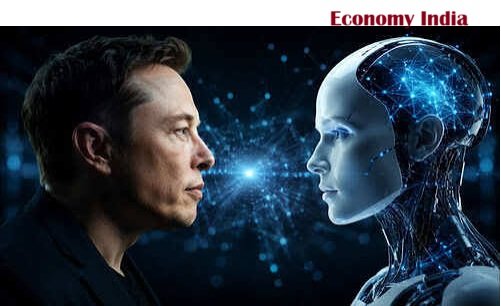

lon Musk predicts AI could dominate coding, research, writing and other digital tasks by 2028, potentially bringing major changes to India’s IT and BPO industry.
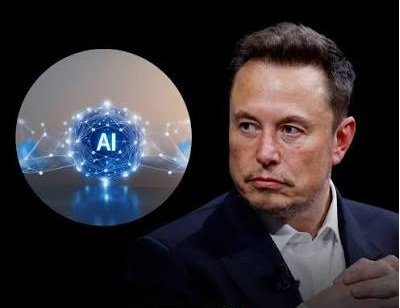
San Francisco (Economy India): Tesla and X owner Elon Musk has made a sweeping prediction about the pace of artificial intelligence, claiming that AI could master virtually all major digital fields and surpass humans by 2028.
Musk made the remarks while responding to a theory put forward by prominent AI researcher François Chollet, who had predicted in 2021 that over the following 10 to 20 years, almost every scientific discipline — including physics, chemistry, biology and archaeology — could increasingly become a branch of computer science.
Chollet recently revisited his earlier prediction, saying the transformation now appears to be underway. Musk, however, suggested that Chollet’s timeline was too slow and that the development of AI could accelerate much faster.

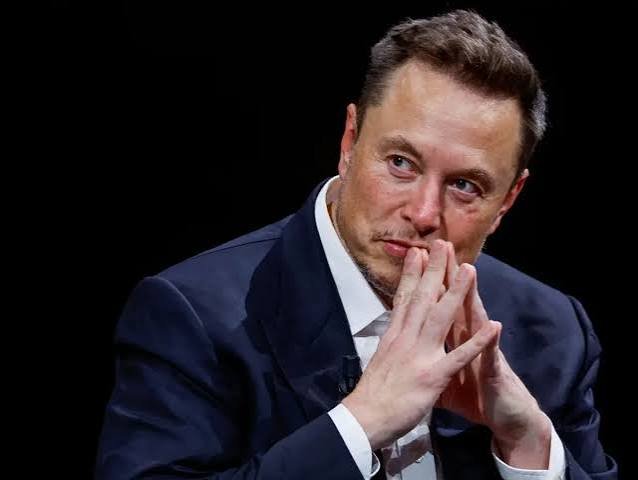
Musk Predicts AI Dominance in Digital Tasks
According to Musk, AI could dominate a wide range of tasks that depend primarily on computers and digital information by 2027-28.
These include:
- Software development and coding
- Scientific research
- Writing and content generation
- Legal analysis
- Accounting
- Data analysis
- Other computer-based knowledge work
Musk has particularly highlighted software engineering as an area where AI capabilities could advance rapidly.
He has suggested that AI could reach a level of performance in software engineering comparable to the dominance of advanced chess engines, making it increasingly difficult for humans to compete with AI on purely technical coding tasks.
This remains a prediction, however, and the actual pace and extent of AI adoption across professional fields will depend on technological, economic, regulatory and organisational factors.
Physical Jobs May Take Longer to Automate
Musk has distinguished between digital work and physical tasks.
Jobs such as manufacturing and construction require AI systems to interact with the physical world, making them considerably more difficult to automate than purely digital activities.
Humanoid robots could play a major role in this transition. Tesla has been developing its Optimus humanoid robot, with the broader goal of deploying robots for physical tasks.
Unlike software-based AI, physical robots need to navigate unpredictable environments, manipulate objects, maintain balance and operate safely alongside humans.
François Chollet’s Theory: Science Is Becoming More Computational
François Chollet’s earlier argument was that computing would increasingly become central to almost every field of science.
He used the transformation of businesses as an analogy. Around the year 2000, the idea that traditional companies would increasingly operate like technology companies might have seemed unusual. Today, major retail, logistics and other businesses depend heavily on software, data and computing infrastructure.
Chollet argues that a similar transformation is taking place in scientific research.
AI in Biological Research
AI systems are increasingly being used to analyse biological data and understand complex protein structures, potentially speeding up parts of biomedical research.
Materials Science
Computational modelling and AI-based simulations are being used to explore new materials and predict their properties.
Climate Research
AI and high-performance computing can process huge datasets and help researchers identify complex patterns associated with climate and environmental systems.
What Could It Mean for India’s IT Industry?
If AI capabilities advance at anything close to the pace suggested by Musk, India’s IT services, software and BPO sectors could face significant changes.
India has built a major global technology-services industry around software development, business-process services, data management and other knowledge-based activities.
The increasing automation of these tasks could therefore force companies to rethink their business models and workforce skills.
IT and BPO Jobs Could Change
Repetitive digital activities such as basic coding, software testing, data processing and routine documentation could become increasingly automated.
At the same time, demand could grow for professionals who can develop, supervise, integrate and evaluate AI systems.
The result could be a shift in the composition of technology jobs rather than simply a one-for-one replacement of human workers.
Research and Innovation Could Accelerate
AI tools could help Indian researchers process large datasets, conduct simulations and automate parts of research workflows.
Areas such as pharmaceuticals, space technology, agriculture, materials science and climate research could potentially benefit from faster computational analysis.
Skills Could Become More Important
As AI takes over more routine digital tasks, workers may need skills beyond basic programming or theoretical knowledge.
Understanding AI tools, data analysis, system design, problem-solving, AI-assisted workflows and the ability to evaluate AI-generated results could become increasingly important.
Will AI Really Surpass Humans by 2028?
Musk’s 2028 timeline represents a highly ambitious prediction about the pace of AI development. It should not be treated as an established forecast.
AI capabilities have advanced rapidly, but achieving reliable automation across entire professions involves much more than demonstrating technical performance in isolated tasks.
Factors such as cost, reliability, safety, regulation, data availability, cybersecurity and the need for human oversight will also influence how quickly AI can be deployed in real-world workplaces.
The more immediate transformation could therefore involve humans working alongside increasingly capable AI systems, with routine tasks becoming automated while workers focus on higher-level judgement, creativity, supervision and problem-solving.
Musk’s comments nevertheless underline how quickly expectations around AI are changing — and why governments, companies and workers are increasingly focusing on how the technology could reshape the global labour market.
(Economy India)