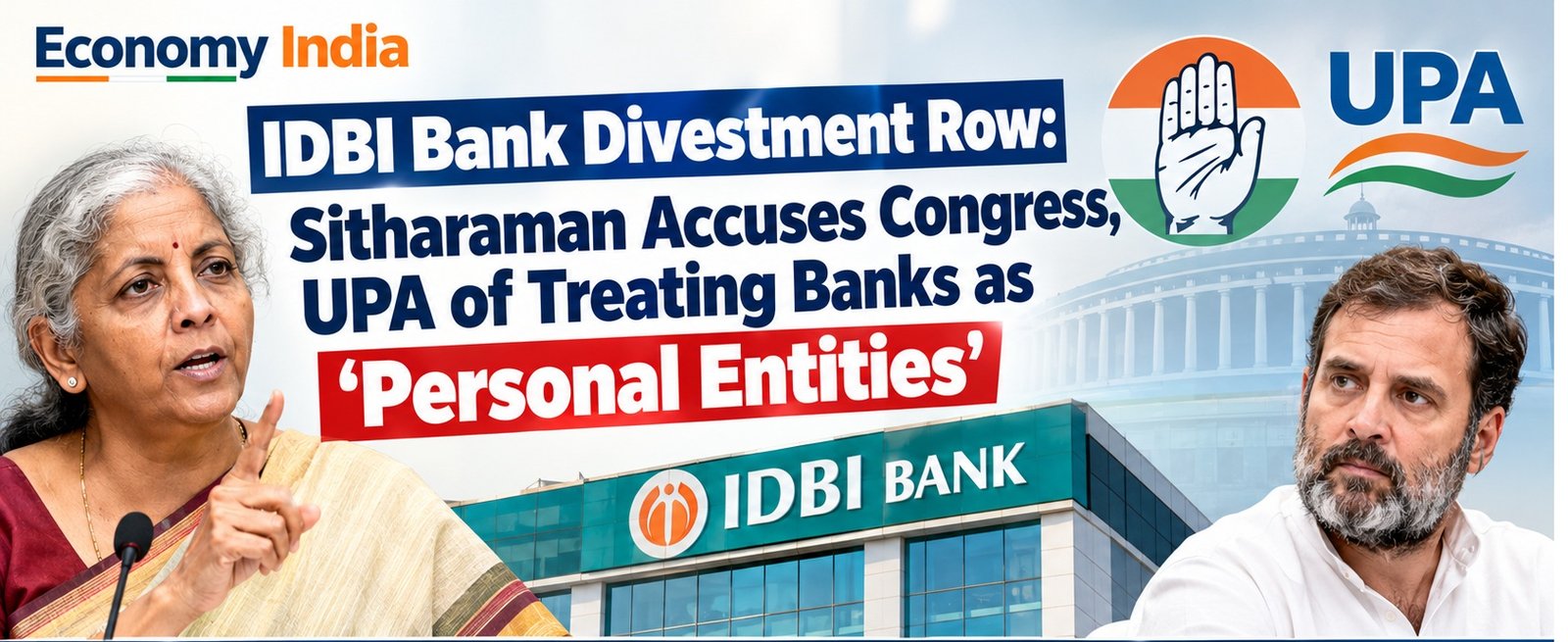
Finance Minister cites alleged political interference in lending decisions, recalls 1976 removal of SBI chairman R.K. Talwar; remarks come amid Rahul Gandhi’s criticism of IDBI Bank sale
New Delhi, October 30, 2026: Finance Minister Nirmala Sitharaman on Friday criticised the Congress party and the previous United Progressive Alliance (UPA) government amid the controversy surrounding the proposed divestment of IDBI Bank, alleging that banks and financial institutions were treated as “personal entities” and subjected to political interference.
In a post on social media platform X, Sitharaman alleged that bank employees were pressured to extend loans according to political preferences, bypassing established lending norms and prudent banking practices.
Her remarks came in response to a post by senior Congress leader and Leader of Opposition in the Lok Sabha Rahul Gandhi, who had questioned the government’s decision to sell a controlling stake in IDBI Bank and expressed support for the bank’s employees opposing the proposed transaction.


Sitharaman Recalls 1976 Removal of SBI Chairman
In her response, the Finance Minister cited historical instances to support her criticism of the Congress leadership’s approach towards public sector banks.
One of the examples she referred to was the removal of State Bank of India chairman R.K. Talwar in 1976, during the tenure of former Prime Minister Indira Gandhi.
According to Sitharaman’s account, Talwar was removed after allegedly refusing to yield to political pressure to relax lending norms for a company associated with Sanjay Gandhi.
The Finance Minister cited the episode to underline her allegation that political influence had been used to interfere with banking decisions during earlier Congress governments.
Her remarks also brought the debate over the autonomy of public sector banks and the importance of professional lending standards into the political spotlight.
Rahul Gandhi Questions IDBI Bank Disinvestment
The controversy intensified after Rahul Gandhi criticised the Centre’s proposed sale of a controlling stake in IDBI Bank.
In a post on X, Gandhi contrasted the Congress government’s role in establishing public sector banking institutions with the current government’s disinvestment policy.
He said public sector banks were institutions built with public money and should serve the country’s development objectives rather than be treated simply as assets for sale.
Gandhi also extended support to IDBI Bank employees who have raised concerns about the proposed privatisation. In a letter addressed to the bank’s employees, he questioned the rationale for selling a lender that employees had helped make profitable.
He raised concerns about the possible implications of privatisation for employees’ service conditions, job protections and reservation provisions for Scheduled Castes, Scheduled Tribes and Other Backward Classes.
The Congress leader also questioned how employees and depositors would be protected following the proposed change in ownership.

Government Approves 60.72% Stake Sale to Fairfax
The political exchange comes against the backdrop of the Centre’s decision to proceed with the strategic disinvestment of IDBI Bank.
On October 14, 2026, the Cabinet Committee on Economic Affairs approved Canada-based Fairfax Financial Holdings’ subsidiary, 10955230 Canada Inc., as the strategic buyer for a 60.72% stake in IDBI Bank.
The proposed transaction is valued at approximately ₹52,878.08 crore and includes:
- Government of India: 30.48% stake
- Life Insurance Corporation of India (LIC): 30.24% stake
- Total stake proposed for sale: 60.72%
Following the transaction, the government is expected to retain a 15% stake, while LIC will retain 19%.
The Finance Ministry has said the buyer was selected following an evaluation process and that independent agencies were engaged to assess the fair value of the bank.
Debate Over Public Sector Banking and Privatisation
The IDBI Bank transaction has brought competing arguments over public sector ownership, banking autonomy and financial-sector reforms into focus.
The government is proceeding with strategic disinvestment, while Rahul Gandhi and sections of the bank’s employees have questioned the sale and raised concerns about the future of employees and the institution’s public-sector character.
Sitharaman’s latest remarks shift attention towards the historical relationship between political authorities and public sector banks, particularly allegations of interference in lending decisions.
The debate now involves both the rationale for the proposed change in ownership of IDBI Bank and wider questions about the role, governance and independence of public financial institutions.
Key takeaway: Finance Minister Nirmala Sitharaman has accused Congress and the former UPA government of using banks as personal entities and interfering in lending decisions. Her remarks came as Rahul Gandhi opposed the proposed IDBI Bank stake sale and backed employees’ concerns over privatisation.
(Economy India)