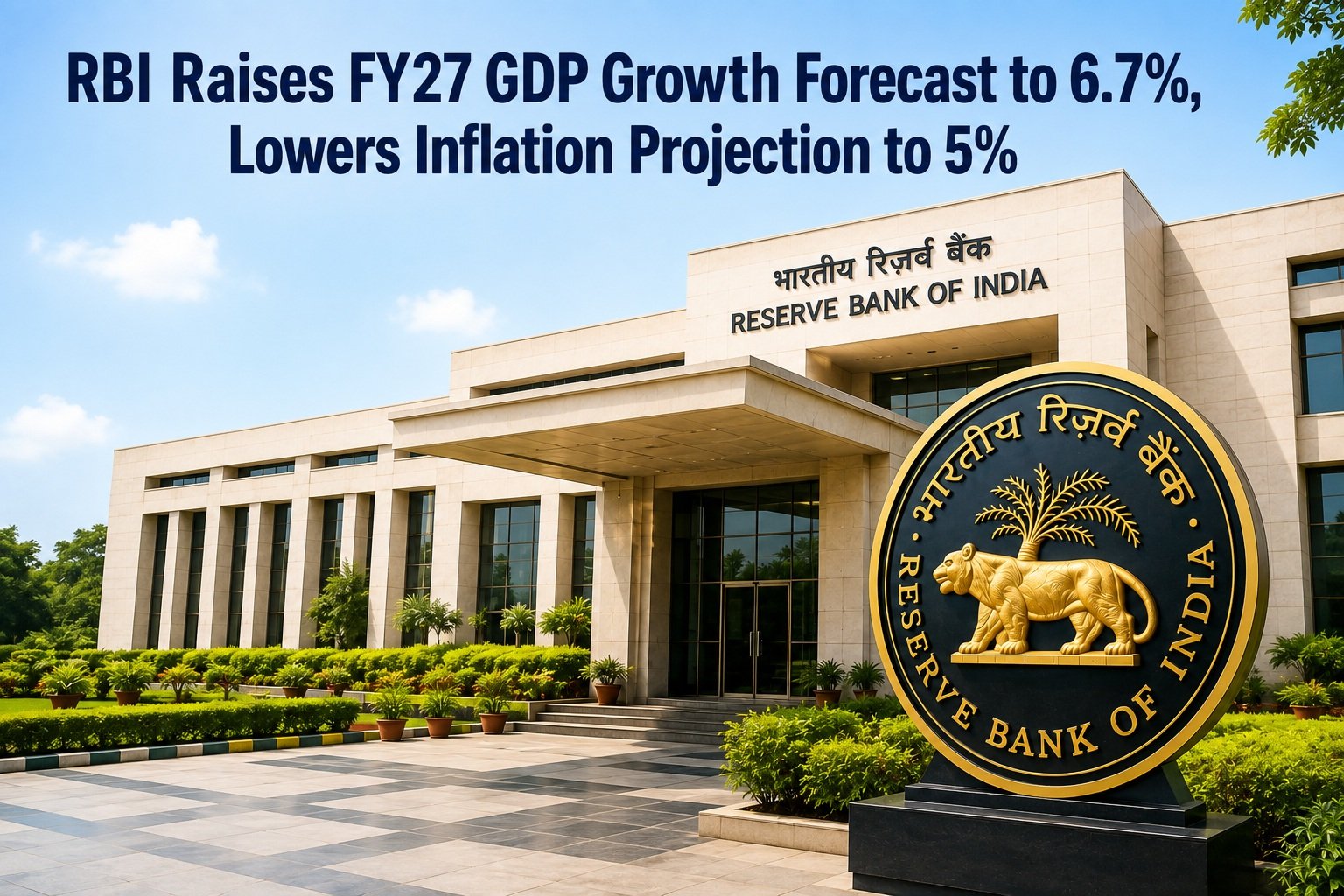
(Economy India):India’s economic outlook received a positive boost after the Reserve Bank of India (RBI) revised its projections for the financial year 2026-27. In its August bi-monthly monetary policy announcement, the central bank increased the country’s GDP growth forecast to 6.7%, up from the earlier estimate of 6.6% made in June. At the same time, it lowered the inflation projection from 5.1% to 5%, signaling improving price stability across the economy.
The revised forecasts reflect the RBI’s confidence in India’s resilient economic fundamentals despite an uncertain global environment. However, the central bank also cautioned that international developments, including geopolitical tensions, global trade uncertainties, and financial market volatility, could influence domestic economic activity in the coming months.
GDP Growth Outlook Improves
The RBI’s revised projection indicates that India’s economy is expected to continue expanding at a healthy pace during FY2026-27. Strong domestic demand, rising infrastructure spending, improved manufacturing activity, and steady growth in the services sector have contributed to the positive outlook.
Government investments in roads, railways, airports, digital infrastructure, and renewable energy projects are expected to support economic growth. Increased public expenditure is also encouraging private sector investments, creating employment opportunities and boosting consumer confidence.
Higher rural demand, supported by favorable agricultural conditions and government welfare schemes, is expected to contribute further to economic expansion. Urban consumption is also showing resilience as incomes improve and business activity remains strong.
Inflation Expected to Ease
Alongside stronger growth expectations, the RBI reduced its inflation forecast to 5% from 5.1%. The downward revision suggests that price pressures are gradually easing, helped by stable food supplies, improving agricultural output, and better management of supply chains.
Lower inflation benefits consumers by preserving purchasing power while providing businesses with a more predictable cost environment. Although inflation remains above the RBI’s long-term target of 4%, the latest forecast indicates that price stability is gradually improving.
The central bank will continue monitoring food prices, crude oil movements, weather conditions, and global commodity markets before making future policy decisions.
Global Risks Continue to Remain
Despite the improved domestic outlook, the RBI emphasized that the global economy continues to face significant uncertainties. Slowing growth in major economies, geopolitical conflicts, supply chain disruptions, and changing trade policies could impact exports, investments, and capital flows.
Global crude oil prices remain another important factor for India, as the country imports a large portion of its energy requirements. Any sharp increase in oil prices could push up inflation and widen the trade deficit.
The central bank noted that maintaining macroeconomic stability will remain a priority as global financial conditions evolve.
Impact on Businesses
The RBI’s revised projections are expected to boost business confidence across sectors. Companies are likely to increase investments as economic growth strengthens and inflation moderates.
Manufacturing, banking, infrastructure, automobiles, real estate, retail, logistics, and technology companies could benefit from stronger domestic demand. Stable inflation also allows businesses to plan production and expansion with greater certainty.
Financial markets generally view higher growth combined with lower inflation as a positive signal for long-term investment.
What It Means for Consumers
For consumers, the revised outlook offers encouraging signs. Lower inflation means prices may rise at a slower pace, helping households manage their expenses more effectively.
A stronger economy could also generate more employment opportunities, higher incomes, and increased spending. Continued infrastructure development and business expansion are expected to support overall economic activity throughout the year.
Outlook for FY2026-27
India remains one of the world’s fastest-growing major economies. The RBI’s revised forecasts highlight confidence in the country’s economic resilience despite global headwinds.
Going forward, policymakers will closely monitor inflation trends, global economic developments, commodity prices, and domestic demand before taking further monetary policy decisions. If inflation continues to moderate while growth remains strong, India could maintain its position as a key driver of global economic growth during FY2026-27.
The RBI’s decision to raise the GDP growth forecast to 6.7% while lowering the inflation estimate to 5% reflects a balanced and optimistic assessment of India’s economy. Although global uncertainties continue to pose risks, strong domestic demand, government investment, and improving inflation dynamics provide a solid foundation for sustained economic growth. The revised projections are likely to strengthen investor confidence and reinforce India’s position as one of the fastest-growing large economies in the world.
(Economy India)