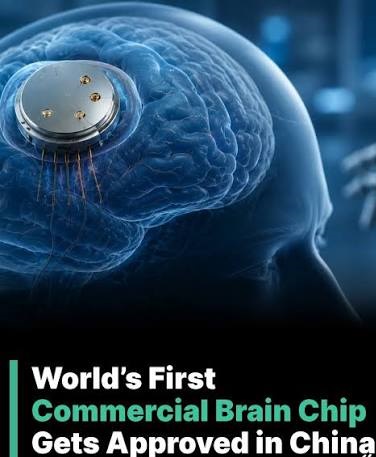

China Grants Approval to Commercial Brain-Computer Interface Device After Successful Clinical Trials
Beijing (Economy India): China has taken a major step forward in the global brain-computer interface (BCI) race by approving the world’s first commercially authorized implanted brain chip, NEO, following successful clinical trials.
The development places China ahead of Elon Musk’s brain-chip company Neuralink, which is still awaiting full commercial approval despite ongoing human trials in the United States.
According to international reports, the coin-sized NEO implant has become the first surgically implanted BCI device to successfully complete clinical testing for commercial use.
Developed by Tsinghua University and NeuroXess
The NEO brain chip was jointly developed by researchers from Tsinghua University and Shanghai-based NeuroXess.

Following regulatory approval, the technology is expected to be manufactured on a larger scale for integration into China’s healthcare system, potentially benefiting thousands of patients suffering from severe neurological conditions.

Designed to Help Paralysis Patients
The first version of the NEO implant has been designed primarily for patients with:
🧠 Spinal cord injuries
♿ Paralysis
🩺 Severe neurological disorders
The device enables users to regain partial control over bodily functions by translating brain signals into digital commands that can operate external devices.
Researchers believe the technology could eventually transform how humans interact with computers, machines, and digital systems.
How NEO Differs from Neuralink
One of the biggest differences between China’s NEO implant and Neuralink’s N1 device lies in the implantation method.
NEO Implant
✅ Positioned between the skull and the brain
✅ Sensors placed above the protective dura mater membrane
✅ Less invasive surgery
✅ Reduced medical risk
Neuralink N1
🔹 Electrodes inserted directly into the cerebral cortex
🔹 Requires deeper brain implantation
🔹 More complex surgical procedure
The NEO device uses eight sensors to capture neural signals and transmit them to a nearby computer, where advanced software converts them into digital commands.

Successful Clinical Testing
Reports indicate that NEO has already been tested on 36 patients, delivering highly encouraging results.
Medical experts believe the less invasive approach significantly lowers surgical risks while maintaining effective neural signal detection.
Potential future applications include treatment and assistance for patients suffering from:
🧠 Parkinson’s disease
⚡ Epilepsy
🩺 Stroke-related disabilities
💭 Depression and neurological disorders
Neuralink Continues Human Trials
While China has moved toward commercialization, Neuralink remains in the clinical testing phase.
The company has received approval for human trials and is testing its N1 implant in patients with severe paralysis caused by spinal cord injuries and neurological diseases.
Neuralink aims to enable users to:
💻 Control computers using thought alone
⌨️ Type without physical movement
🖱️ Operate digital devices through neural signals
Several trial participants have already demonstrated the ability to control computer cursors and interact with digital interfaces using brain activity.
Privacy and Cybersecurity Concerns
Despite the technology’s medical potential, experts have raised concerns regarding privacy and cybersecurity.
Researchers warn that future BCI systems could become targets for cyberattacks if proper safeguards are not implemented.
Potential risks include:
🔒 Unauthorized access to neural data
🧠 Privacy concerns related to thoughts and memory patterns
⚠️ Manipulation of digital commands generated by the brain
Cybersecurity specialists emphasize that robust protections will be essential as brain-computer interfaces become more widespread.
What is Brain-Computer Interface (BCI) Technology?
Brain-Computer Interface (BCI) technology creates a direct communication pathway between the human brain and external devices such as computers, robotic arms, wheelchairs, or smartphones.
The system works by:
1️⃣ Detecting electrical signals generated by the brain
2️⃣ Interpreting those signals through software algorithms
3️⃣ Converting them into digital commands
4️⃣ Allowing users to control devices using thought alone
BCI technology is considered one of the most promising innovations in neuroscience, artificial intelligence, and healthcare.
(Economy India)