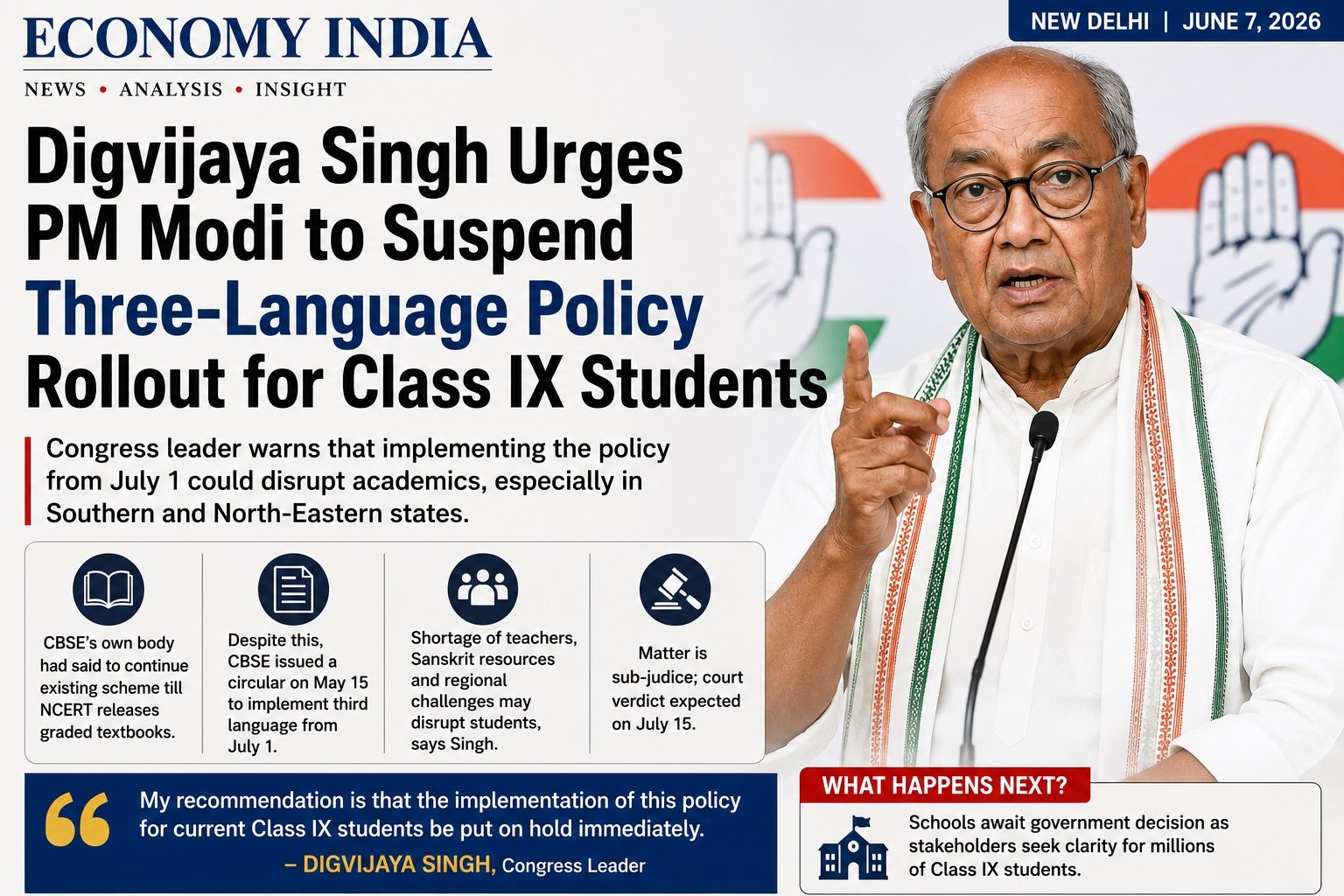
Congress Leader Flags Concerns Over Mid-Session Implementation for Class IX Students, Cites Lack of Teachers and Textbooks
New Delhi (Economy India): Senior Congress leader Digvijaya Singh has written to Prime Minister Narendra Modi, urging the Centre to immediately suspend the implementation of the CBSE‘s three-language policy for Class IX students, citing concerns over inadequate preparation, shortage of teachers, and the absence of suitable textbooks.
Singh, who serves as Chairman of the Parliamentary Standing Committee on Education, Women, Children, Youth and Sports, warned that enforcing the policy in the middle of an academic session could create significant disruption for students, schools, and parents across the country.
In a letter addressed to the Prime Minister, Singh said he was forwarding a representation submitted by a group of concerned parents who opposed the mandatory introduction of a third language from July 1, 2026.
According to Singh, the concerns raised by parents are genuine and deserve urgent consideration.

Concerns Over Mid-Session Rollout
The Congress leader argued that introducing a major curriculum change during an ongoing academic session could adversely affect lakhs of students.
He stated that the policy is being implemented without adequate transition time, trained teachers, or necessary educational resources.
Singh compared the situation to the difficulties experienced during the implementation of CBSE’s On-Screen Marking (OSM) system, which had reportedly caused challenges for students and schools.
“The sudden enforcement of this policy mid-session is likely to create serious disruption,” Singh noted in his communication to the Prime Minister.
Questions Raised Over CBSE Decision
Singh also questioned the circumstances under which the CBSE decided to move forward with the policy.
He pointed out that during a meeting held in December 2025, the CBSE Governing Body had reportedly approved a recommendation from its Curriculum Committee that schools should continue with the existing language scheme until graded language textbooks were released by NCERT.
However, despite that recommendation, the CBSE later issued a circular on May 15, 2026, directing schools to begin implementing third-language instruction for Class IX students from July 1.
The Congress leader questioned how and why the Board appeared to have departed from its earlier position.
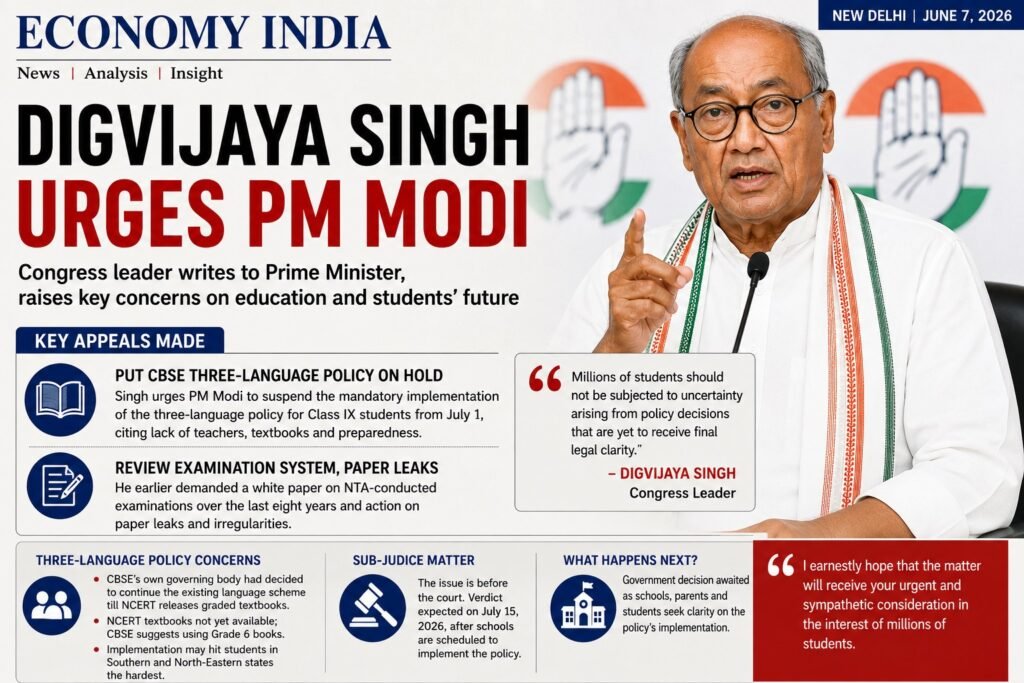
Shortage of Textbooks and Teachers
A key concern highlighted in the letter relates to the availability of learning materials.
According to Singh, NCERT has not yet released graded textbooks for several language subjects. As an interim measure, schools have reportedly been advised to use NCERT’s Grade 6 language textbooks for Class IX students.
Education experts have expressed concerns that such arrangements may not adequately meet the academic requirements of higher-grade students.
The issue of teacher availability has also emerged as a major challenge.
Singh noted that Sanskrit has become a preferred third-language option for many schools, but there is a severe shortage of qualified Sanskrit teachers and appropriate study materials.
He argued that implementing the policy without addressing these shortcomings could undermine its educational objectives.
Southern and North-Eastern States May Face Challenges
The Congress leader said the policy could create additional difficulties for students in Southern and North-Eastern states, where Hindi is not widely spoken.
He also raised concerns about tribal and regional languages that may not currently be included in the CBSE’s recognized language framework.
According to Singh, students from these regions could face disproportionate academic pressure if adequate support systems are not established before implementation.
Appeal for Temporary Suspension
In his letter, Singh urged the Prime Minister to place the policy on hold for the current batch of Class IX students until all necessary infrastructure and academic preparations are completed.
He pointed out that legal proceedings related to the matter are currently pending before the court, with a verdict expected on July 15, 2026.
Since schools have been instructed to begin implementation from July 1, Singh argued that a temporary suspension would prevent confusion and uncertainty among students and educational institutions.
He emphasized that educational reforms should be implemented only after sufficient planning and consultation to safeguard students’ academic interests.
Education Policy Debate Continues
The issue has reignited debate over the implementation of the National Education Policy (NEP) and multilingual education in India.
Supporters argue that learning multiple languages enhances cognitive development and national integration, while critics believe implementation challenges must be addressed before making such policies mandatory.
The controversy comes at a time when educational reforms and examination systems remain under intense public scrutiny.
Recently, Singh had also written to the Prime Minister regarding alleged irregularities in national-level examinations, including NEET-UG 2026, calling for greater transparency and accountability.
As discussions continue, stakeholders across the education sector are closely watching the government’s response to the concerns raised regarding the three-language policy.
(Economy India)