
Licence Fee Payments Cross ₹1,000 Crore Mark as FMCG Giant Expands Operations and Brand Portfolio
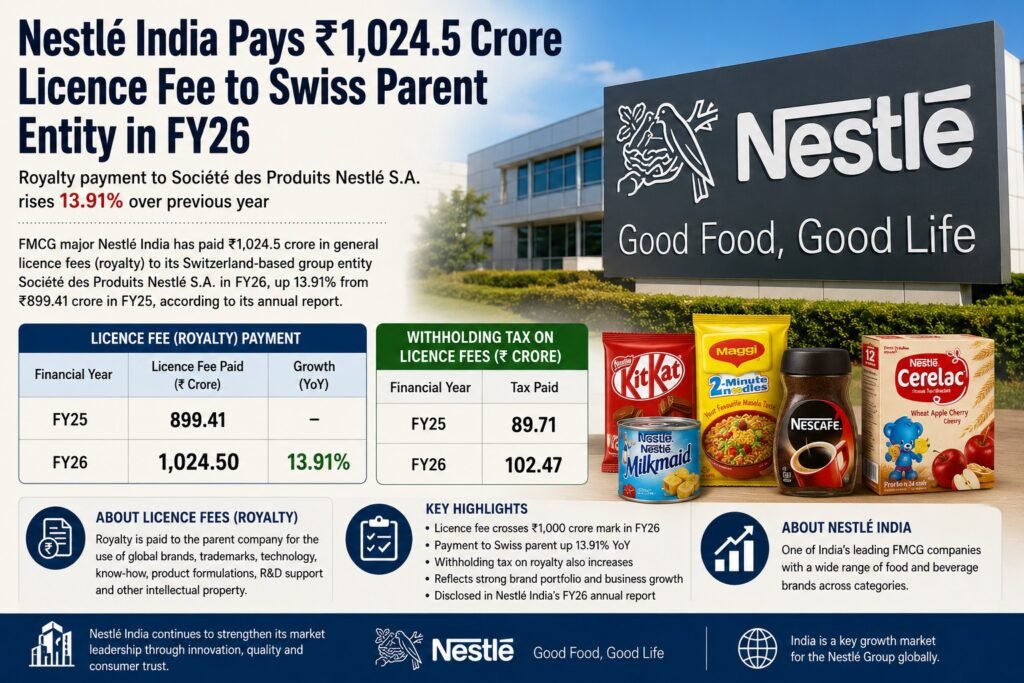
NEW DELHI (Economy India): Nestlé India paid ₹1,024.5 crore in general licence fees, commonly referred to as royalty payments, to its Switzerland-based parent entity, Société des Produits Nestlé S.A., during the financial year 2025-26, according to the company’s latest annual report.
The payment represents a 13.91% increase over the ₹899.41 crore paid in FY25, reflecting the continued growth of Nestlé India‘s business operations and the increasing value derived from the multinational group’s global brands, technology, intellectual property, and operational expertise.
The company also paid ₹102.47 crore as withholding tax on the licence fees during FY26, compared with ₹89.71 crore in the previous financial year.
Royalty Payments Cross ₹1,000 Crore Milestone
The latest disclosure marks the first time Nestlé India’s annual royalty payment has crossed the ₹1,000 crore threshold, highlighting the company’s expanding scale in one of the world’s fastest-growing consumer markets.
Royalty payments are made by subsidiaries to parent companies for the use of:
- Global trademarks and brands
- Proprietary technology
- Manufacturing processes
- Product formulations
- Research and development support
- Marketing and operational expertise
Nestlé India markets several globally recognized brands, including:
- Maggi
- Nescafé
- KitKat
- Milkmaid
- Nestlé Milk Products
- Cerelac
- Nestlé Professional offerings
These brands form the backbone of the company’s revenue generation strategy in India.
Royalty Payment Comparison
| Financial Year | Licence Fee Paid | Growth |
|---|---|---|
| FY25 | ₹899.41 Crore | — |
| FY26 | ₹1,024.50 Crore | 13.91% |
Withholding Tax Paid
| Financial Year | Withholding Tax |
| FY25 | ₹89.71 Crore |
| FY26 | ₹102.47 Crore |
Understanding the Royalty Structure
Royalty payments have often been a subject of discussion among investors in multinational corporations operating in India.
Supporters argue that such payments provide Indian subsidiaries access to:
- International product innovation
- Advanced manufacturing standards
- Global quality benchmarks
- Marketing expertise
- Research and development capabilities
Critics, however, periodically scrutinize royalty arrangements to ensure they remain aligned with shareholder interests and regulatory norms.
Corporate governance experts generally emphasize transparency and board oversight when approving related-party transactions involving parent entities.
Nestlé India’s Strong Market Position
Nestlé India remains one of the country’s leading fast-moving consumer goods (FMCG) companies and has consistently delivered strong financial performance supported by:
- Premiumization strategies
- Rural market expansion
- Product innovation
- Digital distribution channels
- Rising consumer demand
The company continues to benefit from India’s expanding middle class, urbanization trends and increasing consumption of packaged foods and beverages.
Industry analysts note that the rise in royalty payments broadly corresponds with growth in business volumes and brand expansion initiatives.
India’s Importance in Nestlé’s Global Strategy
India has emerged as one of the most strategically important growth markets for global consumer goods companies.
With a population exceeding 1.4 billion and rising disposable incomes, the country offers significant long-term growth opportunities across food, nutrition, beverages and packaged consumer products.
Nestlé has continued to invest in:
- Manufacturing capacity
- Product innovation
- Supply chain expansion
- Sustainability initiatives
- Digital transformation
These investments are aimed at strengthening the company’s market leadership and capturing future consumption growth.

Corporate Governance and Regulatory Oversight
Royalty payments by listed Indian subsidiaries to foreign parent companies are closely monitored under India’s corporate governance framework.
Such transactions typically require:
- Board approval
- Audit committee review
- Regulatory disclosures
- Shareholder transparency
The disclosures in Nestlé India’s annual report provide investors with visibility into related-party transactions and financial arrangements with the parent company.
As India’s FMCG market continues to expand, Nestlé India’s royalty payments may remain on an upward trajectory alongside business growth and brand development.
The crossing of the ₹1,000 crore mark in licence fee payments underscores both the scale of Nestlé India’s operations and the growing strategic importance of the Indian market within the global Nestlé ecosystem.
With strong consumer demand, product innovation and continued investments in manufacturing and distribution, Nestlé India is expected to remain one of the key growth engines for the Swiss food and beverage giant in the years ahead.
(Economy India)