India Calls for Decisive Global Action Against Terrorism at International Security Forum in Moscow
MOSCOW ( Economy India): India’s National Security Adviser (NSA) Ajit Doval has strongly called for a unified and uncompromising global approach against terrorism, stating that there cannot be “double standards” in combating terror threats.
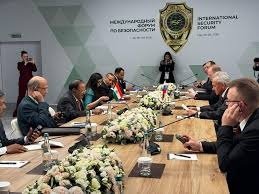
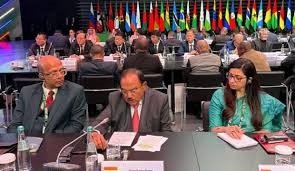
Doval made the remarks while addressing the first International Security Forum and the 14th Meeting of High Representatives for Security Matters in Moscow, according to the Indian Embassy in Russia.
The high-level international gathering was hosted by Sergei Shoigu, Secretary of the Security Council of the Russian Federation, and focused on emerging global security challenges in an increasingly multipolar world order.
India’s Strong Message on Terrorism
According to the Indian Embassy’s statement shared on X, Doval emphasized that responsible nations must clearly decide whether they support sponsors of terrorism or take decisive action against them.
“The NSA stated that there cannot be double standards in the fight against terrorism. Responsible nations have to evaluate their choices and decide whether they support sponsors of terrorism or counter them with decisive action,” the embassy said.
India has consistently advocated a zero-tolerance approach toward terrorism at international forums and has repeatedly raised concerns over cross-border terrorism and state-sponsored terror networks.
Call for Reform of Global Institutions
During the forum, Doval also highlighted the urgent need to reform global institutions and international structures established after World War II in 1945.
He stressed that the present global security architecture must evolve to effectively address contemporary geopolitical and security challenges.
“The reforms must give greater representation to and factor in the views of the Global South,” the embassy noted.
India has long argued for reforms in multilateral institutions such as the United Nations Security Council (UNSC), advocating greater representation for developing nations and emerging economies.
Concerns Over Maritime Security and West Asia
Referring to the ongoing geopolitical tensions in West Asia, Doval emphasized the importance of ensuring uninterrupted global trade through critical maritime corridors, including the Strait of Hormuz and the Red Sea.
The Strait of Hormuz and the Red Sea remain among the world’s most strategically important shipping routes, carrying significant volumes of global energy supplies and international trade.
Any prolonged disruption in these waterways could impact energy prices, global supply chains and economic stability across Asia and other regions.
Meeting with Russian Counterpart Sergei Shoigu
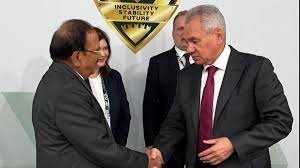
On the sidelines of the forum, Doval also held bilateral discussions with his Russian counterpart Sergei Shoigu.
According to the Indian Embassy, the two leaders reviewed cooperation in defence, security, energy and trade-economic relations between India and Russia.
The officials also exchanged views regarding preparations for the upcoming BRICS National Security Advisers’ meeting scheduled to be held in New Delhi later this year.
The official dates for the BRICS security advisers’ meeting have not yet been announced.
Visit Amid Complex Global Geopolitical Environment
Doval’s Russia visit comes at a time of heightened geopolitical tensions globally, including continuing instability in West Asia, maritime security concerns and the prolonged Russia-Ukraine conflict.
The Russia-Ukraine war has significantly reshaped global geopolitical alignments, energy markets, food supply chains and international security frameworks over the past several years.
Meanwhile, India continues to maintain diplomatic engagement with both Russia and Ukraine while consistently advocating dialogue and diplomacy for peaceful conflict resolution.
On Wednesday, External Affairs Minister S Jaishankar met Ukrainian Foreign Minister Andrii Sybiha in Cyprus, where both sides discussed the Russia-Ukraine conflict, battlefield developments and efforts toward achieving a “comprehensive and lasting peace”.
India’s balanced diplomatic approach reflects its broader strategy of maintaining strategic autonomy amid evolving global power dynamics.
(Economy India)