Sydney ( Economy India ): A fascinating astronomical discovery is prompting scientists to rethink one of the most fundamental questions in space science: What exactly qualifies an object as a star?
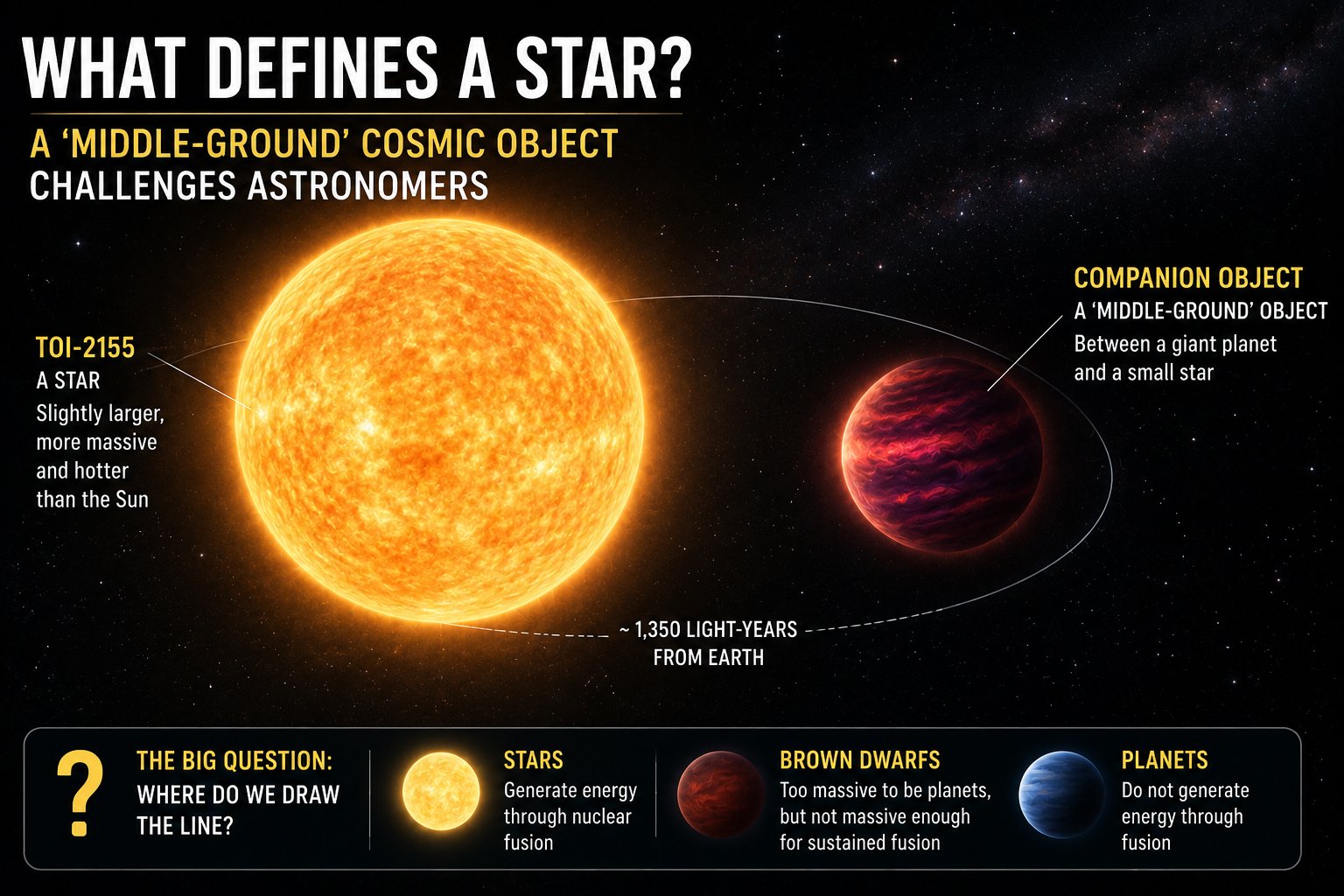
Located about 1,350 light-years from Earth, a star known as TOI-2155 appears fairly ordinary at first glance. It is slightly larger, more massive, and hotter than our Sun. However, what has captured astronomers’ attention is not the star itself, but an unusual companion object orbiting it.
The companion lies in the mysterious boundary between a giant planet and a small star, making it difficult for scientists to classify. Objects in this category are often referred to as brown dwarfs or “failed stars” because they are too massive to be considered planets but not massive enough to sustain the nuclear fusion that powers true stars.
This discovery has renewed debate among astronomers over the criteria used to distinguish stars from planets and brown dwarfs. Traditionally, stars generate energy through sustained hydrogen fusion in their cores, while planets do not. Brown dwarfs occupy the middle ground, possessing characteristics of both but fitting neatly into neither category.

Researchers believe studying systems like TOI-2155 could improve our understanding of how stars and planets form and evolve. It may also help scientists refine the definitions used to classify celestial bodies across the universe.
As astronomical technology continues to advance, discoveries like this are revealing that the universe is more complex than previously imagined, challenging long-held scientific boundaries and opening new avenues of research.
( Economy India )