Reliance Jio Denies Involvement After Telegram CEO Suggests Possible Role in Efforts to Restrict Messaging Platform
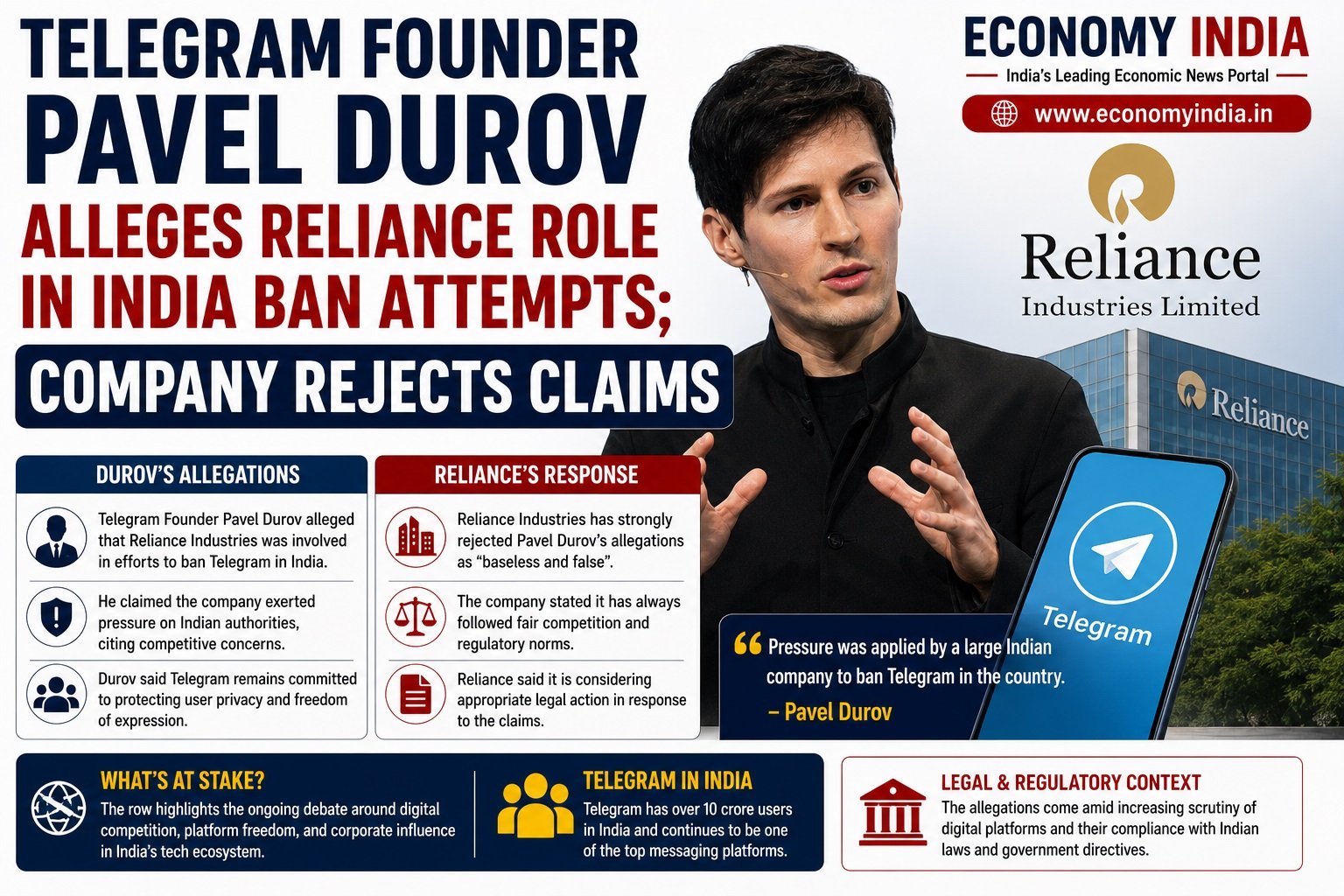
New Delhi (Economy India): Telegram founder and Chief Executive Officer (CEO) Pavel Durov on Thursday alleged that Reliance may have played a role in attempts to restrict or ban the messaging platform in India. However, Reliance Jio strongly denied the allegations, rejecting any suggestion of involvement in actions against Telegram.
The controversy emerged after Durov made public remarks suggesting that efforts to limit Telegram’s operations in India could be linked to commercial interests in the country’s highly competitive digital and telecommunications sector.
Durov Raises Concerns Over Competition
In his remarks, Durov indicated that Telegram has faced challenges in several markets due to its growing popularity and independent business model. He suggested that large corporations with interests in digital communications and social media ecosystems could potentially influence regulatory discussions.
While Durov did not provide specific evidence to support his claims, his comments sparked debate across the technology and telecom industries.
Reliance Jio Rejects Allegations
Responding to the allegations, Reliance Jio categorically denied any involvement in attempts to ban or restrict Telegram in India.
Company representatives stated that the organization has no connection with any alleged efforts targeting the messaging platform and emphasized its commitment to fair competition and compliance with Indian laws and regulations.
Reliance Jio described the allegations as baseless and reiterated that it operates within the framework of established regulatory norms.

Meta’s Investment in Reliance Mentioned
The discussion has also drawn attention to the strategic partnership between Meta Platforms and Reliance Industries. Meta holds a minority investment in Reliance’s digital ventures through its investment in Jio Platforms.
Industry observers note that the partnership has played a significant role in expanding digital services and connectivity across India. However, there is currently no publicly available evidence linking the investment relationship to any regulatory action involving Telegram.
Telegram’s Presence in India
India is one of Telegram’s largest markets, with millions of users relying on the platform for messaging, content sharing, education, business communication, and community engagement.
The platform has experienced rapid growth in recent years due to its:
📱 Secure messaging features
🔒 Privacy-focused tools
📂 Large file-sharing capabilities
👥 Community and channel features
🌐 Cross-platform accessibility
The company continues to compete with other major messaging platforms operating in the country.
Digital Competition Intensifies
The episode highlights the increasingly competitive nature of India’s digital ecosystem, where technology companies, telecom operators, social media platforms, and messaging services are competing for users and market share.
Industry analysts believe that India’s rapidly expanding digital economy has created intense competition among global and domestic technology players.
Key sectors witnessing competition include:
📡 Telecommunications
💬 Messaging Applications
📱 Social Media Platforms
☁️ Digital Services
🤖 Emerging Technologies

Regulatory Environment Remains Important
India remains one of the world’s largest digital markets, and technology companies must comply with local regulations concerning user safety, data governance, cybersecurity, and platform accountability.
Experts note that regulatory decisions affecting digital platforms are typically made through established legal and policy frameworks involving government agencies and relevant authorities.
The allegations made by Telegram founder Pavel Durov have added a new dimension to discussions around competition in India’s rapidly evolving digital landscape. While Reliance Jio has firmly denied any involvement and no evidence has been publicly presented to support the claims, the episode underscores the importance of transparency, fair competition, and regulatory clarity in one of the world’s largest technology markets.
(Economy India)