
Finance Minister calls for evidence-based tax research, simpler compliance and reforms focused on investment, innovation and long-term economic growth
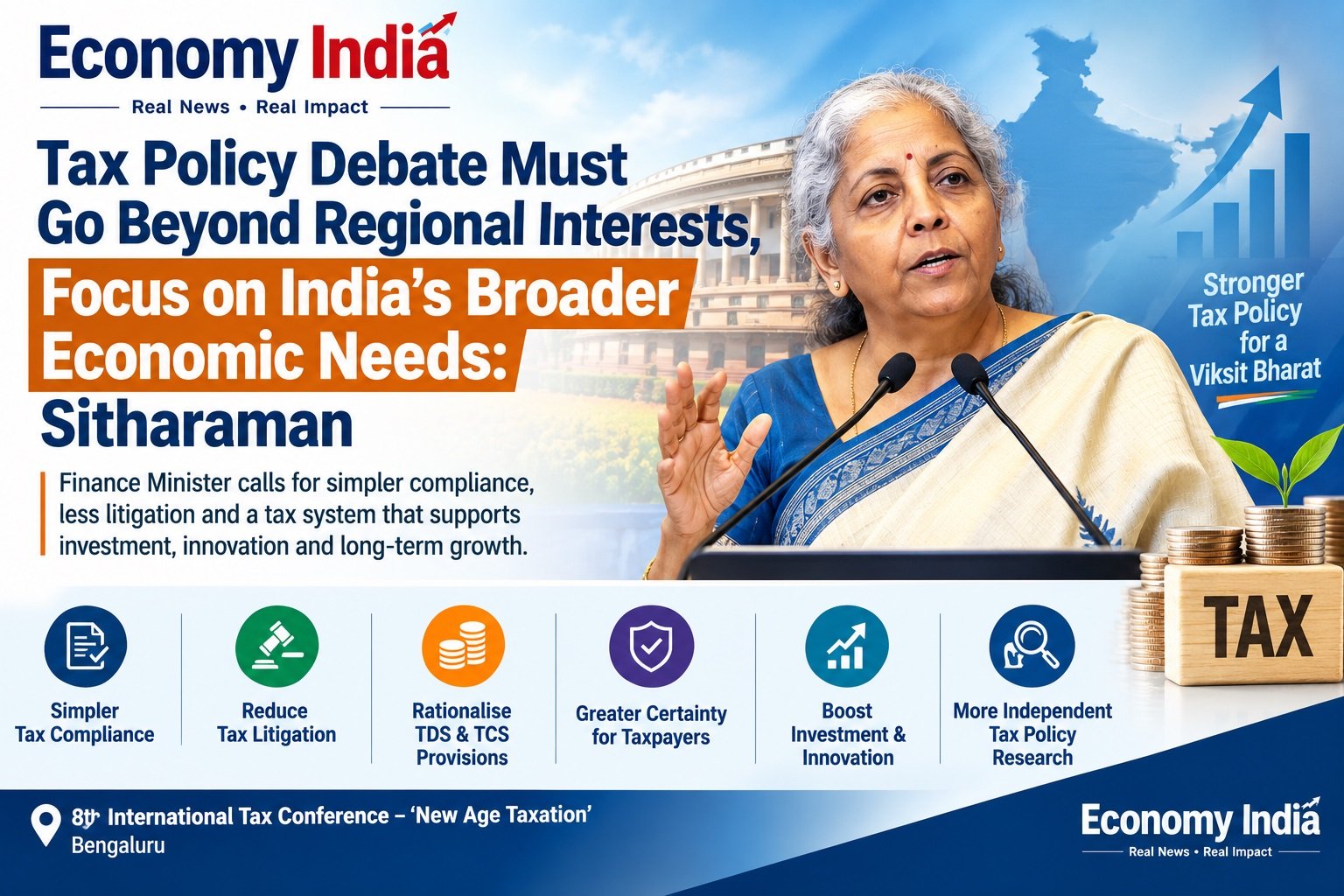
BENGALURU (Economy India): Union Finance Minister Nirmala Sitharaman has called for a broader and more mature debate on India’s tax policy, urging tax professionals, industry representatives and researchers to look beyond sector-specific demands and examine reforms from the perspective of the country’s wider economic and developmental priorities.
Speaking at the 8th International Tax Conference on “New Age Taxation”, organised by the International Tax Research and Analysis Foundation (ITRAF) in Bengaluru, Sitharaman said independent research on taxation should become a stronger part of public discourse.
She stressed that tax-policy discussions should not be driven solely by the interests of individual sectors or professional groups. Instead, proposals should consider their wider implications for taxpayers, government revenue, compliance costs and the overall economy.
Sitharaman Seeks More Mature Tax Policy Debate
Sitharaman said a mature discussion on taxation must move beyond sectoral considerations.

She urged tax professionals and industry bodies to examine the tax system critically and identify provisions that may no longer serve their intended purpose, even when particular sectors continue to benefit from them.
The Finance Minister also called for independent, evidence-based research that can contribute to policy formulation rather than representations focused primarily on exemptions, concessions or lower tax rates.
According to her, policy proposals should ideally be backed by quantified alternatives and an assessment of their likely impact on revenue, administration, compliance and other taxpayers.

Tax Reforms Focused on Easier Compliance
Sitharaman highlighted recent changes in India’s tax administration, saying the government has sought to simplify compliance and make the system more predictable for taxpayers.
Among the measures she referred to were the rationalisation of provisions relating to Tax Deducted at Source (TDS) and Tax Collected at Source (TCS), higher thresholds and a reduction in unnecessary criminal consequences.
The broader objective, according to the Finance Minister, is to make voluntary compliance easier while ensuring that enforcement resources are focused on cases that genuinely require intervention.
Reducing Tax Litigation Remains a Key Objective
The Finance Minister also underlined the importance of reducing tax disputes rather than simply managing the existing backlog of litigation.
The government’s approach, she said, is aimed at creating a tax environment in which taxpayers can comply more easily and with greater certainty.
This approach is particularly significant for businesses and investors, for whom prolonged tax disputes can increase costs and create uncertainty around investment and expansion decisions.
The government has separately highlighted the Income-tax Act, 2025 as a major step towards simplifying India’s direct-tax framework and reducing compliance costs.
India Reworks International Tax Treaties
Sitharaman also discussed India’s evolving approach to international taxation.
She said India has renegotiated tax treaties with Mauritius, Singapore and Cyprus to restore the country’s right to tax capital gains at source.
The move reflects the increasing importance of international tax rules as cross-border investment, global business structures and digital economic activity expand.
For India, strengthening source-based taxation is also part of the broader effort to ensure that income connected with economic activity in the country is appropriately addressed within the tax framework.
Global Economic Uncertainty Adds to Policy Challenges
Sitharaman acknowledged that India’s tax and economic policy is being shaped against a difficult global backdrop.
She pointed to tariff-related uncertainties, ongoing geopolitical conflicts, developments around the Strait of Hormuz and fluctuations in crude oil and fertiliser prices as important challenges.
Crude oil and fertilisers are significant components of India’s import requirements, making international commodity prices and geopolitical disruptions relevant to India’s inflation, external-sector position and overall economic management.
Tax Policy and Investment Certainty
For businesses, the Finance Minister’s emphasis on simpler compliance and reduced litigation comes at a time when tax certainty is increasingly important for investment decisions.
A predictable tax environment can reduce the administrative burden on companies and allow businesses to devote greater resources to investment, innovation and expansion.
Sitharaman’s comments also underline a broader policy objective: taxation should not be viewed only as a mechanism for revenue collection but as part of the framework supporting economic activity and development.
Independent Research to Play a Bigger Role
Sitharaman’s call for greater independent research signals an emphasis on strengthening the analytical foundation of India’s tax-policy debate.
Rather than focusing exclusively on what a particular industry wants from the tax system, she urged stakeholders to examine whether existing provisions remain relevant and whether proposed changes deliver broader economic benefits.
Such research could help policymakers assess tax reforms through multiple dimensions, including revenue mobilisation, compliance costs, litigation, investment, economic efficiency and taxpayer behaviour.
The Road Ahead
India’s tax system is undergoing a period of significant structural change, with the government seeking to simplify rules, improve taxpayer services and reduce disputes.
Sitharaman’s message at the Bengaluru conference was that the next phase of tax reform should be supported by stronger research and a wider policy conversation.
For businesses, investors and taxpayers, the direction points towards a tax framework where greater certainty, simpler compliance and reduced litigation are expected to remain important priorities.
At the same time, the Finance Minister’s call for stakeholders to move beyond sectoral demands places greater emphasis on evidence-based proposals that consider the broader implications for India’s economy.
(Economy India)