
Delhi traders are weighing cash payments for higher-value purchases as the new UPI merchant charge raises concerns over transaction costs.
NEW DELHI (Economy India): Delhi’s trading community is preparing for a possible shift in payment preferences after a new charge on certain higher-value UPI transactions raised concerns among merchants about rising payment costs.
Several Delhi-based trade organisations have indicated that they may encourage customers to use cash for purchases above Rs 2,000 to avoid the additional cost associated with accepting eligible UPI payments.
The development comes after the National Payments Corporation of India (NPCI) announced a revised Merchant Discount Rate (MDR) framework for certain person-to-merchant UPI transactions above Rs 2,000. The new framework is scheduled to come into effect from October 15, 2026.

The proposed MDR can be up to 0.4 per cent, subject to transaction-specific rules and a maximum charge of Rs 300. The charge is applicable to eligible merchants and is not a direct fee imposed on consumers making UPI payments.
Traders Concerned About Impact on Margins
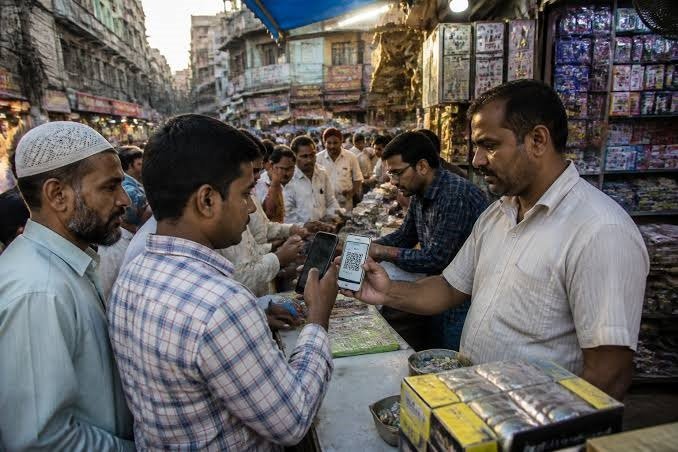
For Delhi’s retailers, wholesalers and other businesses, the concern is primarily about the cumulative impact of payment charges.
A 0.4 per cent charge may appear small on an individual transaction, but businesses handling hundreds or thousands of UPI payments every month could see the cost accumulate.
Traders operating with narrow profit margins are particularly concerned that the additional expense could reduce their earnings unless they absorb the cost, change payment preferences or adjust their pricing strategy.
Some trade bodies are therefore considering advising customers to opt for cash payments for transactions exceeding Rs 2,000.
The move would represent a notable change in payment behaviour at a time when UPI has become one of India’s most widely used retail payment systems.
What Will the 0.4% UPI Charge Mean?
Under the revised MDR framework, eligible person-to-merchant UPI transactions above Rs 2,000 can attract a charge of up to 0.4 per cent, with a maximum MDR of Rs 300 per transaction.
For instance, on an eligible UPI payment of Rs 10,000, a 0.4 per cent MDR would translate into Rs 40.
On a Rs 50,000 transaction, the charge would be Rs 200.
The maximum Rs 300 cap would apply once the calculated MDR reaches that level.
Crucially, the charge is imposed on the merchant side of the transaction. Customers are not being directly charged 0.4 per cent simply for making an eligible UPI payment.
Banks have also been advised that merchants should not pass the MDR directly on to customers as a separate UPI fee.
Smaller Merchants to Remain Protected
The new framework includes provisions intended to shield smaller merchants from the MDR burden.
Small vendors receiving up to Rs 1 lakh a month through UPI QR payments directly into their accounts are exempt from the MDR.
Person-to-person UPI transfers will also continue without an MDR.
There are also separate arrangements for certain essential service categories, including railways, telecommunications, insurance and fuel, where a flat charge applies to specified transactions above Rs 2,000.
The differentiated structure is intended to ensure that the introduction of MDR does not increase costs for every UPI transaction across the economy.
Why Delhi Traders Are Looking at Cash
For traders, the issue is less about the size of the charge on a single transaction and more about its cumulative effect.
Consider a retailer processing Rs 50 lakh in eligible UPI sales during a month. At a hypothetical 0.4 per cent rate across the entire eligible amount, the gross MDR exposure could amount to Rs 20,000 before taking account of exemptions, caps and transaction-specific applicability.
For businesses with limited margins, such costs can become significant.
This is why some traders are looking at cash as an alternative for larger purchases.
Cash also eliminates merchant-side digital transaction charges, although it brings its own costs and risks, including cash handling, accounting, security and banking requirements.
UPI’s Massive Scale Raises Stakes
The debate comes as UPI continues to dominate India’s digital retail payments landscape.
UPI has expanded far beyond metropolitan centres and is now routinely used by street vendors, small shops, restaurants, retailers and large businesses.
Its popularity has been driven by instant payments, QR-code acceptance, interoperability and the absence of a direct transaction fee for consumers.
Any change in the economics of UPI transactions can therefore influence the behaviour of both merchants and customers.
For traders, the question is whether the convenience of UPI will outweigh the additional cost of accepting eligible higher-value transactions.
Will Customers Actually Return to Cash?
The prospect of greater cash usage depends largely on how merchants respond and how customers perceive the change.
Some customers may continue using UPI because of convenience, transaction records and the ability to make payments without carrying cash.
Others may be willing to pay in cash if merchants actively encourage it for larger purchases.
The situation could be different across sectors. Jewellery, electronics, wholesale trade, automobiles and other businesses involving relatively high-value transactions may have a greater incentive to evaluate payment costs than businesses dominated by small-ticket purchases.
The actual impact will become clearer after the new MDR framework is implemented.
Traders Face a Choice Between Cost and Convenience
Delhi’s trading community now faces a practical choice: absorb the additional cost, explore alternative payment channels or encourage customers to use cash.
For some businesses, absorbing the MDR may be manageable because of the convenience and accounting benefits associated with digital payments. For others, particularly those operating on tight margins, shifting some transactions towards cash may appear more attractive.
However, a widespread return to cash could also increase operational costs related to cash collection, storage, reconciliation and security.
A New Test for India’s Digital Payment Ecosystem
The MDR debate comes at an important stage in India’s digital-payment journey.
UPI has helped transform the way Indians pay for goods and services, but maintaining a large-scale payment infrastructure also involves costs for banks, payment-service providers and other participants in the ecosystem.
The new framework attempts to introduce a revenue mechanism for selected higher-value merchant transactions while retaining free UPI payments for consumers and protecting smaller merchants through exemptions.
For traders, however, the immediate priority remains controlling costs.
As the October 15 implementation date approaches, Delhi’s markets will provide an important test of how merchants and consumers respond to the new payment economics—and whether cash begins to regain ground in India’s increasingly digital retail economy.
(Economy India)