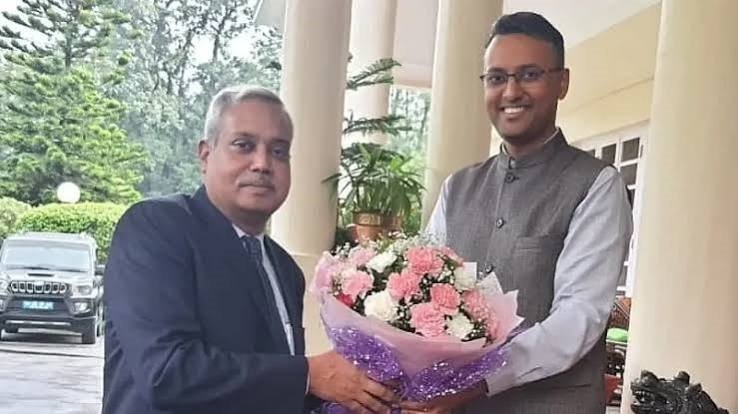

India’s outgoing Ambassador to Nepal Naveen Srivastava met Foreign Minister Shishir Khanal and discussed strengthening the countries’ longstanding, multifaceted bilateral relationship.
Kathmandu (Economy India): India’s outgoing Ambassador to Nepal, Naveen Srivastava, met Nepal’s Foreign Minister Shishir Khanal on Wednesday and discussed the two neighbouring countries’ longstanding and multifaceted bilateral relationship.
The meeting assumes significance as Srivastava approaches the end of his tenure as India’s ambassador in Kathmandu. During the interaction, the Indian envoy expressed his appreciation to Khanal for his continued cooperation and support in strengthening relations between India and Nepal.
The meeting provided an opportunity to take stock of the broad relationship between the two countries, which extends across diplomatic, economic, developmental and people-to-people ties.
India and Nepal share a distinctive relationship shaped by their geographical proximity, historical links, cultural connections and extensive interaction between their people. Over the years, bilateral engagement has expanded beyond traditional diplomatic cooperation to include trade, investment, infrastructure, connectivity, energy, education, tourism and development partnerships.
Outgoing Ambassador Thanks Nepal’s Foreign Minister
Srivastava conveyed his appreciation to Foreign Minister Khanal for his continued support and cooperation during his tenure.
The gesture reflected the importance attached to close diplomatic engagement between the two neighbouring countries. India and Nepal maintain regular political and diplomatic contacts, with discussions covering a broad range of issues of mutual interest.
For an ambassador completing an assignment, meetings with senior officials also provide an opportunity to acknowledge institutional cooperation and underline the importance of continuity in bilateral relations.
The meeting between Srivastava and Khanal comes against the backdrop of India and Nepal’s extensive engagement across several sectors, where sustained government-to-government dialogue remains important for taking forward existing initiatives.
India-Nepal Relationship Extends Beyond Diplomacy
India and Nepal have traditionally maintained close relations, supported by deep social and cultural connections.
The two countries share a long and open border, which has facilitated significant movement of people and goods over generations. Communities on both sides of the border have developed strong economic and social links, making the relationship distinct from conventional state-to-state diplomacy.
People-to-people contacts remain one of the defining features of India-Nepal relations. Families, traders, students, tourists and workers regularly contribute to these cross-border connections.
These links also give the bilateral relationship an important economic dimension, particularly in border regions where trade and movement are closely connected to local livelihoods.
Trade and Economic Cooperation
Economic cooperation is another important pillar of India-Nepal relations.
India is a major trading partner for Nepal, while bilateral commerce covers a wide range of goods and services. The close geographical relationship provides Nepal with access to one of the region’s largest markets and gives Indian businesses opportunities to participate in Nepal’s growing economy.
Cross-border connectivity is particularly important for facilitating trade. Improvements in roads, rail links, border infrastructure and other logistical facilities can help reduce transportation constraints and support more efficient movement of goods.
For Nepal, improved connectivity with India also has significance for access to international markets. For India, stronger connectivity with Nepal supports wider economic engagement with the Himalayan region.
Energy Cooperation Emerging as a Key Area
Energy cooperation has become an increasingly important component of India-Nepal relations, particularly in the hydropower sector.
Nepal possesses substantial hydropower potential, while India has a large and growing electricity market. Cross-border electricity cooperation can therefore provide economic opportunities for both countries.
Electricity trade and energy connectivity also have a broader regional dimension. Greater integration of power systems can support more efficient utilisation of available energy resources and contribute to energy security.
The energy sector is consequently an important area in which bilateral cooperation can generate long-term economic benefits.
Infrastructure and Connectivity at the Centre of Engagement
Connectivity has remained a major area of cooperation between India and Nepal.
The two countries have worked on projects intended to strengthen physical links and improve the movement of people and goods. Roads, railways and border infrastructure form an important part of this engagement.
Better connectivity has implications beyond transportation. It can support tourism, trade, investment and local economic activity while strengthening links between businesses and communities in both countries.
For landlocked Nepal, efficient connections with neighbouring countries are particularly important for international trade and access to wider markets.
India’s Development Partnership with Nepal
Development cooperation represents another significant dimension of the bilateral relationship.
India has supported development-oriented initiatives in Nepal across areas such as infrastructure, education, healthcare and community development. Such projects form part of India’s broader development partnership with neighbouring countries.
The focus on local and community-level development also complements larger connectivity and infrastructure projects.
For Nepal, development partnerships can contribute to improvements in public infrastructure and social services, while for India they represent an important component of its engagement with a close neighbour.
Deep Cultural and Social Connections
The India-Nepal relationship is also characterised by extensive cultural connections.
Religious traditions, languages, festivals, family relationships and historical links have created strong bonds between people in the two countries.
These connections have continued despite changes in the political and economic environment.
Tourism and pilgrimage are additional areas where the shared cultural heritage of India and Nepal creates opportunities for greater interaction. Cross-border travel allows people to visit important religious and cultural sites in both countries, supporting tourism-related economic activity.
Importance of Continued Diplomatic Engagement
The meeting between Srivastava and Khanal highlights the importance of continued diplomatic engagement in managing and strengthening the multifaceted India-Nepal relationship.
While individual diplomatic assignments have a defined tenure, bilateral relationships operate over a much longer period. Institutional mechanisms and regular communication therefore remain important for maintaining continuity.
For India and Nepal, sustained dialogue can help advance cooperation in areas where the two countries share economic and developmental interests.
It can also provide a platform for addressing issues through established diplomatic channels and maintaining regular communication between the two governments.
A Relationship with Strong Economic Potential
The breadth of India-Nepal relations gives the partnership considerable economic significance.
Trade, energy, infrastructure and connectivity are areas where cooperation can directly influence economic opportunities. Stronger transport links can facilitate commerce, while greater energy cooperation can support industrial activity and electricity security.
Similarly, tourism and people-to-people exchanges can generate employment and support businesses on both sides of the border.
The close proximity of the two economies means that developments in one country can have economic implications for communities and businesses in the other.
Focus on Sustaining the Bilateral Partnership
Srivastava’s meeting with Khanal also comes at a time when both countries continue to engage across multiple areas of mutual interest.
His expression of appreciation for Nepal’s cooperation during his tenure reflects the importance of diplomatic coordination in maintaining the relationship.
The broad nature of India-Nepal ties means that cooperation is not confined to a single sector. Instead, it involves a combination of political dialogue, economic engagement, development cooperation, connectivity and extensive people-to-people relations.
As diplomatic transitions take place, maintaining continuity in these areas remains important for both sides.
India-Nepal Ties Remain Multifaceted
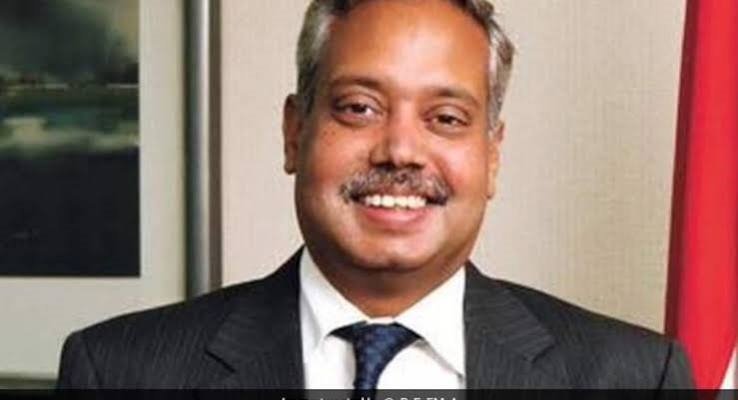
The meeting between India’s outgoing Ambassador Naveen Srivastava and Nepal’s Foreign Minister Shishir Khanal serves as a reminder of the breadth of the relationship between the two neighbouring countries.
From trade and energy to infrastructure, development cooperation and people-to-people contacts, India and Nepal have built extensive channels of engagement over decades.
Srivastava’s acknowledgement of Khanal’s continued cooperation underlines the role of diplomatic engagement in sustaining these ties.
As the two countries continue to pursue shared economic and developmental interests, connectivity, energy cooperation, trade and people-to-people relations are expected to remain important elements of the India-Nepal partnership.
(Economy India)