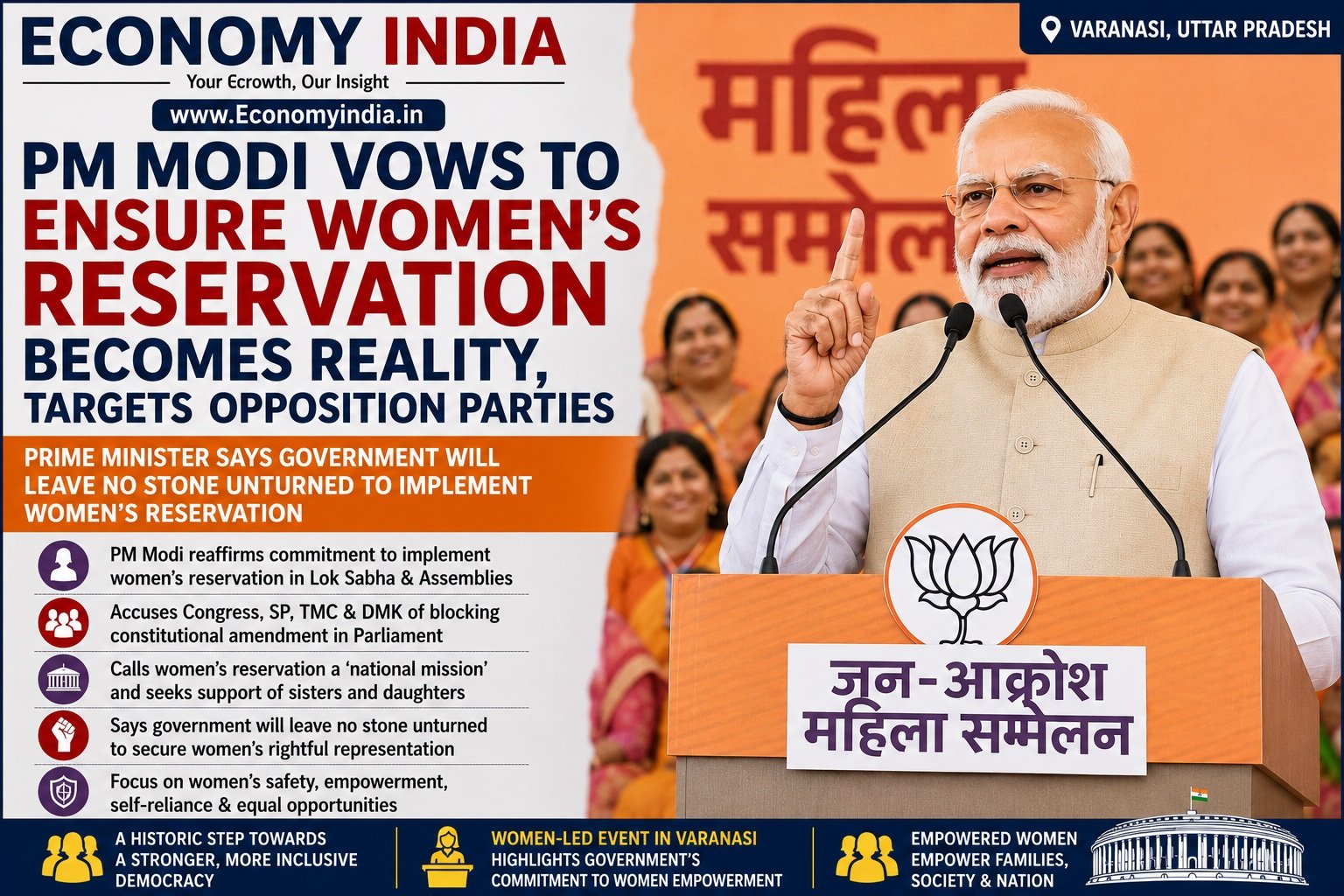

Prime Minister Says Government Will Leave No Stone Unturned to Implement Women’s Reservation
Varanasi (Economy India): Prime Minister Narendra Modi on Tuesday reaffirmed his commitment to implementing reservation for women in legislative bodies, asserting that his government would leave no stone unturned to ensure women receive their rightful representation in Parliament and state assemblies.
Addressing the ‘Jan-Akrosh Mahila Sammelan’ during his two-day visit to his parliamentary constituency, Varanasi, Modi launched a sharp attack on opposition parties, including the Congress, Samajwadi Party (SP), Trinamool Congress (TMC), and Dravida Munnetra Kazhagam (DMK), accusing them of obstructing efforts to pass the constitutional amendment related to women’s reservation.
“Need Your Blessings for a National Mission”
Speaking before a large gathering of women, the Prime Minister described the implementation of women’s reservation as a major national objective.
“I have come here to seek the blessings of my sisters and daughters for a historic mission. As the Member of Parliament from Kashi and as the Prime Minister of India, I seek your support in achieving the important goal of implementing reservation for women in the Lok Sabha and state legislative assemblies,” Modi said.
He emphasized that empowering women strengthens families, society, and the nation as a whole.
Criticism of Opposition Parties
Modi alleged that opposition parties had repeatedly blocked efforts to provide greater political representation to women.
“Recently, due to the actions of parties such as the Congress and Samajwadi Party, our efforts could not succeed in Parliament. However, I assure all women that I will spare no effort in ensuring that this reservation becomes a reality,” he said.
The Prime Minister further accused family-centric political parties of betraying women by opposing measures aimed at increasing their participation in democratic institutions.
According to Modi, these parties have delayed women’s reservation for decades and do not want more women entering state assemblies and Parliament.
Women’s Empowerment Central to Development
Highlighting the importance of women’s empowerment, Modi said that when women become stronger and more independent, the entire country benefits.
He noted that women across India, including those in eastern Uttar Pradesh, have historically faced social barriers and limited opportunities.
Recalling common stereotypes faced by women, Modi said many were often told they were not capable of achieving certain goals or did not need access to education and opportunities.
He stressed that breaking such barriers has been a key focus of his public life.

Recalling Initiatives from Gujarat
The Prime Minister referred to his tenure as Chief Minister of Gujarat, stating that efforts were made to increase school enrollment among girls and provide greater educational support to young women.
He said initiatives aimed at encouraging girls’ education were introduced to challenge traditional mindsets and improve opportunities for women.
Modi argued that such policies helped create a stronger foundation for women’s participation in social, economic, and political life.
Women’s Leadership Highlighted
The event witnessed significant participation from women across the region and was notable for being largely managed by women.
Women police personnel were deployed for security arrangements, while women representatives from self-help groups and various organizations welcomed the Prime Minister with cultural gifts and handicrafts representing the heritage of Varanasi.
Several groups presented symbolic gifts, including artwork depicting the new Parliament building, traditional Zardozi embroidery, and cultural artifacts associated with Kashi.
Focus on Women’s Issues
During the conference, Modi discussed key issues including:
🔹 Women’s safety
🔹 Equal opportunities
🔹 Economic empowerment
🔹 Self-reliance and entrepreneurship
🔹 Political representation
He reiterated that increasing women’s participation in governance is essential for India’s long-term development and democratic progress.
(Economy India)