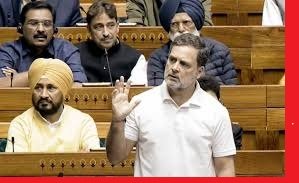

NEW DELHI (Economy India): Leader of the Opposition Rahul Gandhi launched a sharp attack on the Narendra Modi-led government in the Lok Sabha on Tuesday, accusing it of “selling Bharat Mata” through what he described as a “one-sided” interim trade agreement with the United States. Participating in the debate on the Union Budget 2026–27, the Congress leader alleged that the deal would severely hurt Indian farmers, weaken domestic manufacturing, and further erode the country’s economic self-reliance.
Gandhi’s remarks came amid an intense political showdown in Parliament, with the interim India–US trade framework emerging as a major flashpoint between the ruling BJP and the Opposition. While the government has projected the agreement as a strategic step to boost exports, attract investment, and strengthen bilateral ties, the Congress has raised concerns over its potential impact on agriculture, small industries, and employment.
“You Have Sold India,” Rahul Tells Government
Speaking during the Budget debate, Rahul Gandhi accused the Centre of compromising national interests for political and diplomatic gains.
“You have sold India. Are you not ashamed of selling India? You have sold our mother, Bharat Mata,” he said, drawing sharp reactions from treasury bench members.
He alleged that the interim trade agreement was drafted in a manner that disproportionately favours the United States, particularly in sensitive sectors such as agriculture, dairy, and textiles. According to Gandhi, Indian farmers and small producers would be unable to compete with heavily subsidised American products.
“The interests of farmers have been compromised. Agricultural products from the US will flood Indian markets, and our farmers will be pushed into distress,” he warned.
Farmers at the Centre of Opposition Criticism
Agriculture emerged as the central theme of Gandhi’s criticism. He argued that allowing greater access to Indian markets for US farm products would depress prices and undermine the livelihoods of millions of farmers already grappling with rising input costs and climate-related challenges.
India’s farming sector employs nearly half of the country’s workforce, making it politically and economically sensitive. Opposition leaders have repeatedly accused the government of pursuing trade liberalisation without adequate safeguards for domestic producers.
Gandhi also linked the trade agreement to the broader agrarian crisis, pointing to stagnant farm incomes, increasing rural debt, and farmer protests over recent years.
“The government talks about doubling farmers’ income, but every policy decision it takes pushes farmers deeper into uncertainty,” he said.
Textile Industry “Finished,” Claims Rahul Gandhi
In another major allegation, the Congress leader claimed that India’s textile and garment industry—one of the country’s largest employers—was already “finished” due to flawed economic policies, and that the interim trade agreement would worsen the situation.
“The textile industry has been destroyed. Millions of jobs have been lost. Now, with this agreement, you are opening the doors wider for foreign competition while our domestic industry is struggling to survive,” he said.
India’s textile sector employs over 45 million people directly and is considered crucial for labour-intensive manufacturing and exports. Industry bodies have expressed mixed views on the trade deal, with some welcoming better access to the US market and others warning about unequal competition.
What Is the Interim India–US Trade Agreement?
The interim trade agreement, announced earlier this year, is positioned as a stepping stone towards a comprehensive bilateral trade pact between India and the United States. While the full details have not been made public, government sources have indicated that it covers market access, regulatory cooperation, supply chain resilience, and select tariff adjustments.
Prime Minister Narendra Modi has described the framework as a “win-win” arrangement that will strengthen ‘Make in India’, create jobs, and integrate Indian businesses into global value chains.
However, critics argue that interim agreements often lack parliamentary scrutiny and can lock countries into commitments without sufficient debate.
Government’s Defence: Growth, Jobs and Global Integration
The government has strongly rejected the Opposition’s allegations, asserting that the agreement protects national interests while opening new opportunities for Indian exporters and manufacturers.
Senior BJP leaders have accused Rahul Gandhi of fear-mongering and misrepresenting facts for political mileage. According to the government, the trade framework is carefully calibrated to safeguard sensitive sectors while promoting investment and technology transfer.
Finance Minister Nirmala Sitharaman, during her Budget speech, emphasised that India’s trade strategy is aligned with long-term growth, job creation, and competitiveness.
“Our trade engagements are guided by the principle of Atmanirbhar Bharat, not isolation. We are opening markets where India is strong and protecting sectors where support is required,” she said.
Political Context: Budget Debate Turns Combative
Rahul Gandhi’s remarks came during a charged Budget session, with the Opposition targeting the government over issues ranging from unemployment and inflation to farmer welfare and industrial slowdown.
The Congress has framed the Budget as pro-corporate and anti-poor, alleging that it prioritises large businesses while ignoring the needs of farmers, MSMEs, and the middle class.
The BJP, on the other hand, has defended the Budget as growth-oriented and reform-driven, highlighting increased capital expenditure, infrastructure push, and skill development initiatives.
Trade, Sovereignty and Electoral Politics
Trade agreements have historically been politically sensitive in India, often triggering debates over sovereignty, livelihoods, and economic justice. Rahul Gandhi’s use of emotive language such as “Bharat Mata” reflects the Congress’s attempt to position itself as a defender of national and farmer interests ahead of upcoming elections.
Political analysts say the interim trade agreement is likely to remain a contentious issue, especially if its implications become more visible at the ground level.
“The success or failure of this agreement will ultimately be judged by its impact on jobs, farm incomes, and industrial growth. Until then, it will remain a powerful political tool for both sides,” said an economist tracking trade policy.
Industry and Expert Views Mixed
Experts remain divided on the potential impact of the interim trade agreement. Some believe it could help Indian exporters gain better access to the US market, especially in pharmaceuticals, IT services, and engineering goods.
Others caution that without strong safeguard mechanisms, domestic sectors such as agriculture and textiles could face short-term disruptions.
“Trade agreements are not inherently good or bad. Their outcomes depend on design, implementation, and complementary domestic policies,” said a trade policy expert.
What Lies Ahead
As the debate continues in Parliament, the government is expected to provide further clarity on the agreement’s provisions and safeguards. The Opposition, meanwhile, has indicated that it will continue to raise the issue both inside and outside the House.
With trade, jobs, and farmer welfare at the heart of India’s economic discourse, the interim India–US trade agreement is set to remain under intense political and public scrutiny in the months ahead.
For now, Rahul Gandhi’s fiery remarks have ensured that the agreement is not just an economic document, but a major political battleground.
(Economy India)