
Gift Nifty Signals Weak Start; Foreign Investors Sell ₹31,120 Crore Worth of Equities Amid Rising Global Uncertainty
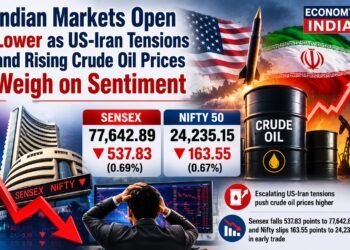
MUMBAI (Economy India): Indian equity markets are likely to begin the new trading week on a cautious note, with Gift Nifty indicating a sharp decline of nearly 350 points ahead of Monday’s opening session. The negative signal comes amid persistent foreign institutional investor (FII) selling, escalating geopolitical tensions between the United States and Iran, and weakening technical indicators.
Market participants are expected to closely monitor global developments, crude oil prices, foreign fund flows and key technical levels as volatility remains elevated across financial markets.
After witnessing sharp selling pressure in recent sessions, investors are preparing for another challenging week where global risk factors could continue to influence market direction.

Gift Nifty Indicates Weak Opening
Gift Nifty, widely regarded as an early indicator of Indian market sentiment, was trading around 350 points lower, suggesting a negative start for benchmark indices.

The indication follows growing concerns surrounding geopolitical developments in West Asia and continued risk-off sentiment among foreign investors.
Analysts believe that market volatility could remain elevated until there is greater clarity on global developments and institutional investment flows.
Key Support and Resistance Levels
According to market analysts, traders should closely watch critical support and resistance zones during the week.
Nifty Support Levels
| Support Zone | Level |
|---|---|
| Immediate Support | 23,345 |
| Secondary Support | 23,320 |
| Key Support | 23,230 |
| Strong Support | 22,858 |
| Major Support | 22,798 |
| Critical Support | 22,558 |
Nifty Resistance Levels
| Resistance Zone | Level |
| Immediate Resistance | 23,466 |
| Secondary Resistance | 23,783 |
| Strong Resistance | 23,812 |
| Key Resistance | 23,872 |
| Major Resistance | 23,935 |
| Critical Resistance | 24,140 |
Market experts note that a sustained move above resistance levels could trigger a recovery, while a break below key support levels may accelerate selling pressure.

FII Selling Continues to Pressure Markets
One of the biggest concerns for investors remains the aggressive selling by Foreign Institutional Investors (FIIs).
During the first week of June, FIIs sold equities worth approximately ₹31,120 crore in the cash segment, reflecting a cautious stance toward emerging markets amid global uncertainty.
Although Domestic Institutional Investors (DIIs) have continued to absorb selling pressure and provide support to the market, the scale of foreign outflows has significantly impacted investor sentiment.
Institutional Activity Snapshot
| Category | Activity |
| Foreign Institutional Investors (FIIs) | Net Sellers |
| FII Equity Sale | ₹31,120 Crore |
| Domestic Institutional Investors (DIIs) | Net Buyers |
| Market Impact | Increased Volatility |
Market strategists suggest that sustained FII outflows could remain a near-term headwind for Indian equities.
US-Iran Conflict Raises Global Risk Concerns
Geopolitical tensions have emerged as another major factor influencing investor behavior.
Reports indicate that US military forces intercepted drones allegedly launched by Iran toward the Strait of Hormuz, followed by military action targeting Iranian radar facilities.
In response, Iran reportedly claimed to have targeted American military installations in Kuwait and Bahrain while also taking aggressive measures against vessels attempting to cross the strategically important Strait of Hormuz.
The Strait of Hormuz remains one of the world’s most critical energy shipping routes, handling a substantial portion of global crude oil exports.
Any disruption in the region could lead to:
- Higher crude oil prices
- Increased inflationary pressures
- Currency volatility
- Higher import costs for oil-importing nations such as India
- Greater uncertainty across global financial markets

Crude Oil Becomes Key Market Variable
The geopolitical escalation has already pushed oil prices higher.
India, which imports more than 80 percent of its crude oil requirements, remains particularly vulnerable to prolonged spikes in energy prices.
Higher oil prices can impact:
- Inflation
- Fiscal deficit
- Corporate profitability
- Consumer spending
- Current account balance
Market participants will closely monitor developments in the Middle East throughout the week.
Technical Indicators Signal Weakness
From a technical perspective, market momentum appears to be weakening.
The Relative Strength Index (RSI) on the weekly timeframe is currently around 39.64, indicating that the market remains in a neutral-to-bearish zone.
Technical analysts point out that the index has fallen below a descending trendline structure, suggesting that selling pressure continues to dominate at higher levels.
Technical Outlook
| Indicator | Status |
| Weekly RSI | 39.64 |
| Trend | Bearish |
| Market Structure | Below Descending Trendline |
| Momentum | Weakening |
| Volatility | Elevated |
According to analysts:
- Immediate resistance is placed at 23,900 and 24,100.
- Immediate support is located at 23,200 and 23,000.
A break below 23,000 could trigger further downside momentum and intensify selling pressure.
Conversely, a sustained move above 24,100 may signal the end of the current bearish phase and pave the way for a stronger recovery.
What Investors Should Watch This Week
Key Market Triggers
- FII and DII investment activity
- Developments in US-Iran tensions
- Crude oil price movement
- Global market performance
- Rupee-dollar exchange rate
- Technical support and resistance levels
- Corporate announcements and economic data
While India’s long-term economic fundamentals remain strong, near-term market sentiment is likely to remain influenced by global geopolitical developments and foreign investor behavior.
With Gift Nifty indicating a weak opening and risk sentiment deteriorating globally, traders may adopt a cautious approach at the start of the week. However, strong domestic institutional participation and supportive economic fundamentals could help limit downside risks if global conditions stabilize.
Investors are advised to remain selective, monitor key support levels closely and avoid excessive leverage amid heightened market volatility.