

Ashish Kumar Das to Succeed Salil Parekh as Infosys CEO After His Second Term Ends on March 31, 2027
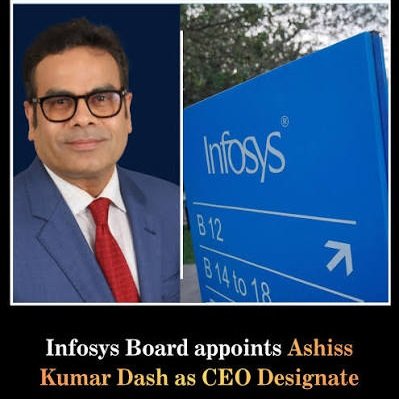
New Delhi (Economy India): Indian information technology major Infosys on Thursday announced the appointment of Ashish Kumar Das as Chief Executive Officer (CEO)-designate, with the senior executive set to take charge of the company on April 1, 2027.
Das will succeed Salil Parekh, who currently serves as the company’s Managing Director and Chief Executive Officer. Parekh’s second term as CEO is scheduled to end on March 31, 2027.
The leadership transition marks an important development for Infosys, as Parekh is set to complete more than nine years at the helm of the technology services company.
Ashish Kumar Das to Take Over From Salil Parekh
Infosys said Das will formally assume the role of CEO and Managing Director from April 1, 2027, following the completion of Parekh’s second term.

The appointment is expected to provide the company with sufficient time to ensure a smooth leadership transition and continuity in its strategic direction.
The incoming CEO will take charge at a time when the global information technology services industry continues to undergo significant transformation driven by artificial intelligence, cloud computing, digital technologies and changing enterprise technology spending patterns.
Salil Parekh’s Nine-Year Leadership
Salil Parekh has led Infosys for more than nine years and has played a key role in guiding the company through a rapidly changing global technology landscape.
During his tenure, the IT sector witnessed major shifts in client spending, digital transformation, cloud adoption and the growing importance of artificial intelligence.
His second term as Managing Director and CEO will conclude on March 31, 2027.
The upcoming leadership change will therefore mark the end of a significant chapter in Infosys’ corporate history and the beginning of a new phase under Das.
Leadership Transition Comes Amid Rapid Technology Changes
The appointment of a new CEO comes at a crucial time for the global IT services industry.
Companies across sectors are increasingly investing in artificial intelligence, automation, cloud platforms, cybersecurity and data-driven technologies. At the same time, technology service providers are facing pressure to demonstrate measurable business value to clients while adapting to rapid advances in generative AI.
Infosys, like other major Indian IT companies, is expected to continue focusing on digital transformation and emerging technologies as businesses worldwide reassess their technology strategies.
The new leadership will be responsible for navigating these changes while maintaining the company’s long-term growth strategy and relationships with global clients.
Focus on Smooth Succession
The designation of Ashish Kumar Das as CEO-designate well ahead of the transition date is expected to facilitate an orderly succession process.
A planned transition can allow the incoming leadership team to gain a deeper understanding of the company’s operations, strategic priorities and stakeholder expectations before formally assuming responsibility.
The move also provides clarity to employees, investors and clients regarding the company’s leadership roadmap beyond March 2027.
What Lies Ahead for Infosys
Under its new leadership, Infosys is likely to remain focused on strengthening its position in the global technology services market.
The company will need to respond to growing demand for AI-enabled services while managing evolving client budgets and increasing competition from global consulting and technology firms.
The transition will also be closely watched by investors and industry analysts as the company prepares for the next phase of its growth.
With Ashish Kumar Das scheduled to take charge on April 1, 2027, Infosys now has a clear timeline for the leadership transition following the conclusion of Salil Parekh’s second term.
The appointment represents a significant leadership change for one of India’s largest technology companies and comes as the global IT industry enters a new era shaped by artificial intelligence and accelerated digital transformation.
(Economy India)