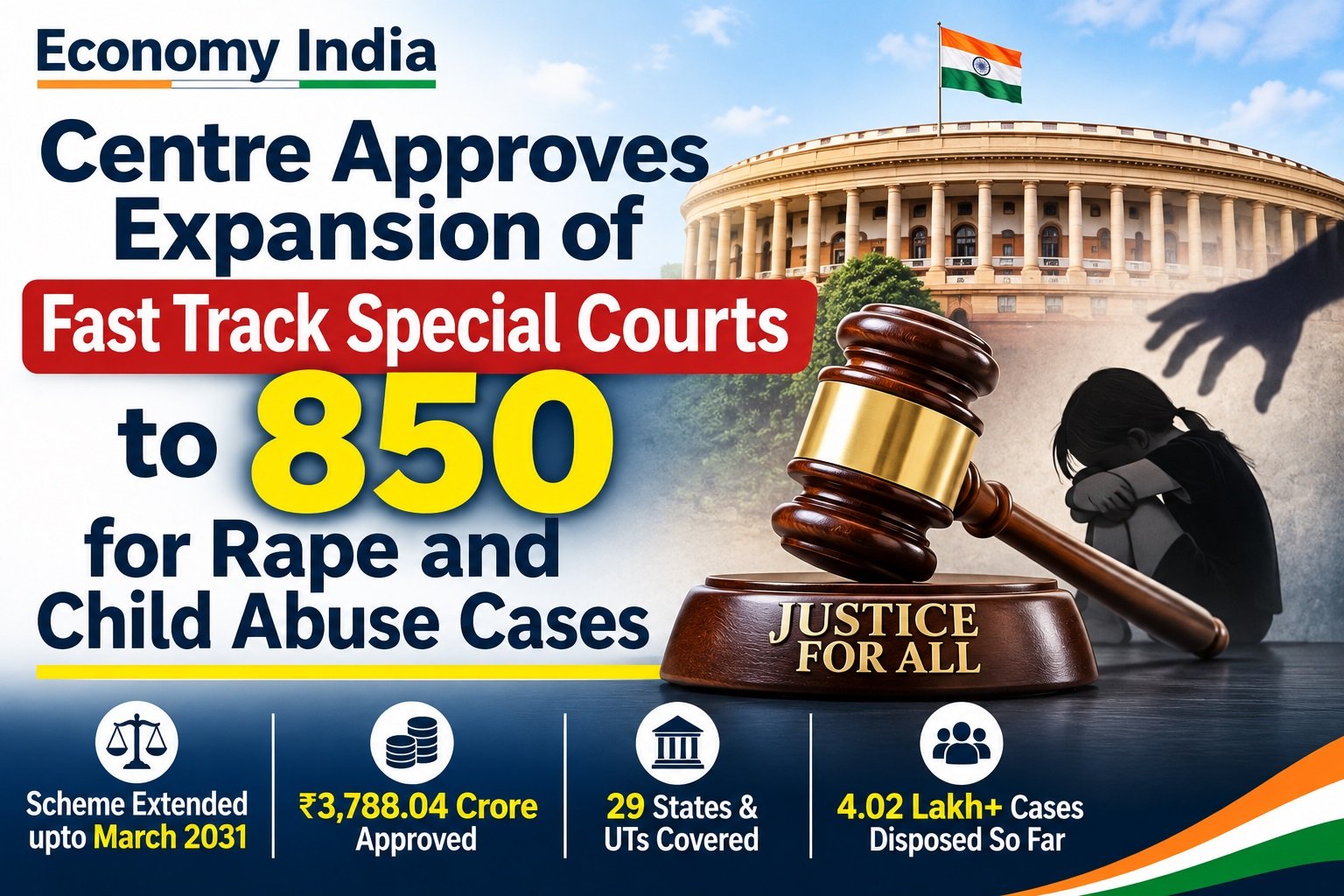
Cabinet extends the scheme until March 2031 with a ₹3,788.04-crore outlay; specialised courts have disposed of more than 4.02 lakh cases since their launch in 2019.
NEW DEHLI (Economy India): The Union Cabinet on Wednesday approved the continuation and strengthening of the Central Government’s scheme for Fast Track Special CourtsCentre Approves Expansion of Fast Track Special Courts (FTSCs), including exclusive POCSO courts, and decided to increase their number from the existing 779 to 850 to accelerate trials in rape and child sexual abuse cases.
The scheme, aimed at ensuring faster judicial proceedings in cases involving sexual offences against women and children, has been extended for another five years, covering the period from April 1, 2026, to March 31, 2031.
The government has approved a total financial outlay of ₹3,788.04 crore for the programme. The expansion is intended to strengthen the specialised judicial mechanism, improve the disposal of pending cases and provide survivors with a more supportive environment during legal proceedings. <Cite refs={[“turn767576search0″,”turn767576search7″,”turn767576search6”]}/>


850 Fast Track Special Courts to Strengthen Judicial Capacity
Under the approved plan, the number of Fast Track Special Courts will increase from 779 to 850 across participating States and Union Territories.
The additional courts will be allocated to districts based on the pendency of rape cases and offences registered under the Protection of Children from Sexual Offences (POCSO) Act, 2012.
The courts are specifically designed to handle cases involving rape and sexual offences against children, enabling these matters to receive focused judicial attention rather than being processed alongside the broader criminal case workload.
The scheme currently operates in 29 States and Union Territories.
₹3,788 Crore Financial Outlay for Five Years
The approved financial allocation includes contributions from both the Central Government and State and Union Territory administrations.
The funding structure is as follows:
- Total outlay: ₹3,788.04 crore
- Central Government share: ₹2,353.15 crore
- States and Union Territories’ share: ₹1,434.89 crore
- Implementation period: April 1, 2026, to March 31, 2031
The Centre’s contribution will be financed through the Nirbhaya Fund, which supports initiatives aimed at improving the safety and security of women.
The Department of Justice under the Union Ministry of Law and Justice will oversee implementation in coordination with State Governments and Union Territory administrations. <Cite refs={[“turn767576search0″,”turn767576search5″,”turn767576search8”]}/>

Dedicated Judicial Officers and Support Staff
The scheme provides for dedicated personnel at each Fast Track Special Court to improve efficiency and support the timely handling of cases.
Each court will have:
- One dedicated judicial officer
- One special public prosecutor
- Six support personnel
This staffing arrangement is intended to strengthen case management, support prosecution and improve the pace of judicial proceedings.
The exclusive POCSO courts will focus on offences covered under the Protection of Children from Sexual Offences Act, 2012, while other Fast Track Special Courts will handle designated rape cases.
More Than 4.02 Lakh Cases Disposed of Since 2019
The Fast Track Special Courts scheme was launched on October 2, 2019, following directions from the Supreme Court and the enactment of the Criminal Law (Amendment) Act, 2018.
Since its introduction, these specialised courts have disposed of more than 4.02 lakh cases involving rape and offences under the POCSO Act, according to the government.
The scheme was introduced to address delays in the judicial process and ensure that cases involving sexual violence against women and children receive priority attention.
The latest Cabinet approval seeks to extend this mechanism and expand its reach to districts facing a higher burden of pending cases. <Cite refs={[“turn767576search0″,”turn767576search3″,”turn767576search9”]}/>
Focus on Victim-Friendly and Child-Friendly Courtrooms
Beyond increasing the number of courts, the programme also aims to create a more sensitive judicial environment for survivors, particularly children.
The scheme supports facilities such as Vulnerable Witness Deposition Centres and child-friendly court infrastructure. These facilities are intended to allow survivors and vulnerable witnesses to give testimony in a safer and more supportive setting, while reducing the possibility of additional trauma during court proceedings.
The government will also continue monitoring the functioning of these courts through an online dashboard, periodic reviews and consultations with High Courts and State Governments.
Monitoring will help track court performance, identify implementation challenges and assess progress in case disposal.
Faster Trials Remain a Key Challenge
The expansion of Fast Track Special Courts is an important step towards strengthening the judicial response to sexual offences. However, the effective delivery of faster justice also depends on timely investigations, adequate prosecution resources, regular court functioning and the availability of supporting infrastructure.
The availability of dedicated judges, prosecutors and support personnel will be central to the programme’s implementation.
With the five-year extension and expansion to 850 courts, the government aims to strengthen specialised judicial capacity and improve access to timely justice for women and children.
The continuation of the scheme until March 2031 places renewed emphasis on reducing delays in rape and child sexual abuse cases and ensuring that survivors have access to a more responsive judicial process.
(Economy India)