
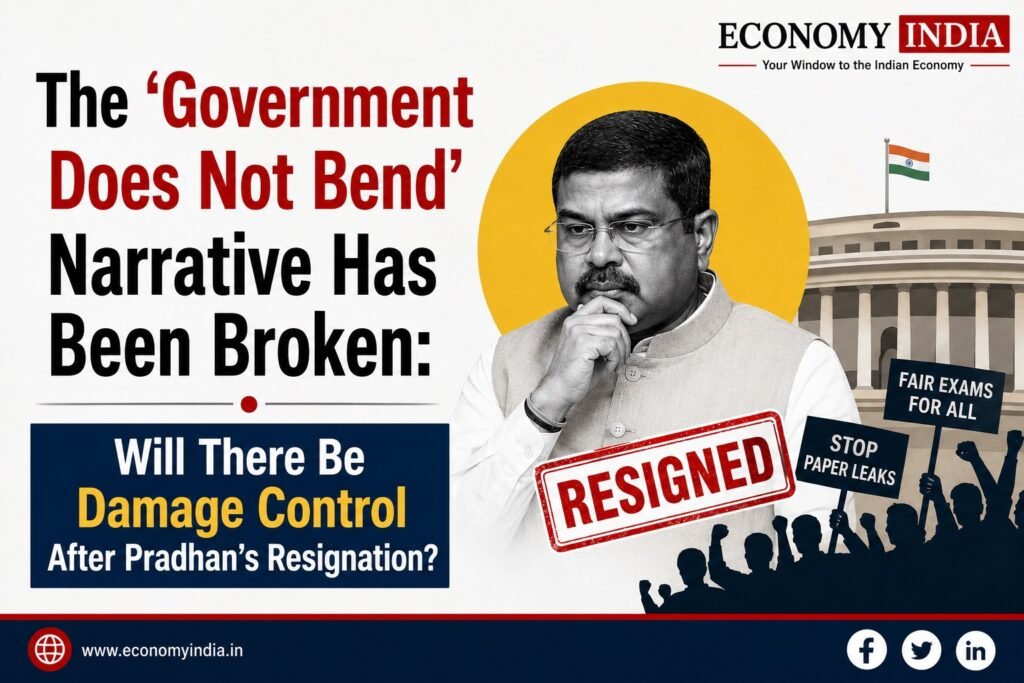
Dharmendra Pradhan’s resignation has triggered a fresh political debate over whether sustained public pressure can force the Modi government to change course or whether the move is part of a broader damage-control strategy.
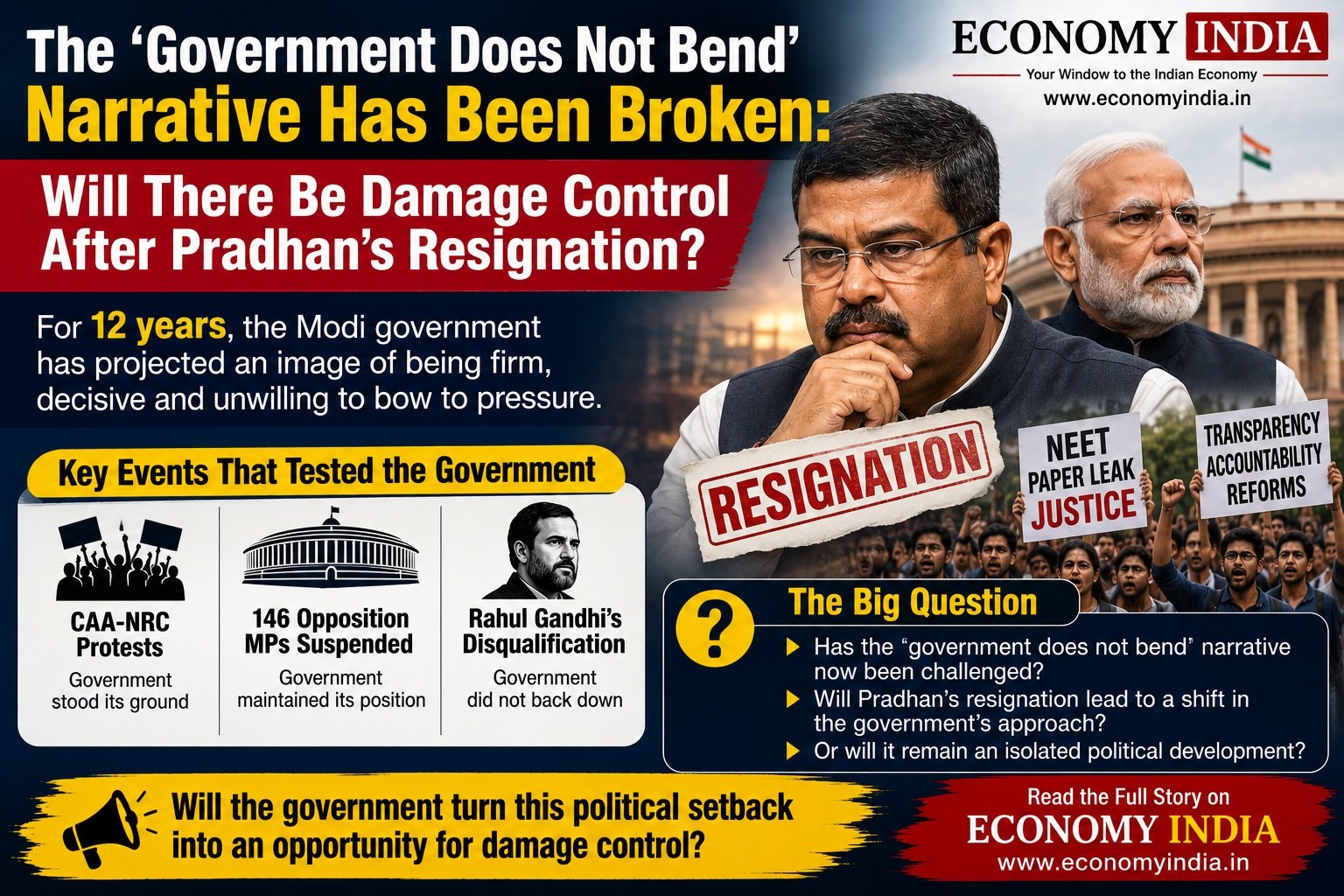
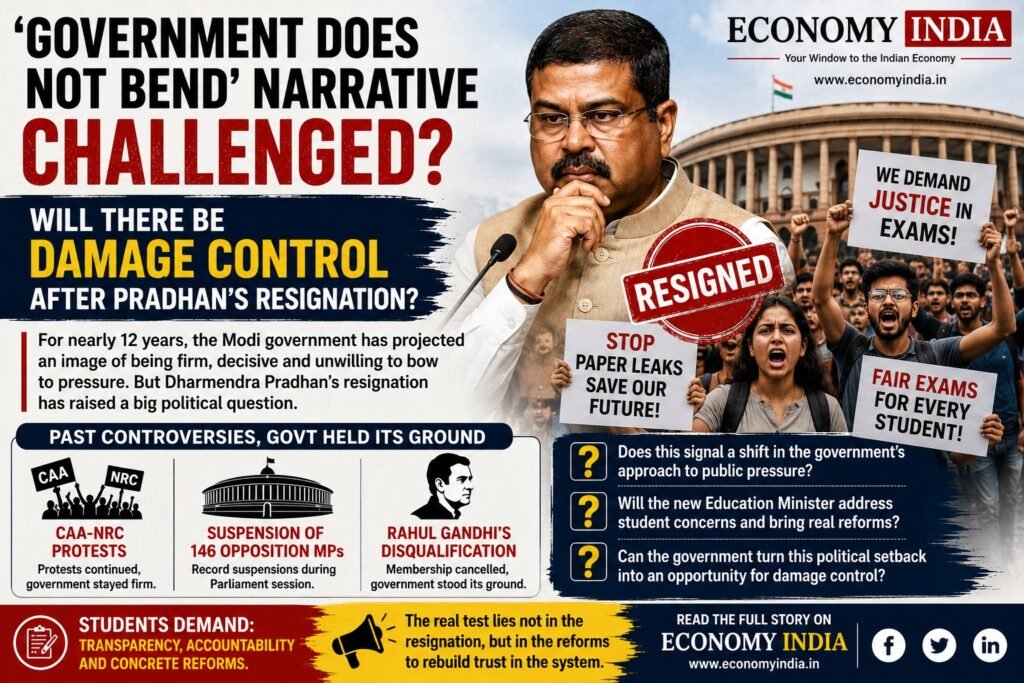
New Delhi (Economy India): For nearly 12 years, the Narendra Modi-led Central government has built an image of being firm, decisive and unwilling to bow to pressure. Whether it was the protests against the Citizenship Amendment Act (CAA) and the National Register of Citizens (NRC), the suspension of 146 Opposition MPs during a parliamentary session, or the disqualification of Rahul Gandhi as a Lok Sabha member, the government has generally projected an image of standing its ground in the face of political opposition and public protests.
However, the resignation of Union Education Minister Dharmendra Pradhan has raised questions about whether this long-standing political narrative has suffered a setback.
The development has triggered a broader political debate: Does Pradhan’s resignation signal a shift in the government’s approach to sustained public pressure, or is it simply an administrative and political course correction?

A Government Known for Standing Firm
Since coming to power at the Centre in 2014, the Narendra Modi government has often projected itself as a government that does not retreat easily in the face of protests or opposition pressure.
The government faced intense criticism during the nationwide protests against the CAA and the proposed NRC. The demonstrations continued for months in several parts of the country, with Shaheen Bagh emerging as one of the most prominent symbols of the movement.
Despite the protests, the government maintained its position on the legislation and repeatedly defended its decision.
Similarly, the suspension of Opposition MPs during the Winter Session of Parliament in 2023 became another major political flashpoint. A total of 146 Opposition MPs were suspended from both Houses during the session, triggering sharp criticism from opposition parties and raising questions about parliamentary functioning.
The disqualification of Rahul Gandhi from the Lok Sabha following his conviction in a defamation case also became a major political controversy. Although his membership was subsequently restored after the Supreme Court granted a stay on his conviction, the episode generated significant political debate.
In each of these situations, the government largely maintained its position rather than appearing to retreat under pressure.
Why Pradhan’s Resignation Matters
Against this backdrop, Dharmendra Pradhan’s resignation has assumed political significance.
For the government, a minister’s resignation can be presented as an administrative decision taken in response to circumstances. However, for the Opposition and protesting students, it can be interpreted as evidence that sustained pressure can eventually force the government to reconsider its position.
This is where the political narrative becomes important.
The Modi government has traditionally projected strength and decisiveness as key elements of its political identity. The perception that the government does not bow to pressure has been central to its image among supporters.
Pradhan’s resignation could therefore provide the Opposition with an opportunity to challenge that perception.
The question now is whether the resignation will remain an isolated political development or whether it will become a broader symbol of a government responding to public pressure.
The Student Movement and the Question of Accountability
The resignation has also come against the backdrop of student protests and concerns surrounding the examination system.
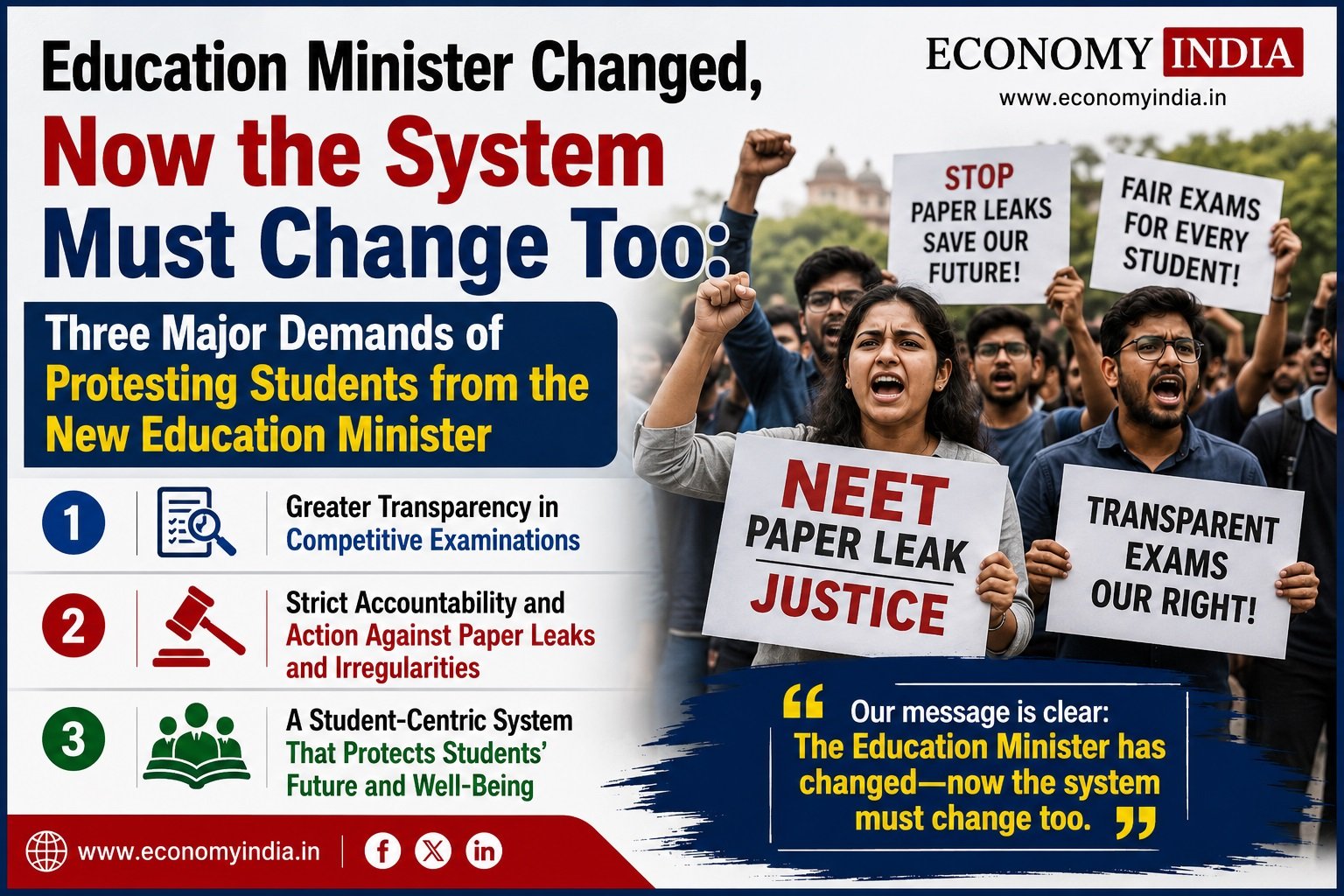
Students protesting over alleged irregularities in competitive examinations have been demanding greater transparency, accountability and reforms. For many young aspirants, national-level examinations such as NEET are directly linked to their future careers.
Any controversy surrounding such examinations can therefore have a significant political and social impact.
The protesting students have argued that changing the Education Minister is only the first step. They want systemic reforms, stronger safeguards against paper leaks and greater accountability from examination authorities.
This means the political challenge for the government may not end with Pradhan’s resignation.
If the new Education Minister is unable to address the concerns of students, the resignation could be seen as merely symbolic. On the other hand, if the government introduces meaningful reforms, the move could be presented as evidence of its willingness to respond to genuine concerns.
Will the Government Go for Damage Control?
The immediate political challenge is likely to be damage control.
The government will need to manage two competing narratives. The first is the Opposition’s claim that public pressure forced the government to act. The second is the government’s own narrative that changes in leadership are part of normal administrative decision-making and should not be interpreted as a sign of weakness.
How the government handles the transition will therefore be crucial.
The appointment of a new Education Minister, the government’s communication strategy and the steps taken to address student concerns could determine whether the resignation creates lasting political damage or remains a temporary controversy.
If the new minister announces concrete reforms and engages directly with students, the government may be able to shift the conversation from resignation to reform.
Opposition Sees an Opportunity
For the Opposition, Pradhan’s resignation could provide a fresh political opening.
Opposition parties are likely to argue that the government eventually had to respond to public anger and student protests. They may use the development to challenge the image of an administration that never yields to pressure.
The Opposition could also attempt to connect the resignation with other instances where the government faced sustained public criticism.
However, converting the resignation into a larger political narrative will not necessarily be easy. The BJP can argue that one minister’s resignation does not represent a change in the government’s overall approach.
The political impact will depend largely on how effectively the Opposition can connect the issue with broader concerns among voters.
The BJP’s Counter-Narrative
The BJP, on the other hand, is likely to emphasise that the government’s decision-making process is based on public interest and administrative considerations rather than political pressure.
The party could also argue that leadership changes are a normal part of governance and that the resignation should not be viewed as an admission of failure.
If the government follows the resignation with visible reforms in the examination system, it could attempt to turn a politically difficult moment into an opportunity to demonstrate accountability.
The success of this strategy will depend on whether the reforms are seen as genuine and effective by students and the wider public.
The Bigger Political Question
The larger question goes beyond Dharmendra Pradhan.
For more than a decade, the Modi government’s political brand has been associated with decisiveness, stability and firmness. Its supporters have viewed this as a strength, while critics have often described the same approach as excessive rigidity.
The resignation has reopened this debate.
Does responding to sustained public pressure weaken the government’s image of firmness? Or does it demonstrate that a strong government can also acknowledge mistakes and make corrections when necessary?
The answer may depend on what happens next.
If the resignation is followed by meaningful reforms and a transparent engagement with students, it could strengthen the argument that the government is capable of course correction. If no significant changes follow, critics may describe the move as an attempt at damage control without addressing the underlying problems.
What Lies Ahead?
The coming months will be crucial for the government and the new Education Minister.
The immediate priorities are likely to include restoring confidence in the examination system, addressing concerns raised by students and ensuring that future competitive examinations are conducted transparently and securely.
For the Opposition, the challenge will be to sustain the political momentum generated by the resignation.
For the government, the challenge will be to ensure that the resignation does not become a symbol of political retreat.
Ultimately, the real test will not be whether the government can control the political narrative but whether it can deliver concrete reforms.
The ‘government does not bend’ narrative may have been challenged, but whether Dharmendra Pradhan’s resignation leads to lasting political damage or becomes the starting point for effective damage control will depend on what the government does next.
(Economy India)