
New Delhi Tells Washington Such Attacks Must Stop Amid Rising Tensions in West Asia
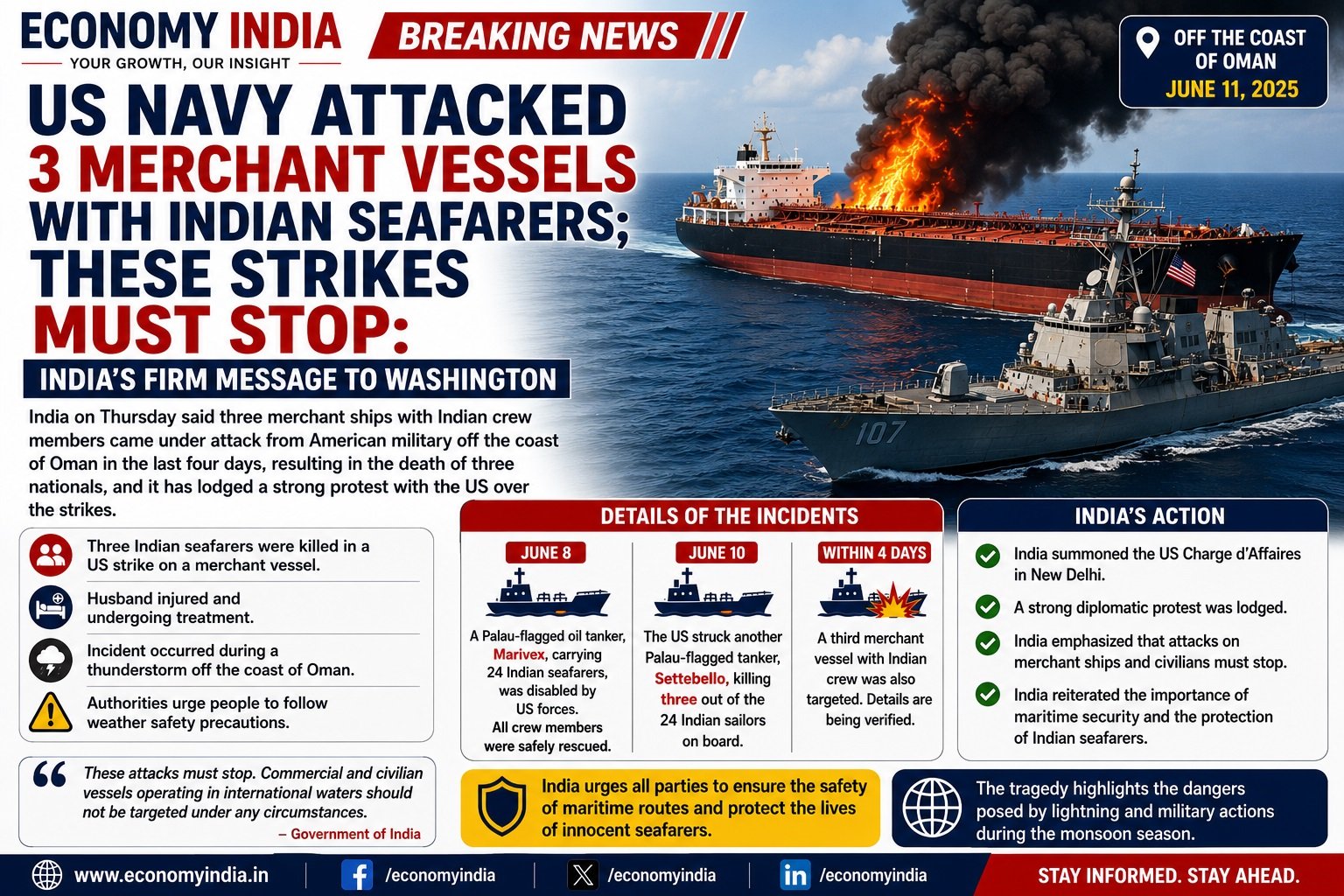
New Delhi (Economy India): India on Thursday publicly confirmed that three merchant vessels carrying Indian seafarers were targeted by the US Navy off the coast of Oman over the past four days, resulting in the death of three Indian nationals and triggering a strong diplomatic protest from New Delhi.
The development marks India’s first official acknowledgment that American military strikes directly impacted commercial ships carrying Indian crew members operating in international waters.
In a firm message to Washington, the Indian government stated that attacks on merchant shipping and civilian vessels must stop immediately, emphasizing the importance of protecting seafarers and ensuring freedom of navigation through critical global trade routes.
Three Merchant Ships Reportedly Targeted
According to official information, multiple commercial vessels carrying Indian crew members came under attack in separate incidents near the Gulf region.

Marivex Tanker Disabled
On June 8, the Palau-flagged oil tanker Marivex, carrying 24 Indian seafarers, was reportedly disabled during an American military operation near the coast of Oman.
Fortunately, all crew members aboard the vessel were rescued safely, and no fatalities were reported in the incident.
Settebello Tanker Hit; Three Indians Killed
A more serious incident occurred on June 10 when another Palau-flagged tanker, Settebello, came under attack.
The vessel had 24 Indian sailors on board.
According to official reports, the strike resulted in the deaths of three Indian crew members, while the remaining sailors survived the attack.
Authorities are continuing efforts to verify details surrounding the incident and provide assistance to the affected families.
Third Vessel Also Targeted
Government sources indicated that a third merchant vessel carrying Indian crew members was also affected during military operations in the region, although complete details regarding the attack have not yet been made public.
Indian authorities are monitoring the situation closely and coordinating with relevant international agencies.
India Summons US Diplomat
In response to the incidents, India summoned the US Charge d’Affaires in New Delhi and lodged a strong diplomatic protest.
Sources said the government conveyed its serious concerns over the targeting of commercial vessels carrying Indian nationals and sought an explanation regarding the military actions.
The diplomatic démarche reflects India’s growing concern over the safety of its citizens working aboard international merchant ships.
New Delhi’s Firm Position
Government officials stressed that commercial shipping must remain protected from military operations and geopolitical conflicts.
India reiterated that civilian vessels operating in international waters should not become targets under any circumstances.
Officials also emphasized that global maritime trade routes are essential for international commerce, energy supplies, and economic stability.
“These attacks must stop,” India’s message to Washington underscored, reflecting the seriousness with which New Delhi views the incidents.
Maritime Security Concerns Intensify
The attacks come amid escalating tensions in West Asia, where military confrontations have increasingly affected commercial shipping activities.
The Gulf region remains one of the world’s most important maritime corridors, handling a substantial share of global oil exports and international trade.
Any disruption to these routes can have far-reaching consequences for energy markets, shipping costs, and global supply chains.
Impact on Indian Seafarers
India is one of the largest suppliers of skilled seafarers to the global shipping industry.
Thousands of Indian sailors serve aboard merchant vessels operating across international waters, including in high-risk regions such as the Gulf and the Strait of Hormuz.
The deaths of three Indian nationals have renewed concerns regarding the safety and protection of civilian maritime workers in conflict-prone areas.
Industry experts have called for stronger international safeguards and greater accountability to ensure that commercial ships are not caught in military confrontations.
Strategic and Economic Implications
The incidents are likely to have diplomatic, economic, and security implications for India-US relations and regional maritime stability.
With energy imports and trade flows heavily dependent on secure sea lanes, India has consistently advocated for freedom of navigation and peaceful resolution of conflicts in the region.
Analysts believe New Delhi will continue engaging with international partners to ensure accountability and prevent further attacks on civilian vessels.
Conclusion
The deaths of three Indian sailors and the targeting of merchant vessels near Oman have triggered one of the strongest diplomatic responses from India in recent months. As geopolitical tensions continue to rise in West Asia, New Delhi has made its position clear: civilian shipping and commercial vessels must remain protected, and international waterways must remain safe, open, and free from military escalation.
The coming days are expected to witness further diplomatic engagement between India and the United States as investigations into the incidents continue.
(Economy India)