
New Framework Aims to Strengthen Infrastructure and Real Estate Investment Ecosystem in India
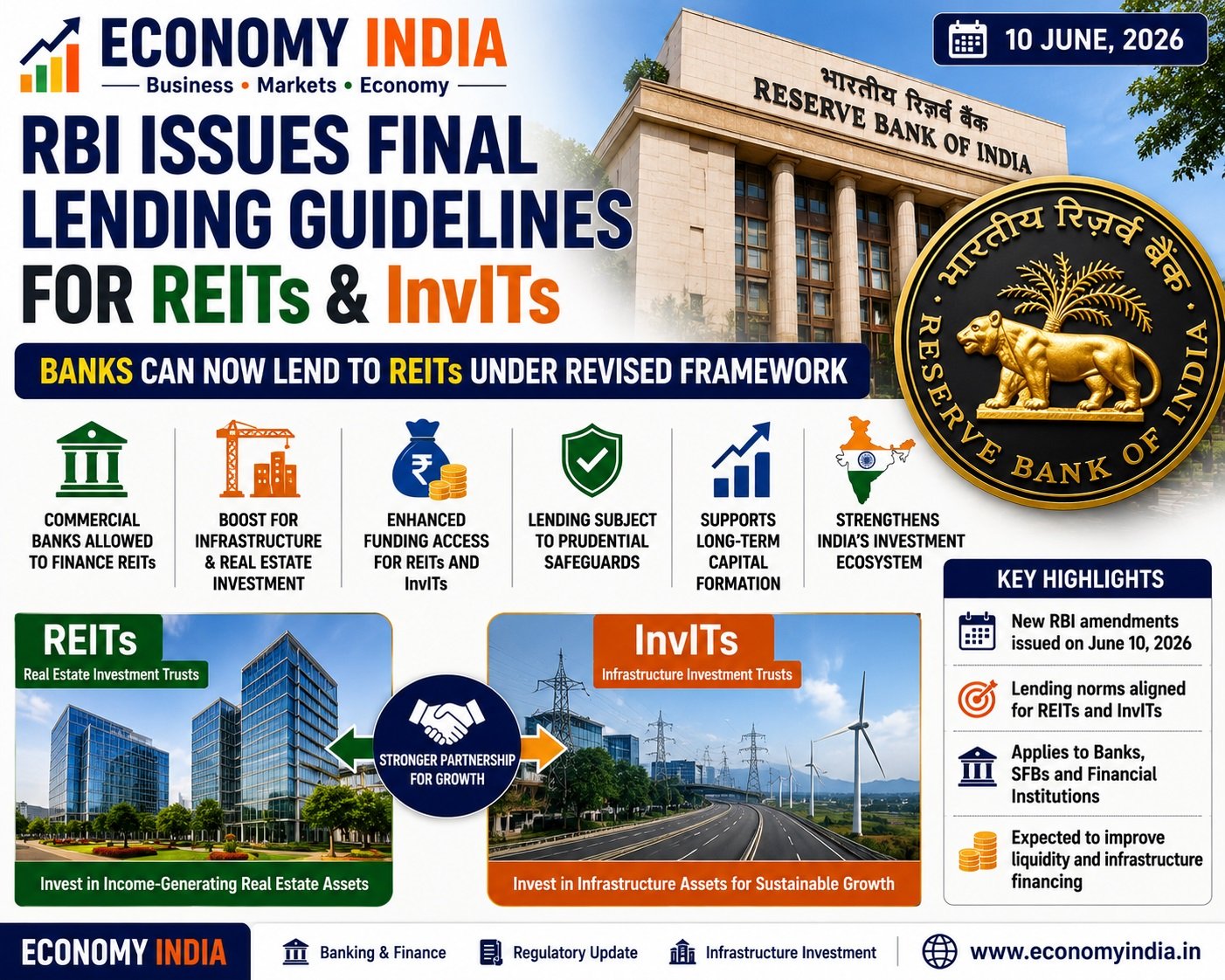
Mumbai (Economy India): The Reserve Bank of India (RBI) has issued the final revised directions on lending to Real Estate Investment Trusts (REITs) and Infrastructure Investment Trusts (InvITs), paving the way for enhanced financing support to these investment vehicles while maintaining prudent risk management safeguards.
The revised framework follows a draft circular released by the central bank on February 13, 2026, which sought stakeholder feedback on proposed changes to lending norms applicable to REITs and InvITs.
According to the RBI, the feedback received from market participants, financial institutions, and industry stakeholders has been reviewed and incorporated into the final amendment directions.
Commercial Banks Allowed to Lend to REITs
One of the most significant changes introduced under the revised framework is the permission granted to commercial banks to provide loans to REITs, subject to regulatory exposure limits and prudent safeguards.

The move is expected to improve access to credit for REITs and support the growth of India’s real estate investment ecosystem.
REITs have emerged as an important investment avenue in recent years, allowing investors to participate in income-generating real estate assets through a regulated structure.
Industry experts believe easier access to bank financing could help REITs expand their portfolios and undertake new projects more efficiently.

Alignment of InvIT Lending Guidelines
The RBI has also revised existing lending norms applicable to InvITs to ensure consistency with the prudential safeguards introduced for REIT financing.
The updated guidelines apply to:
- Commercial Banks
- Small Finance Banks (SFBs)
- All India Financial Institutions (AIFIs)
The harmonisation of lending norms is expected to create a more transparent and predictable regulatory environment for infrastructure financing.
InvITs play a crucial role in mobilising long-term capital for infrastructure projects such as roads, power transmission networks, renewable energy assets, and logistics facilities.
Key Regulatory Amendments Issued
The RBI has formally issued the following amendment directions:
Banking and Lending
- Indian Reserve Bank (Commercial Banks – Loans and Advances) Third Amendment Directions, 2026
- Indian Reserve Bank (Small Finance Banks – Loans and Advances) Second Amendment Directions, 2026
- Indian Reserve Bank (All India Financial Institutions – Loans and Advances) Amendment Directions, 2026
Risk Management and Capital Adequacy
- Indian Reserve Bank (Commercial Banks – Concentration Risk Management) Third Amendment Directions, 2026
- Indian Reserve Bank (Commercial Banks – Prudential Norms on Capital Adequacy) Eighth Amendment Directions, 2026
These amendments are intended to ensure that increased lending flexibility does not compromise financial stability or risk management standards.
No Immediate Changes to Financial Statement Disclosure Norms
The RBI also clarified that proposed amendments relating to financial statement presentation and disclosure requirements for commercial banks will not be implemented at this stage.
The decision has been taken in light of changes to asset classification categories introduced under the RBI Directions on Capital Charge for Credit Risk – Standardised Approach, 2026, which will come into effect from April 1, 2027.
As a result, the amendments earlier proposed in the RBI (Commercial Banks – Financial Statements: Presentation and Disclosures) Directions, 2025 have been deferred.
The central bank indicated that any future revisions in disclosure requirements will be considered after the new capital framework becomes operational.

Boost for Infrastructure and Real Estate Sectors
Market participants view the revised lending framework as a positive development for India’s infrastructure and real estate sectors.
By improving access to institutional credit, the new guidelines are expected to:
✔ Strengthen infrastructure financing
✔ Support real estate asset monetisation
✔ Improve liquidity for REITs and InvITs
✔ Encourage long-term investments
✔ Enhance capital market participation
✔ Facilitate economic growth through infrastructure development
Experts believe the reforms align with India’s broader objective of increasing private-sector participation in infrastructure creation and asset management.
Importance of REITs and InvITs
REITs and InvITs have become increasingly important components of India’s financial markets.
REITs
Real Estate Investment Trusts allow investors to invest in income-generating commercial properties such as office buildings, shopping malls, and business parks.
InvITs
Infrastructure Investment Trusts provide investment opportunities in infrastructure assets, including highways, power transmission projects, renewable energy facilities, and telecom towers.
Both structures help unlock capital, improve asset utilisation, and attract long-term domestic and foreign investments.
(Economy India)