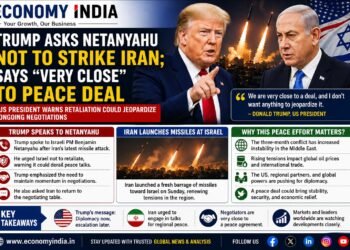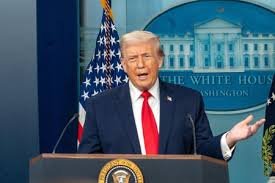
Dubai (Economy India): Amid intensifying hostilities in the Middle East, Donald Trump has sparked fresh controversy by stating that the United States should be involved in the process of selecting Iran’s next Supreme Leader.
Trump’s remarks come at a time when military tensions between Iran, Israel, and the United States have sharply escalated, with continued airstrikes and retaliatory attacks spreading across the region.
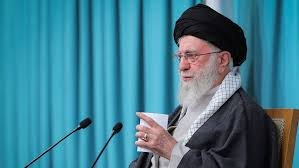
Trump Opposes Mojtaba Khamenei’s Possible Appointment
During an interview with the U.S. news website Axios, Trump said that the possible appointment of Mojtaba Khamenei, son of Iran’s Supreme Leader Ali Khamenei, would be “unacceptable.”
According to Trump, the international community — particularly the United States — should play a role in shaping Iran’s political future if a leadership transition occurs.

His statement has raised serious questions among geopolitical analysts about whether Washington and Tel Aviv aim to simply change Iran’s policies or ultimately seek to dismantle the Islamic Republic’s leadership structure.
Escalating War Across the Region
The conflict has rapidly intensified across West Asia, involving multiple countries and militant groups. Ongoing airstrikes by United States and Israel have targeted Iranian military installations, leadership networks, and alleged nuclear facilities.
In response, Iran has launched retaliatory attacks against Israeli and American positions across the region.
Officials report that the conflict has already affected at least 14 countries, increasing fears of a broader regional war.
Azerbaijan–Iran Tensions Rise
Adding another layer to the crisis, Azerbaijan accused Iran of conducting drone attacks on Thursday. Tehran has strongly denied these allegations.
Meanwhile, Iranian forces reportedly launched new strikes early Thursday targeting U.S. and Israeli bases, warning that Washington would “deeply regret” an alleged torpedo attack on an Iranian warship in the Indian Ocean.
Lebanon Front Expands
As fighting intensified with Hezbollah, Israel issued evacuation warnings for residents in the southern suburbs of Beirut.
At the same time, United Nations peacekeeping forces reported increased ground combat in southern Lebanon, as additional Israeli troops crossed the border.
The expansion of the conflict into Lebanon has significantly heightened the risk of a multi-front regional war.
Rising Death Toll
According to officials from countries involved in the conflict:
- Iran: At least 1,230 people killed
- Lebanon: More than 120 casualties
- Israel: Nearly a dozen fatalities
- United States: Six American soldiers killed
The war has also disrupted global oil supplies and international aviation routes, creating volatility in global energy markets.
Global Economic Concerns
The escalating conflict is already impacting the global economy, particularly energy supply chains and aviation routes across the Middle East. Analysts warn that prolonged instability could trigger sharp oil price fluctuations, supply disruptions, and wider geopolitical risks.
For energy-import dependent economies such as India, prolonged disruptions in the region could have serious implications for crude oil supply and inflation trends.
Trump’s remarks on the leadership transition in Iran have added a new diplomatic flashpoint to an already volatile situation. As the conflict widens across West Asia, the coming weeks could prove critical for regional stability, global energy markets, and international security.
(Economy India)