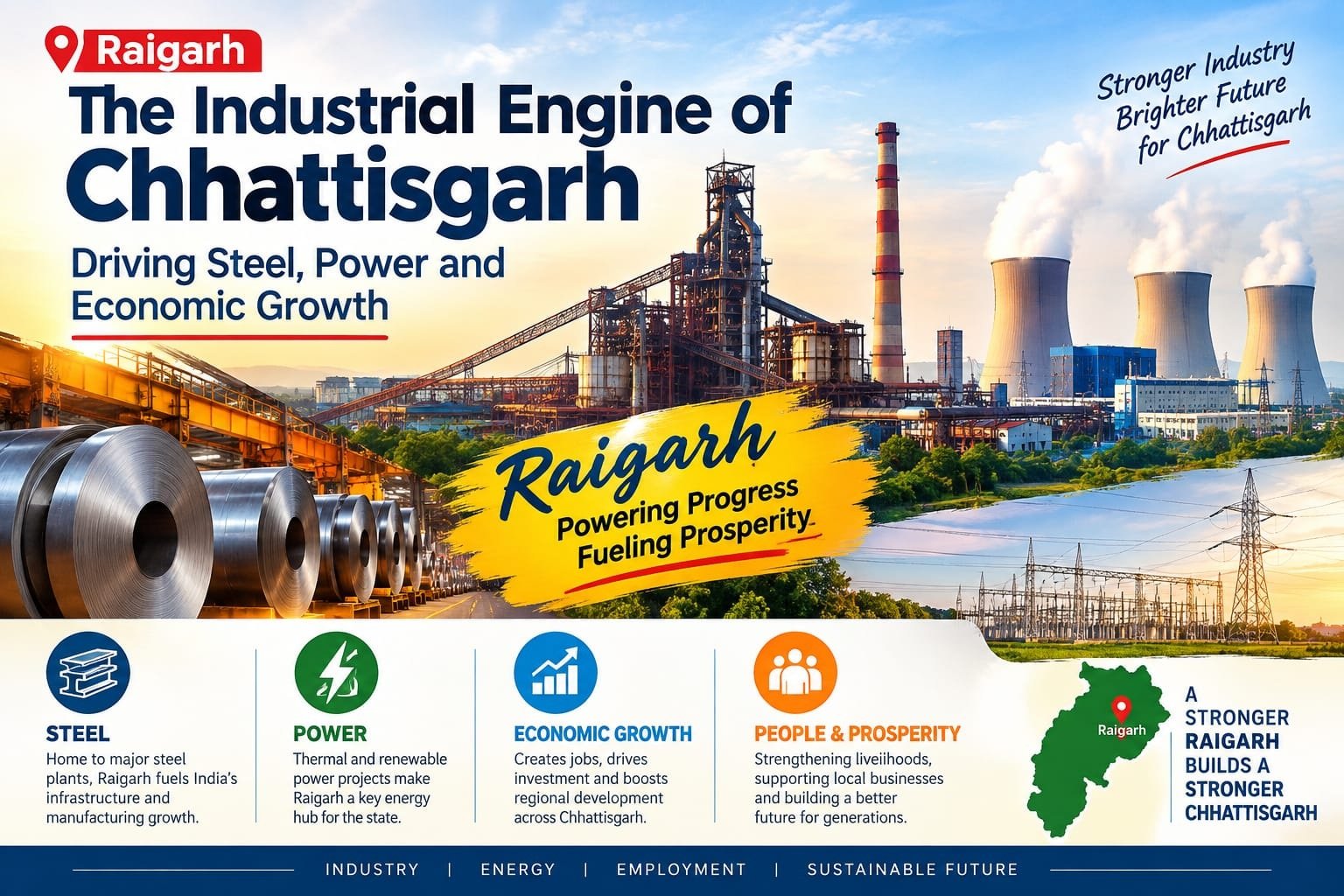
From coal and minerals to steel, power and manufacturing, Raigarh has emerged as one of Chhattisgarh’s most important industrial centres
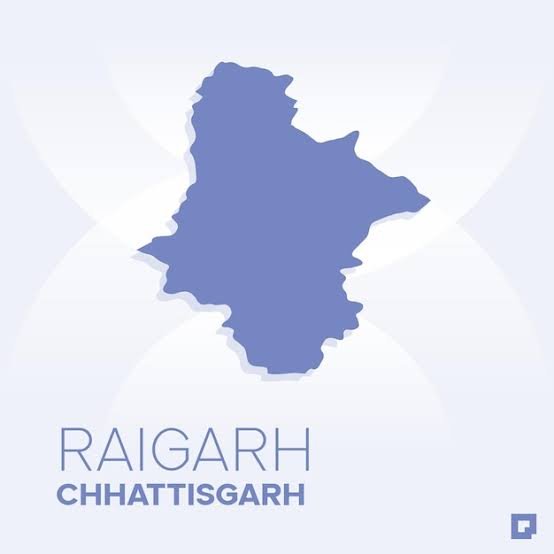
Raigarh, Chhattisgarh (Economy India): When the story of Chhattisgarh’s industrial growth is discussed, Raigarh occupies a special place. Located in the eastern part of the state, the district has developed into a powerful industrial ecosystem built around steel, power, coal, mining, engineering and manufacturing.
The district administration itself describes Raigarh as a rapidly growing industrial district and identifies it as one of the country’s leading steel-producing regions. The district is home to major industrial companies and plants, including Jindal Steel and Power (JSPL), MSP Steel and Monnet Steel, along with a large number of small and medium industrial units.
For Economy India, Raigarh represents more than an industrial district. It represents the transformation of mineral wealth into industrial capacity, employment, infrastructure and economic activity.
A Mineral-Rich Foundation for Industrial Growth
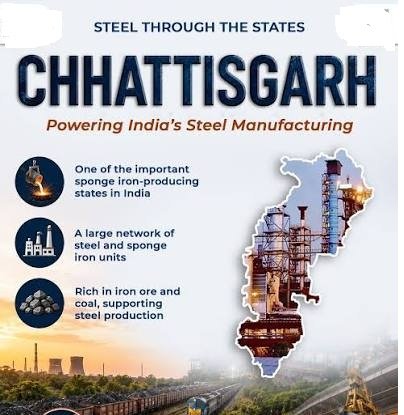
Raigarh’s industrial strength begins with its natural resource base.
The district has substantial deposits of coal as well as limestone, quartz, fireclay, dolomite and quartzite. These resources have supported the development of energy-intensive industries, particularly steel and power.
The scale of industrial activity can be understood from the district administration’s statement that Raigarh consumes approximately 20,000 tonnes of coal every day.
That level of consumption reflects the deep connection between the district’s mineral resources and its industrial economy.
Coal supports power generation and industrial processes, while steel plants create demand for transport, engineering, maintenance, fabrication, logistics, construction and a wide network of ancillary businesses.
This creates a multiplier effect across the local economy.
Steel: The Core of Raigarh’s Industrial Identity
Steel is at the heart of Raigarh’s industrial economy.
The district has developed a substantial cluster of steel and related industries, ranging from large integrated plants to smaller and medium-sized units. The presence of companies such as JSPL, MSP Steel and Monnet Steel has helped establish Raigarh as an important steel manufacturing centre.
The steel ecosystem extends beyond primary production.
It includes:
- Sponge iron manufacturing
- Steel melting
- Rolling mills
- TMT and structural steel
- Pipes and fabricated products
- Engineering services
- Industrial maintenance
- Transportation and logistics
- Equipment suppliers
- Contracting and construction services
This industrial chain makes Raigarh significantly more than a location for large factories. It is an interconnected manufacturing ecosystem.
Mining Revenue Shows the Economic Importance of Minerals
The contribution of mining to Raigarh’s economy is also visible in official district revenue data.
According to the District Statistical Book 2020, mining royalty collections were recorded at approximately Rs 221.60 crore in 2015-16, rising to around Rs 822.41 crore in 2016-17 and Rs 888.33 crore in 2017-18. Mining royalty remained substantial at approximately Rs 856.02 crore in 2018-19 and Rs 501.01 crore in 2019-20.
These figures underline the importance of mineral-based economic activity to the district.
However, the next phase of growth will increasingly depend on how effectively Raigarh converts its resource advantage into higher-value manufacturing.
Power and Energy: Another Major Growth Engine
Steel manufacturing requires large quantities of reliable power, making energy infrastructure an essential part of Raigarh’s industrial ecosystem.
The district hosts several steel and power plants, and the availability of coal and industrial infrastructure has helped support energy-intensive manufacturing.
For Raigarh, the future opportunity lies not only in producing electricity but also in creating a more efficient industrial energy ecosystem.
The transition toward renewable energy, energy efficiency and cleaner production technologies could become increasingly important for local industries as global markets demand lower-carbon products.
This is particularly relevant for steel producers, where energy costs and carbon intensity are becoming major factors in international competitiveness.
From Primary Industry to Value-Added Manufacturing
The next big opportunity for Raigarh is to move further up the industrial value chain.
Instead of primarily producing raw materials and intermediate products, the district can strengthen downstream manufacturing in areas such as:
- Engineering components
- Industrial machinery
- Steel-based products
- Fabrication
- Auto and infrastructure components
- Electrical equipment
- Construction materials
- Industrial services
- MSME manufacturing
Such diversification could help create more employment per unit of investment and increase the economic value generated within the district.
A stronger downstream ecosystem would also reduce dependence on commodity cycles.
MSMEs Can Become the Next Layer of Growth
Large industrial companies provide the foundation, but MSMEs can determine how deeply industrialisation spreads into the local economy.
Raigarh already has a large industrial base, and official district records have referred to a significant number of industrial units established across the district.
The opportunity is to build stronger linkages between large plants and local enterprises.
For example, local MSMEs can participate in:
- Component manufacturing
- Industrial repair
- Welding and fabrication
- Packaging
- Logistics
- Safety equipment
- Industrial consumables
- IT-enabled industrial services
- Waste management
- Recycling and circular economy activities
A stronger supplier ecosystem can make the industrial economy more inclusive while reducing dependence on suppliers from outside the region.
Infrastructure Will Decide the Next Phase
Industrial growth cannot be sustained by factories alone.
Road connectivity, rail infrastructure, logistics facilities, warehouses, reliable electricity, water availability, digital connectivity and skilled manpower are equally important.
Raigarh’s industrial development has already influenced its demographic and economic character. The district administration notes that railway and industrial development have attracted people from different parts of India.
This migration of workers, professionals and entrepreneurs has helped create a diverse economic environment.
The next challenge is to ensure that infrastructure keeps pace with industrial expansion.
Agriculture and Agro-Processing Offer a New Opportunity
Although Raigarh is widely identified with steel, power and mining, the district’s economic future does not have to depend entirely on heavy industry.
The district administration has recently listed a proposal for an agro-processing cluster under the PM Kisan Sampada Yojana as well as a medicinal plants business centre under the Ministry of AYUSH.
Such initiatives could provide an additional economic pillar.
Agro-processing can create opportunities for farmers, food-processing companies, packaging businesses, logistics operators and rural entrepreneurs.
This can help connect the rural economy with the industrial economy.
Kosa Silk and Dhokra Add a Different Dimension
Raigarh’s economic identity is not limited to heavy industry.
The district is also known for Kosa silk, including Tasar and Mulberry silk. The official district website notes that silk production provides livelihoods for villagers and that units produce silk sarees and dress materials, including products for export.
Raigarh is also known for Dhokra or bell-metal casting, a traditional craft practised by tribal communities.
These sectors offer opportunities for handicraft exports, tourism, e-commerce and rural entrepreneurship.
The coexistence of modern steel plants and traditional Kosa and Dhokra craftsmanship gives Raigarh a distinctive economic character.
Sustainability Will Shape Raigarh’s Industrial Future
The biggest challenge before Raigarh is also its biggest opportunity: building the next generation of industry in a more sustainable manner.
Steel and power are energy-intensive sectors. As global buyers increasingly demand lower-carbon supply chains, Indian steel producers will face growing pressure to improve energy efficiency and reduce emissions.
For Raigarh, this could accelerate investments in:
- Renewable energy
- Waste-heat recovery
- Energy-efficient equipment
- Scrap recycling
- Green hydrogen-linked technologies
- Cleaner production processes
- Industrial waste utilisation
- Circular economy models
The shift towards greener manufacturing should not be viewed only as an environmental requirement. It can also become an industrial competitiveness strategy.
Skills Will Be Critical
Industrialisation creates demand for skilled workers.
Raigarh’s future workforce will need capabilities in mechanical engineering, electrical systems, automation, welding, fabrication, industrial safety, machine operations, logistics, data technology and modern manufacturing.
Skill development linked directly to industrial demand can help local youth capture a greater share of the employment opportunities generated by the district’s industrial economy.
Industry-academia partnerships, apprenticeship programmes and technology-focused training centres can further strengthen this ecosystem.
Raigarh’s Economic Multiplier Effect
The real strength of Raigarh lies in the multiplier effect generated by its industrial base.
A steel plant does not operate in isolation.
It requires:
Coal → Power → Raw Materials → Steel Production → Transport → Engineering → Maintenance → Logistics → Construction → Services → Employment → Local Consumption
Each stage creates economic activity.
Workers spend their income locally. Businesses purchase services. Transporters move materials. Contractors employ labour. Shops and service providers benefit from industrial activity.
This creates an economic ecosystem that extends well beyond the factory gates.
The Road Ahead
Raigarh has already established itself as one of Chhattisgarh’s key industrial centres. The official district administration continues to identify the region with steel, power, coal and mineral-based industries, while new opportunities are emerging in agro-processing and other sectors.
The next phase should focus on diversification rather than simply expansion.
The objective should be to move:
From minerals to manufacturing.
From manufacturing to value addition.
From value addition to innovation.
From industrial growth to sustainable industrial growth.
If this transition is successfully managed, Raigarh can strengthen its position not only as a steel and power hub but as a broader manufacturing and economic centre of Chhattisgarh.
Raigarh Is More Than a Steel City
Raigarh’s story is ultimately the story of how natural resources can become an economic engine.
Coal and minerals created the foundation.
Steel and power created industrial capacity.
Industries created jobs and markets.
Infrastructure connected the economy.
MSMEs expanded the ecosystem.
Now, the next chapter is about value addition, technology, sustainability and inclusive growth.
For Chhattisgarh, Raigarh is not merely another industrial district. It is a strategic economic engine with the potential to influence the state’s next phase of industrial development.
Raigarh’s future will depend on how effectively it converts its mineral strength into a diversified, technology-driven and sustainable industrial economy.
— Economy India Special Feature