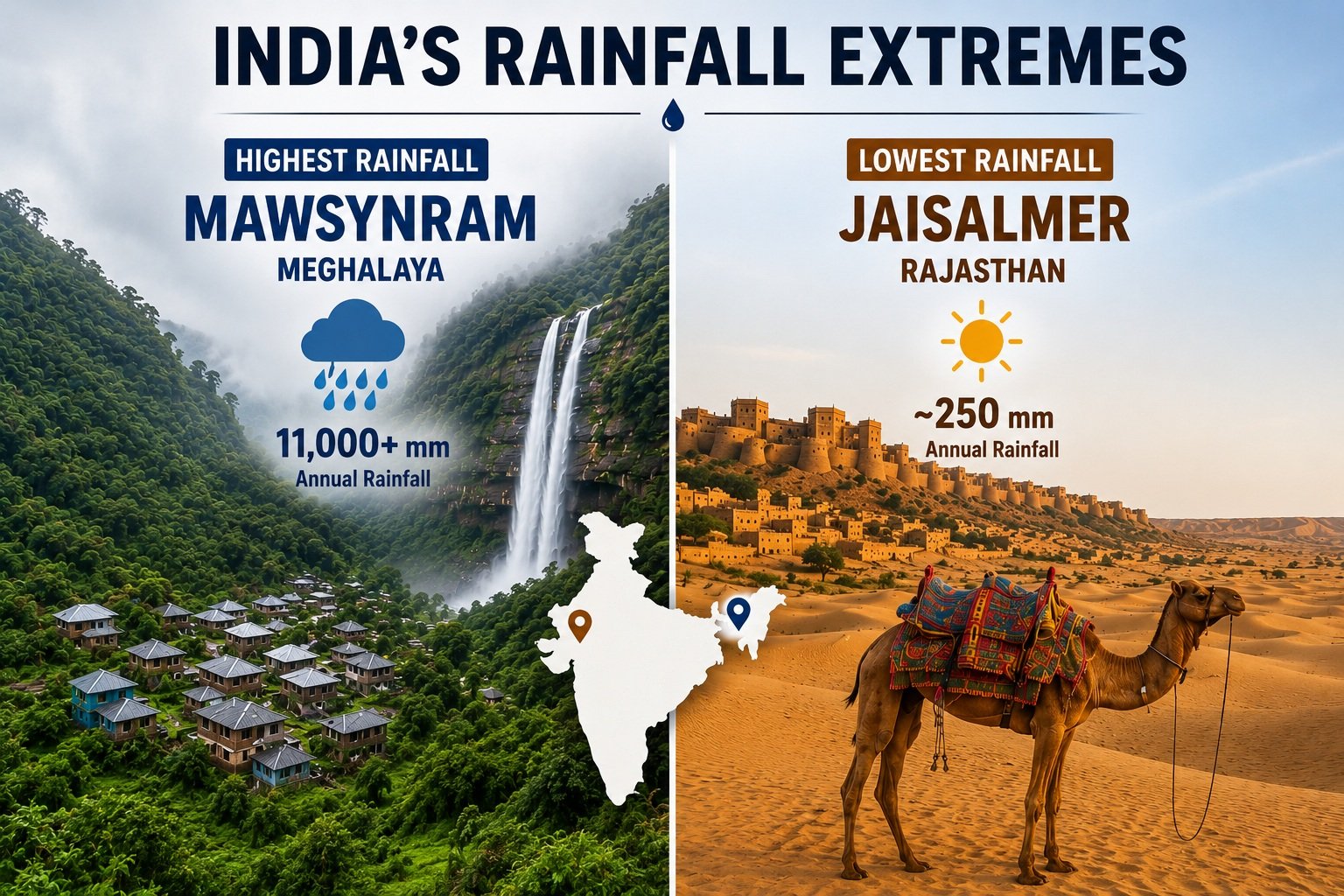

India’s Highest and Lowest Rainfall Regions:
( Economy India ): India’s diverse geography creates significant variations in rainfall across the country. While some regions receive some of the highest annual rainfall in the world, others experience arid conditions with very little precipitation. These differences play a crucial role in shaping agriculture, water availability, infrastructure, and the overall economy.
Mawsynram: The Wettest Place in India
Located in the northeastern state of Meghalaya, Mawsynram is recognized as the wettest place in India and one of the wettest places on Earth. The region receives an average annual rainfall of over 11,000 millimeters. Moisture-laden monsoon winds from the Bay of Bengal rise over the Khasi Hills, producing intense orographic rainfall.
Benefits of Heavy Rainfall
- Abundant freshwater resources throughout the year.
- Strong potential for hydropower generation.
- Rich biodiversity and dense forests.
- Growth in eco-tourism and nature-based tourism.
Challenges
- Frequent floods and landslides.
- Damage to roads, bridges, and public infrastructure.
- Agricultural losses due to excessive rainfall.
- High maintenance costs for transportation and public services.
Jaisalmer: One of India’s Driest Regions
Jaisalmer, located in Rajasthan’s Thar Desert, is among the driest regions in India. The district receives an average annual rainfall of around 250 millimeters, making water scarcity a persistent challenge.
Challenges of Low Rainfall
- Severe shortage of drinking water.
- Heavy dependence on groundwater and irrigation.
- Frequent drought conditions.
- Limited agricultural productivity.
Possible Solutions
- Expansion of rainwater harvesting systems.
- Adoption of drip and sprinkler irrigation.
- Cultivation of drought-resistant crops.
- Improved water conservation and efficient resource management.
Economic Impact of Rainfall Variations
Rainfall distribution has a direct influence on India’s economy. Agriculture, which supports millions of livelihoods, remains heavily dependent on the southwest monsoon. Excessive rainfall can cause floods that damage crops, infrastructure, and property, while deficient rainfall often leads to droughts, lower agricultural output, and reduced rural incomes.

The uneven distribution of rainfall also affects electricity generation, industrial water supply, urban planning, and food prices. As climate change increases the frequency of extreme weather events, strengthening water management systems and climate-resilient infrastructure has become essential for sustainable economic growth.
Conclusion
India’s rainfall pattern reflects the country’s remarkable geographical diversity. Mawsynram in Meghalaya represents the country’s highest rainfall region, while Jaisalmer in Rajasthan remains one of its driest. Effective water conservation, modern irrigation technologies, and climate adaptation strategies will be critical to ensuring long-term agricultural productivity, water security, and economic resilience.
( Economy India )