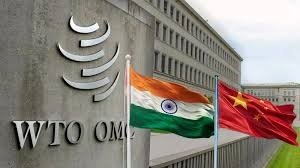

India’s opposition to the China-led IFD Agreement reflects deeper tensions over global trade governance, sovereignty, and the future of multilateralism
New Delhi (Economy India): India’s strong opposition to the China-led Investment Facilitation for Development (IFD) Agreement at the World Trade Organization signals more than a disagreement over trade rules—it reflects a deeper geopolitical contest shaping the future of global economic governance.
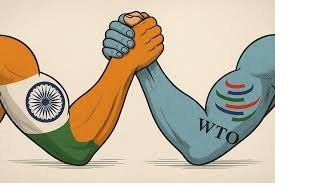
As articulated by Piyush Goyal, India believes that incorporating the IFD Agreement into the WTO framework risks undermining the organisation’s foundational principles. On the other hand, China and several supporting nations view the agreement as a necessary step toward improving global investment flows.
This divergence highlights a broader clash of visions: rule expansion vs rule restraint, efficiency vs equity, and influence vs sovereignty.
Understanding the IFD Agreement
The Investment Facilitation for Development Agreement is designed to:
- Simplify investment procedures
- Increase transparency in regulatory processes
- Improve ease of doing business globally
Unlike traditional investment treaties, the IFD does not directly address:
- Market access
- Investor protection
Instead, it focuses on administrative efficiency.
China’s Strategic Push
For China, the IFD Agreement represents both an economic and geopolitical opportunity.
Economic Objectives:
- Facilitate outbound investments
- Strengthen global supply chain integration
- Enhance ease of investment in developing markets
Geopolitical Objectives:
- Shape global trade rules
- Expand leadership within multilateral institutions
- Build influence among developing economies
China’s push for IFD aligns with its broader strategy of:
- Promoting connectivity (e.g., Belt and Road Initiative)
- Positioning itself as a leader in global governance
India’s Opposition: A Strategic Calculation
India’s resistance is rooted in multiple concerns:
3.1 Preserving WTO Mandate
India argues that:
- WTO’s core mandate is trade, not investment
- Expanding into investment could dilute its focus
3.2 Protecting Policy Sovereignty
India is cautious about:
- External scrutiny of domestic policies
- Reduced flexibility in regulatory decisions
This is particularly relevant for:
- Industrial policy
- MSME protection
- Public welfare programs
3.3 Consensus-Based Multilateralism
India insists that:
- WTO decisions must be based on consensus
- Plurilateral agreements (like IFD) should not be imposed on all members
The Plurilateral vs Multilateral Debate
The IFD Agreement is a plurilateral initiative, meaning:
- It is supported by a group of countries, not all WTO members
- It may still be incorporated into WTO framework
India’s Concern:
- Plurilateral agreements could bypass consensus
- Create a “two-tier” WTO system
China’s View:
- Flexible frameworks are needed for progress
- Consensus-based systems are too slow
The Developing World Divide
Interestingly, the debate is not strictly India vs China—it reflects divisions within the Global South.
Supporters of IFD:
- Seek easier investment flows
- Want integration into global markets
Opponents (including India):
- Prioritize policy space
- Fear regulatory constraints
This divide complicates coalition-building among developing nations.
Strategic Implications for India
India’s stance has several implications:
6.1 Leadership Role
India positions itself as:
- A defender of equitable trade rules
- A voice for cautious reform
6.2 Economic Autonomy
By opposing IFD, India seeks to:
- Retain flexibility in policymaking
- Avoid binding commitments in investment
6.3 Trade Negotiation Strategy
India’s approach reflects a broader pattern:
- Selective engagement
- Issue-based alliances
China’s proactive role in pushing IFD highlights its evolving position:
- From rule-taker to rule-maker
- From participant to agenda-setter
This shift has implications for global trade governance.
Broader Geopolitical Context
The India-China divergence at the WTO is part of a larger strategic rivalry:
Economic Competition
- Manufacturing leadership
- Supply chain dominance
Institutional Influence
- Role in global organizations
- Norm-setting authority
Global South Leadership
- Competing visions for development
Implications for WTO Reform
The disagreement over IFD raises key questions:
9.1 Can WTO Adapt?
- Need for reform vs risk of fragmentation
9.2 Will Plurilateralism Rise?
- Faster decision-making
- But reduced inclusivity
9.3 Is Consensus Sustainable?
- Increasing difficulty in reaching agreement
- Growing divergence among members
Economy India Insight
The India–China divide over the IFD Agreement is not just about investment—it is about the future architecture of global trade governance.
India’s caution reflects a belief that:
👉 Rules must evolve, but not at the cost of fairness and inclusivity
China’s push reflects:
👉 The need for faster, flexible frameworks in a changing global economy
Future Outlook
Short-Term
- Continued debate within WTO
- No immediate consensus
Medium-Term
- Possible compromise frameworks
- Limited adoption of IFD
Long-Term
- Redefinition of WTO structure
- Greater role for emerging economies
India’s opposition to the China-led IFD Agreement highlights a fundamental tension in global trade governance—efficiency vs equity, speed vs consensus, expansion vs restraint.
As the WTO navigates this complex landscape, the outcome of this debate will shape:
- The future of multilateral trade
- The balance of power in global economic institutions
- The role of emerging economies like India and China
In this evolving order, India’s stance represents a cautious yet strategic approach to safeguarding its economic sovereignty while engaging with global systems.
(Economy India)