
RBI data shows valuation gains from gold and a weaker US dollar offset pressure from current account and capital flows
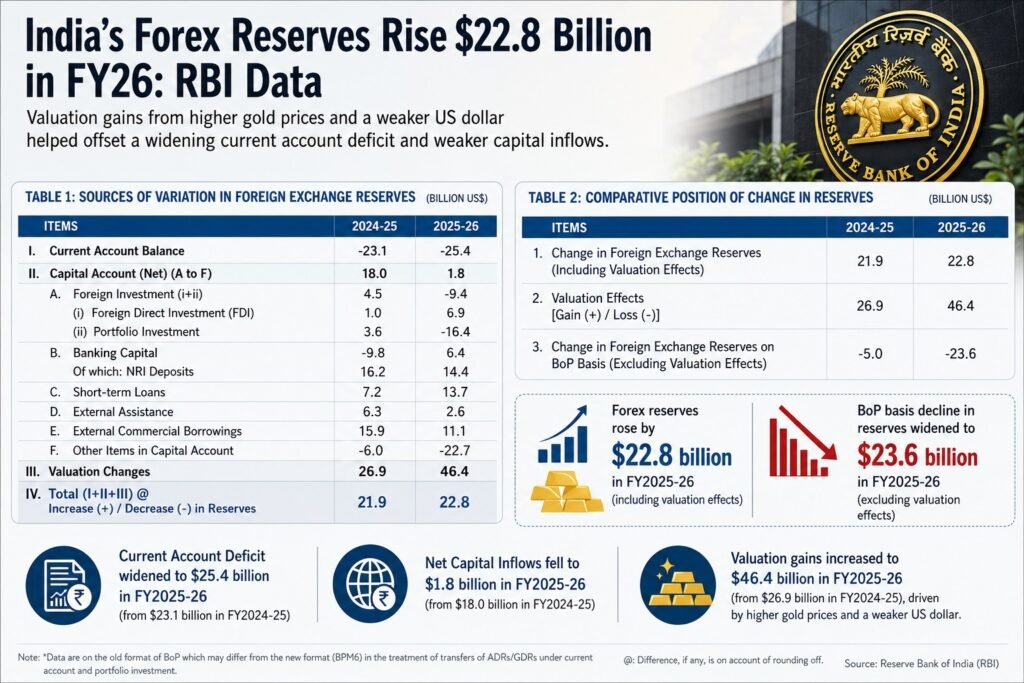
Mumbai (Economy India): India’s foreign exchange reserves increased by $22.8 billion during FY2025-26, supported largely by valuation gains arising from higher gold prices and the depreciation of the US dollar against major global currencies, according to data released by the Reserve Bank of India (RBI).
The central bank published the sources of variation in India’s foreign exchange reserves alongside the Balance of Payments (BoP) statistics for the fourth quarter (January-March 2025-26) and the full financial year 2025-26.
The data highlights the contrasting trends within India’s external sector, where significant valuation gains helped offset pressures stemming from a widening current account deficit and weaker capital inflows.
Current Account Deficit Widens
According to the RBI, India’s current account deficit (CAD) widened to $25.4 billion in FY2025-26, compared with $23.1 billion in FY2024-25.

The increase reflects continued pressure from trade and external payment obligations, underscoring the challenges facing the country’s balance of payments position amid evolving global economic conditions.
Sharp Decline in Net Capital Inflows
Net capital account inflows declined significantly during the year.
The capital account recorded a net surplus of only $1.8 billion in FY2025-26, down sharply from $18 billion in the previous financial year.
A major factor behind the slowdown was a reversal in foreign investment flows.
Net foreign investment registered an outflow of $9.4 billion, compared with an inflow of $4.5 billion in FY2024-25.
While Foreign Direct Investment (FDI) improved substantially to $6.9 billion, up from $1 billion a year earlier, portfolio investment recorded an outflow of $16.4 billion, reversing inflows of $3.6 billion reported during the previous year.
Banking Capital and External Borrowings Support Flows
Despite weaker foreign investment, several components of the capital account remained positive.
Banking capital recorded net inflows of $6.4 billion, compared with an outflow of $9.8 billion in FY2024-25. Non-Resident Indian (NRI) deposits continued to remain a significant source of foreign exchange, contributing $14.4 billion during the year.
Short-term debt inflows increased to $13.7 billion, while external commercial borrowings contributed $11.1 billion.
External assistance added $2.6 billion to the capital account.
However, other capital account items registered a substantial outflow of $22.7 billion, compared with an outflow of $6 billion in the previous year.
Valuation Gains Drive Reserve Growth
The RBI noted that valuation gains played a decisive role in boosting the country’s foreign exchange reserves.
Valuation gains rose to $46.4 billion in FY2025-26, significantly higher than $26.9 billion in FY2024-25.
These gains primarily reflected a sharp increase in global gold prices and the depreciation of the US dollar against major international currencies.
As a result, India’s overall foreign exchange reserves increased by $22.8 billion on a nominal basis, marginally higher than the $21.9 billion increase recorded in FY2024-25.
Underlying Balance of Payments Position Weakens
The RBI data also revealed a weaker underlying balance of payments position when valuation effects are excluded.
On a Balance of Payments basis, foreign exchange reserves declined by $23.6 billion in FY2025-26, compared with a decline of $5 billion in FY2024-25.
This indicates that reserve accumulation during the year was driven predominantly by favourable valuation effects rather than by surplus external inflows.
Economists note that while rising reserves strengthen India’s external stability and provide a buffer against global volatility, the underlying trends in current account and capital flows will remain important indicators for policymakers monitoring the country’s external sector health.
Outlook for India’s External Sector
The RBI data suggests that India’s foreign exchange reserves continue to benefit from favourable market movements and robust reserve management. However, sustaining reserve growth over the long term will depend on stronger capital inflows, stable portfolio investments, export performance, and continued resilience in external financing channels.
As global economic uncertainty persists, India’s external sector will remain under close watch, particularly with regard to trade dynamics, foreign investment trends, and currency movements.
(Economy Indi)