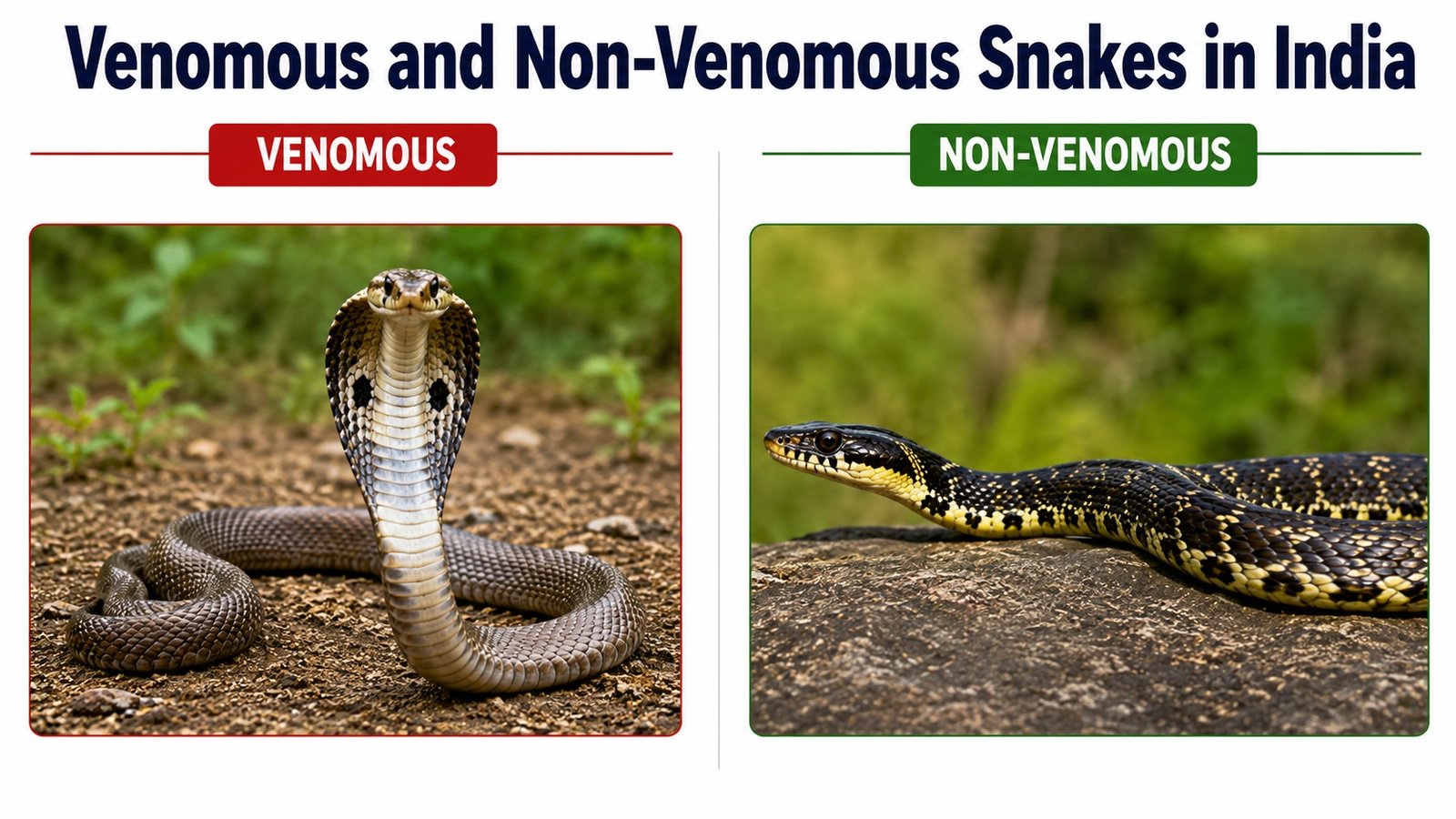
(Economy India):India is home to more than 300 species of snakes, but only about 60 species are venomous. Most snakes are harmless to humans and play an important role in controlling rodents and maintaining ecological balance. Below are some of the most common venomous and non-venomous snakes found in India.
| Snake | Photo | Venomous? | Description |
|---|---|---|---|
| Indian Cobra (Naja naja) |

| ☠️ Yes | One of India’s most recognized venomous snakes. It spreads a hood when threatened and has a powerful neurotoxic venom. |
| Common Krait (Bungarus caeruleus) |


| ☠️ Yes | A highly venomous nocturnal snake with black or bluish-black scales and thin white bands. |
| Russell’s Viper (Daboia russelii) |

| ☠️ Yes | A heavy-bodied venomous snake with large brown oval markings. It is responsible for many snakebite cases in India. |
| Saw-scaled Viper (Echis carinatus) |

| ☠️ Yes | A small but aggressive venomous snake commonly found in dry and rocky regions. |
| King Cobra (Ophiophagus hannah) |

| ☠️ Yes | The world’s longest venomous snake. It is mainly found in forests of South and Northeast India. |
Common Non-Venomous Snakes in India
| Snake | Photo | Venomous? | Description |
|---|---|---|---|
| Indian Rat Snake (Ptyas mucosa) |

| A fast-moving, harmless snake commonly found in farms and villages. It helps control rats. |
| Indian Rock Python (Python molurus) |

| One of India’s largest snakes. It is non-venomous and kills prey by constriction. |
| Checkered Keelback |

| A harmless freshwater snake often seen near ponds, lakes, and rivers. |
| Common Wolf Snake |

| Frequently mistaken for the Common Krait, but it is completely non-venomous. |
| Green Vine Snake (Ahaetulla nasuta) |

These snakes account for most medically significant snakebite incidents across the country.
Snakebite Safety Tips
- Stay calm and avoid unnecessary movement.
- Keep the bitten limb still and below heart level.
- Reach the nearest hospital immediately.
- Do not cut the wound, suck out the venom, or apply a tight tourniquet.
- Never try to catch or kill the snake.
Although India has a rich diversity of snakes, most species are non-venomous and beneficial to the environment. Learning to identify common venomous snakes and respecting all snakes from a safe distance can help prevent accidents and support wildlife conservation.
(Economy India)