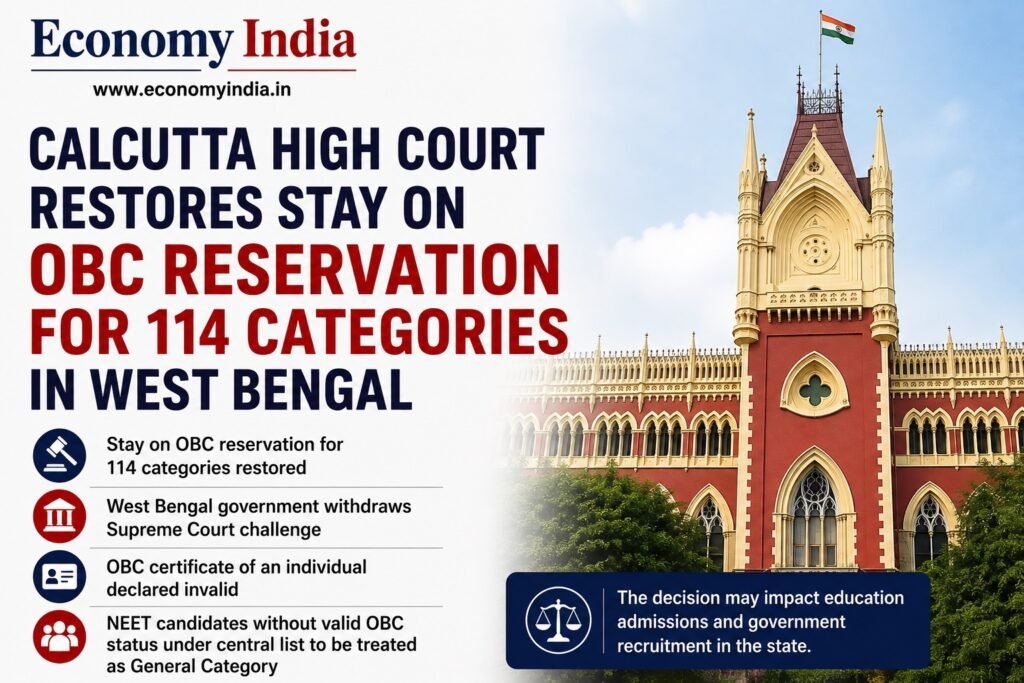
Court Says Earlier Stay Order Becomes Effective Again After State Government Withdraws Supreme Court Challenge
Kolkata (Economy India): The Calcutta High Court has said that its earlier order staying the Other Backward Classes (OBC) reservation granted to 114 categories in West Bengal has once again become effective after the state’s present government withdrew a Special Leave Petition (SLP) that had been filed before the Supreme Court by the previous government challenging the High Court’s decision.
The development could have significant implications for candidates seeking to avail themselves of OBC reservation benefits in education and competitive examinations in West Bengal.
The High Court also invalidated the OBC certificate of an individual who had approached the court and held that candidates who appeared for the National Eligibility-cum-Entrance Test (NEET) claiming OBC status under the Central List should be treated as General Category candidates where their OBC status was not legally valid.
Earlier Stay Order Comes Back Into Effect
The Calcutta High Court made it clear that the earlier stay on OBC reservation for the 114 categories has been revived following the withdrawal of the challenge before the Supreme Court.

The matter relates to the legal validity of the inclusion of several communities in the OBC reservation framework of West Bengal.
The earlier court proceedings had questioned the manner in which these categories were included in the state’s OBC list and the resulting reservation benefits.
With the Supreme Court challenge now withdrawn by the state government, the High Court’s earlier order staying the reservation has again assumed significance.
State Government Withdraws Supreme Court Petition
The court noted that the Special Leave Petition filed before the Supreme Court by the previous West Bengal government challenging the High Court’s order has been withdrawn by the current government.
The withdrawal changes the legal position surrounding the earlier stay order and means that the High Court’s directions are once again operative.
The development is likely to be closely watched by students, job aspirants and other beneficiaries who have relied on OBC certificates issued under the affected categories.
Impact on OBC Certificates
In another important part of its ruling, the High Court declared the OBC certificate of a petitioner invalid.
The court also addressed the position of candidates who had identified themselves as OBC candidates under the Central OBC List while appearing for NEET.
According to the court, candidates who did not have a legally valid OBC status under the applicable rules should be treated as General Category candidates.
This could have implications for admission processes where reservation status affects eligibility, merit ranking or seat allocation.
Implications for NEET Candidates
The court’s observation is particularly significant for candidates who participated in NEET by claiming OBC status.
Reservation under the Central List is subject to specific eligibility requirements and documentation. A candidate’s state-level classification does not automatically establish eligibility for benefits available under the Central OBC List.
The court’s direction means that candidates whose OBC status does not satisfy the applicable legal requirements may have to be considered under the General Category.
This could potentially affect admission-related processes where candidates have already used OBC status to claim reservation benefits.
Why the 114 Categories Matter
The dispute involving the 114 OBC categories has been an important issue in West Bengal’s reservation framework.
The High Court’s earlier intervention had put the reservation benefits associated with these categories on hold. The subsequent legal challenge before the Supreme Court had kept the issue under judicial consideration.
The withdrawal of that challenge has now brought the earlier High Court order back into force.
The development may therefore require authorities and institutions to review how reservation benefits are applied to candidates belonging to the affected categories.
Possible Impact on Education and Recruitment
The court’s decision could have wider implications beyond individual cases.
OBC reservation can affect admissions to educational institutions as well as recruitment to government positions. Any change in the validity of OBC classifications can therefore influence thousands of students and job aspirants.
Authorities may need to examine certificates and reservation claims in accordance with the latest judicial directions.
Candidates who have previously relied on OBC certificates from the affected categories may also need to understand how the court’s order applies to their individual circumstances.
Difference Between State and Central OBC Lists
One of the important issues highlighted by the case is the distinction between state-level OBC classification and the Central OBC List.
Reservation benefits are governed by the applicable list and rules for a particular admission or recruitment process. A community’s inclusion in a state OBC list does not necessarily mean that it is eligible for reservation under the Central List.
This distinction becomes particularly important for national-level examinations such as NEET, where candidates may seek reservation under centrally applicable categories.
Court’s Position on General Category Status
The High Court’s direction that affected candidates should be considered under the General Category is significant because reservation status can influence the admission process.
Where a candidate is unable to establish valid eligibility for OBC reservation under the relevant rules, the candidate cannot necessarily continue to claim the benefits attached to that category.
The court’s observation is therefore expected to receive close attention from education authorities and candidates involved in the ongoing admission process.
What Happens Next?
Following the withdrawal of the Supreme Court challenge, authorities in West Bengal may have to take steps consistent with the Calcutta High Court’s revived order.
The practical impact will depend on how the relevant government departments, examination authorities and educational institutions implement the court’s directions.
Candidates belonging to the affected categories are likely to closely monitor official notifications for further clarification regarding certificates, admissions, recruitment and reservation benefits.
Broader Significance of the Verdict
The case highlights the importance of following the legal and procedural requirements governing reservation policies.
OBC reservation is intended to provide representation and opportunities to eligible communities, but the classification and certification process must comply with constitutional and legal requirements.
The latest development also underlines the importance of maintaining clarity between state and central reservation frameworks, particularly when candidates participate in national-level examinations.
Economy India Takeaway
The Calcutta High Court has restored the effect of its earlier stay on OBC reservation for 114 categories in West Bengal after the state’s current government withdrew the Special Leave Petition filed before the Supreme Court by the previous government.
The court also invalidated an individual’s OBC certificate and said that candidates who had claimed OBC status under the Central List while appearing for NEET should be treated as General Category candidates where their OBC status was not legally valid.
The decision could have important consequences for students, job aspirants and others relying on OBC reservation benefits in West Bengal. Authorities and affected candidates are now expected to closely examine the implications of the court’s order.
(Economy India)