
Introduction
( Economy India ): India’s public sector has played a vital role in the country’s economic development. Among the top-performing Public Sector Undertakings (PSUs), Navratna Companies hold a special place. These companies are recognized for their outstanding financial performance, operational excellence, and strategic importance. The Government of India grants Navratna status to selected Central Public Sector Enterprises (CPSEs), giving them greater financial and operational autonomy.
Today, Navratna companies contribute significantly to India’s energy security, infrastructure development, mining, engineering, transportation, and international trade.
What is a Navratna Company?
A Navratna Company is a Central Public Sector Enterprise (CPSE) that has been granted Navratna status by the Government of India based on its financial strength, profitability, and performance.
The Navratna status allows these companies to:

- Make large investments without seeking prior government approval.
- Form joint ventures and strategic partnerships.
- Expand operations both in India and overseas.
- Improve decision-making speed and business competitiveness.
Eligibility for Navratna Status
To receive Navratna status, a company must:
- Be a Miniratna Category-I company.
- Have an excellent financial track record.
- Score highly on performance indicators such as:
- Net Profit
- Net Worth
- Earnings Per Share (EPS)
- Revenue Growth
- Global Competitiveness
- Productivity and Efficiency
The final approval is granted by the Government of India.
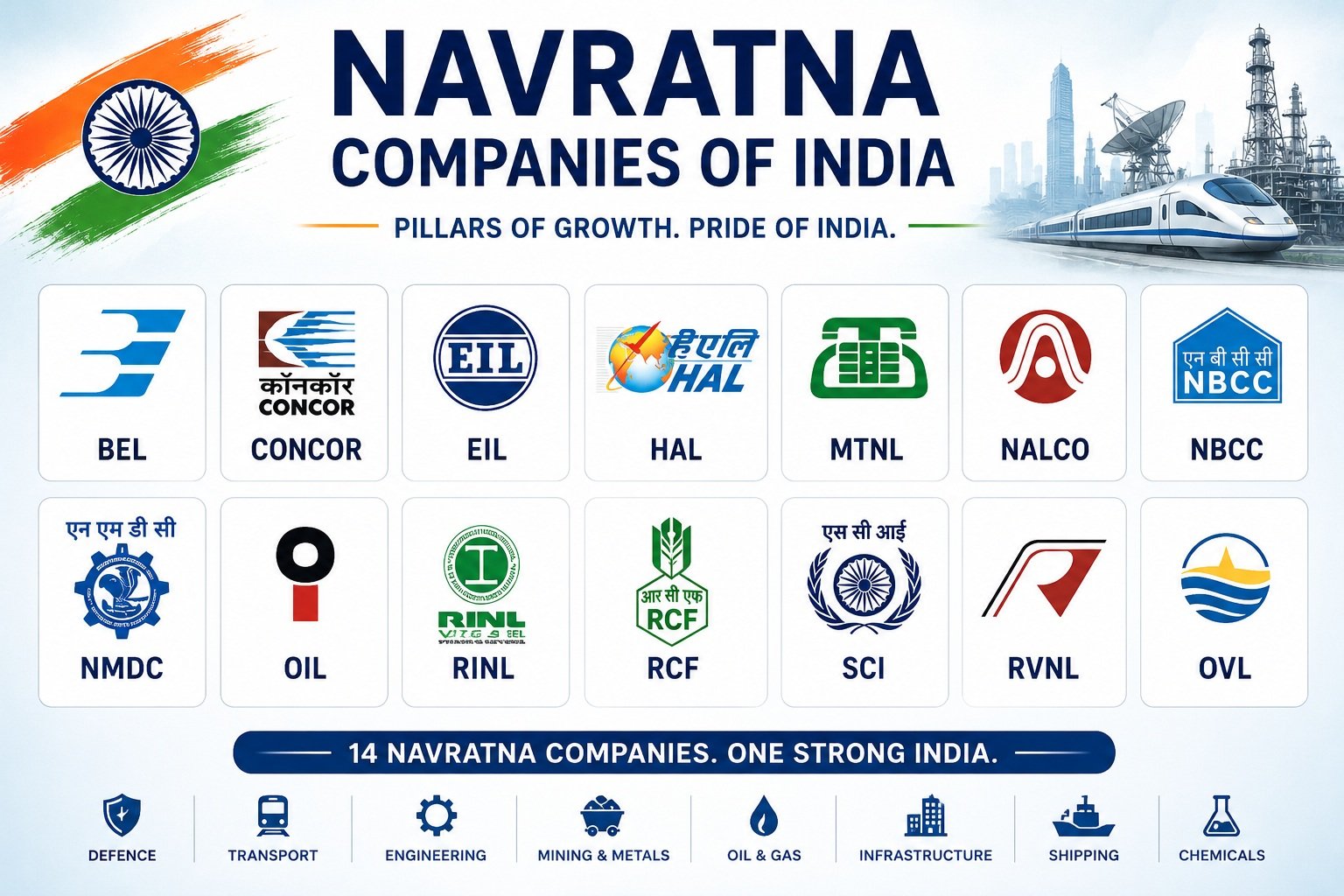
List of India’s Navratna Companies
1. Bharat Electronics Limited (BEL)
- Sector: Defence Electronics
- Headquarters: Bengaluru
- Established: 1954
BEL manufactures advanced defence electronics, radar systems, communication equipment, and weapon systems for the Indian Armed Forces.
2. Container Corporation of India Limited (CONCOR)
- Sector: Logistics and Transportation
- Headquarters: New Delhi
- Established: 1988
CONCOR provides containerized cargo transportation and logistics services across India.
3. Engineers India Limited (EIL)
- Sector: Engineering Consultancy
- Headquarters: New Delhi
- Established: 1965
EIL offers engineering consultancy and project management services for oil, gas, petrochemical, and infrastructure projects.
4. Hindustan Aeronautics Limited (HAL)
- Sector: Aerospace and Defence
- Headquarters: Bengaluru
- Established: 1940
HAL designs, manufactures, and maintains aircraft, helicopters, engines, and aerospace equipment.
5. Mahanagar Telephone Nigam Limited (MTNL)
- Sector: Telecommunications
- Headquarters: New Delhi
- Established: 1986
MTNL provides telecom and broadband services in Delhi and Mumbai.
6. National Aluminium Company Limited (NALCO)
- Sector: Mining and Metals
- Headquarters: Bhubaneswar
- Established: 1981
NALCO is one of India’s leading producers of alumina and aluminium products.
7. NBCC (India) Limited
- Sector: Construction and Infrastructure
- Headquarters: New Delhi
- Established: 1960
NBCC undertakes large government infrastructure, redevelopment, and project management assignments.
8. NMDC Limited
- Sector: Mining
- Headquarters: Hyderabad
- Established: 1958
NMDC is India’s largest producer of iron ore and contributes significantly to the country’s steel industry.
9. Oil India Limited (OIL)
- Sector: Oil and Gas
- Headquarters: Duliajan, Assam
- Established: 1959
Oil India explores, develops, and produces crude oil and natural gas in India and abroad.
10. Rashtriya Ispat Nigam Limited (RINL)
- Sector: Steel
- Headquarters: Visakhapatnam
- Established: 1982
RINL operates the Visakhapatnam Steel Plant and produces high-quality steel products.
11. Rashtriya Chemicals and Fertilizers Limited (RCF)
- Sector: Fertilizers and Chemicals
- Headquarters: Mumbai
- Established: 1978
RCF manufactures fertilizers and industrial chemicals that support Indian agriculture.
12. Shipping Corporation of India Limited (SCI)
- Sector: Shipping
- Headquarters: Mumbai
- Established: 1961
SCI is India’s largest shipping company and provides maritime transport services globally.
13. Rail Vikas Nigam Limited (RVNL)
- Sector: Railway Infrastructure
- Headquarters: New Delhi
- Established: 2003
RVNL develops railway infrastructure projects, including tracks, bridges, and electrification.
14. ONGC Videsh Limited (OVL)
- Sector: International Oil & Gas Exploration
- Headquarters: New Delhi
- Established: 1965
OVL is the overseas investment arm of ONGC and operates oil and gas assets across multiple countries.
Importance of Navratna Companies
Navratna companies are essential for India’s economic progress because they:
- Generate substantial revenue for the government.
- Create millions of direct and indirect jobs.
- Support national infrastructure development.
- Strengthen India’s energy and defence sectors.
- Enhance India’s global business presence.
- Promote technological innovation and self-reliance.
Difference Between Maharatna, Navratna, and Miniratna Companies
| Category | Number of Companies | Autonomy Level | Investment Powers |
|---|---|---|---|
| Maharatna | Highest-performing CPSEs | Very High | Highest |
| Navratna | High-performing CPSEs | High | High |
| Miniratna | Profitable CPSEs | Moderate | Limited |
Challenges Faced by Navratna Companies
Despite their success, Navratna companies face several challenges:
- Rising global competition
- Rapid technological changes
- Market volatility
- Environmental regulations
- Privatization pressures
- Demand for digital transformation
Continuous innovation and efficient management are essential for maintaining their competitive edge.
Future Outlook
As India aims to become a $5 trillion economy, Navratna companies will continue to play a crucial role in infrastructure development, clean energy, defence manufacturing, railway modernization, mining, logistics, and digital transformation. Government initiatives such as Make in India, Digital India, and Atmanirbhar Bharat are expected to further strengthen these enterprises.
Conclusion
Navratna companies represent the backbone of India’s public sector. With greater operational freedom, strong financial performance, and strategic importance, they continue to contribute significantly to national development. Their role in building infrastructure, ensuring energy security, supporting defence production, and driving economic growth makes them indispensable to India’s future.
( Economy India )