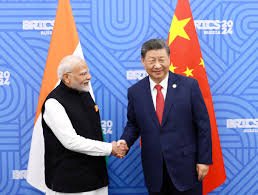

Piyush Goyal signals cautious optimism as Modi and Xi revive dialogue at the SCO summit. With border tensions easing, India-China ties may move towards normalization — but challenges remain in trade balance, geopolitical rivalry, and trust deficit.
NEW DELHII (Economy India): India and China, the two Asian giants whose combined population makes up nearly 40% of humanity, have always shared a complex relationship — marked by deep economic interdependence and equally sharp geopolitical rivalries. Over the past four years, however, their ties have been overshadowed by one singular event: the Galwan Valley clash of June 2020.
The violent face-off along the Line of Actual Control (LAC), which claimed the lives of 20 Indian soldiers and at least four Chinese troops, triggered a downward spiral in bilateral trust. India responded with unprecedented measures — tighter scrutiny on Chinese investments, bans on over 200 Chinese mobile apps, restrictions on trade through the “Public Notice 3” (PN3) system, and an accelerated drive for self-reliance under Atmanirbhar Bharat.
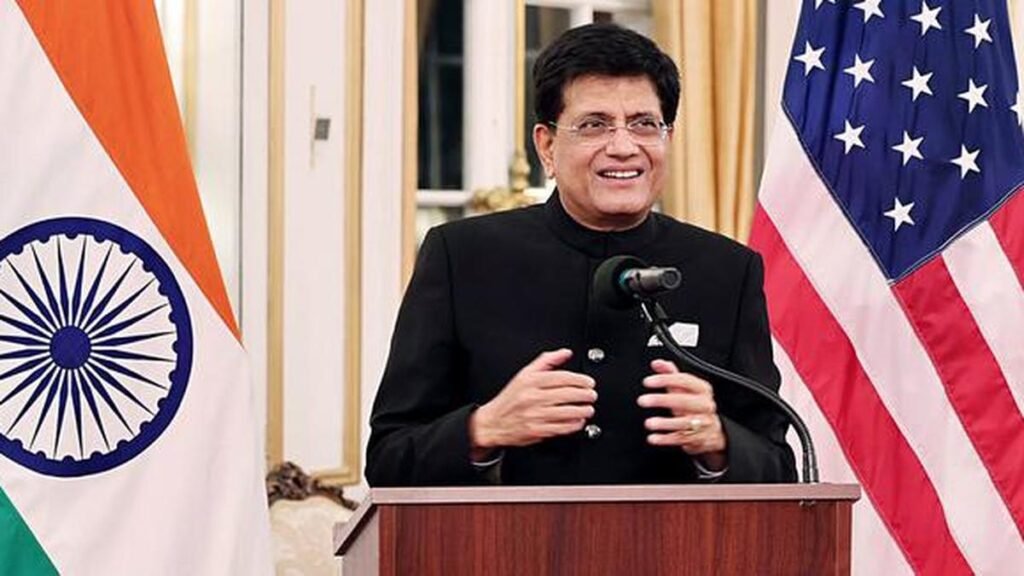
Now, Commerce and Industry Minister Piyush Goyal has suggested that relations are “gradually moving towards normalcy.” Speaking on the sidelines of the Shanghai Cooperation Organisation (SCO) summit, Goyal said the resolution of border issues would naturally lead to easing tensions. His comments come after Prime Minister Narendra Modi and Chinese President Xi Jinping agreed to pursue a “fair, reasonable and mutually acceptable” solution to the boundary question, while pledging to expand trade and investment ties.
The statement has triggered fresh debate: is India truly on the cusp of a reset with China, or is this merely tactical optics ahead of deeper geopolitical realignments?
The Galwan Factor: A Turning Point in India-China Ties
Until 2020, despite border disputes and occasional military standoffs, India and China managed to maintain stable trade and diplomatic ties. Bilateral trade was booming, China was India’s largest trading partner, and even strategic differences were often overshadowed by mutual economic benefit.
The Galwan Valley clash changed that equilibrium. For the first time in over four decades, Indian and Chinese soldiers lost their lives in a direct confrontation. Public sentiment in India turned sharply against Beijing. The Modi government moved swiftly:
- Banning 200+ Chinese apps, including TikTok and WeChat, citing security concerns.
- Imposing tighter FDI screening rules for investments from “border-sharing nations.”
- Bringing trade through PN3 (Public Notice 3) under stricter licensing norms.
- Scaling up military presence along the LAC.
The clash became a defining moment — not just militarily but economically. It hardened the perception that China could not be trusted, and India’s political establishment began to articulate the importance of strategic autonomy and reduced dependency.

India-China Trade Landscape: Interdependence Despite Frictions
Despite heightened tensions, trade between the two countries has paradoxically expanded. In FY24, bilateral trade touched $135 billion, with India importing nearly $101 billion worth of goods from China and exporting only about $34 billion. The trade deficit of $99 billion remains India’s highest with any single nation.
Key dependencies include:
- Electronics & Telecom: Nearly 65% of India’s smartphone components are sourced from China.
- Pharmaceutical APIs: India, a global pharma hub, still relies on China for over 70% of its active pharmaceutical ingredients.
- Solar Modules & Batteries: India’s renewable energy push depends heavily on Chinese imports.
- Machinery & Chemicals: Core industrial supply chains remain tied to China.
India has tried to counter this through Atmanirbhar Bharat, Production-Linked Incentive (PLI) schemes, and efforts to diversify sourcing from countries like Vietnam, Taiwan, and South Korea. Yet, in the short term, reducing dependency remains difficult.
This paradox — of strategic rivalry but economic dependency — forms the heart of India-China engagement today.
The Modi–Xi Dialogue at SCO: A Signal, Not a Solution
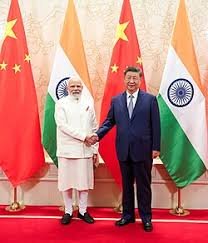
At the recent SCO summit, Prime Minister Narendra Modi and President Xi Jinping met briefly but meaningfully. They reaffirmed their intent to find a “mutually acceptable” border settlement and recognized their economies’ role in stabilizing global trade.
While no major breakthroughs were announced, the symbolism matters. The SCO, where both countries are members alongside Russia, Central Asian states, and now Iran, provides a platform for limited dialogue despite broader rivalries.
Piyush Goyal’s subsequent remarks — calling Galwan a “blip” and saying that normalcy is a natural consequence of border resolution — suggest that New Delhi may be exploring cautious openings for re-engagement.
But India’s position remains firm: peace along the border is a prerequisite for normal relations. Without LAC stability, trade and investment normalization will remain incomplete.
Piyush Goyal’s Statement: Reading Between the Lines
Minister Goyal’s choice of words is revealing. By calling Galwan a “blip,” he appears to frame the crisis as an unfortunate but temporary deviation rather than a permanent rupture. This framing allows space for economic diplomacy to proceed, even as military negotiations continue.
His optimism also hints at:
- Possible relaxation of PN3 trade restrictions in specific sectors, especially where India’s domestic industries face supply gaps.
- A signal to global investors that India is open to pragmatic engagement with China despite political tensions.
- A domestic balancing act, assuring businesses that stability may return while keeping national security at the forefront.
For Indian industry, such a reset could ease supply chain disruptions and reduce costs in key sectors. But politically, Goyal’s words will likely face scrutiny from voices that argue China cannot be trusted without verifiable de-escalation along the border.
Geopolitical Balancing: India Between Quad and SCO
India’s China policy today operates within a delicate geopolitical balance. On one side, New Delhi is deepening ties with the Quad (US, Japan, Australia) and forging strategic links with Europe. On the other, it remains an active member of BRICS and SCO, where cooperation with China (and Russia) is essential.
For Beijing, normalization with India has its own incentives:
- China’s economy is slowing, and stabilizing trade relations is crucial.
- Beijing is wary of India drifting too close to Washington.
- The Belt and Road Initiative (BRI) and SCO both require India’s participation for full legitimacy.
For New Delhi, maintaining engagement with China while safeguarding sovereignty offers strategic flexibility. India’s rise as an alternative manufacturing hub makes it both a partner and competitor to China in global supply chains.
Expert Perspectives: Opportunities and Risks
Economists and strategic analysts see both opportunities and risks in the emerging thaw.
Opportunities:
- Reduced border tensions free diplomatic bandwidth for cooperation in climate tech, renewable energy, and infrastructure financing.
- Normalization could encourage FDI inflows, as global investors prefer stability in Asia’s two largest markets.
- Both economies working together can contribute to stabilizing global supply chains, particularly in electronics and pharma.
Risks:
- Trust deficit remains high; future flare-ups along the LAC could undo progress.
- India’s massive trade deficit exposes vulnerabilities in economic re-engagement.
- Strategic rivalry in the Indo-Pacific — especially naval competition in the Indian Ocean — remains unresolved.
As one analyst put it, “India and China are too big to disengage, but too mistrustful to fully integrate.”
Looking Ahead: A Fragile Reset
The road to normalization will be neither smooth nor quick. India insists that border peace is non-negotiable, while China may prioritize economic normalization even before full resolution. This divergence could prolong the uncertainty.
In the near term, expect:
- Incremental relaxations in trade restrictions.
- More dialogue through SCO and BRICS platforms.
- Continued military talks to reduce friction along the LAC.
In the long run, the best-case scenario is of competitive coexistence — where India and China remain strategic rivals but economic partners. The worst case is renewed border escalation that derails normalization entirely.
Piyush Goyal’s remarks mark a rare note of optimism in the India-China narrative, four years after Galwan ruptured trust. The suggestion that ties are “moving towards normalcy” reflects both economic realism and diplomatic signaling.
But normalization will not be automatic. It depends on sustained border peace, careful management of the trade deficit, and a willingness to compartmentalize competition and cooperation.
For Economy India readers, the key takeaway is clear: the India-China relationship is too consequential for global trade to ignore. What happens along the icy ridges of the Himalayas will echo across supply chains, investment flows, and strategic alignments worldwide.
(Economy India)