
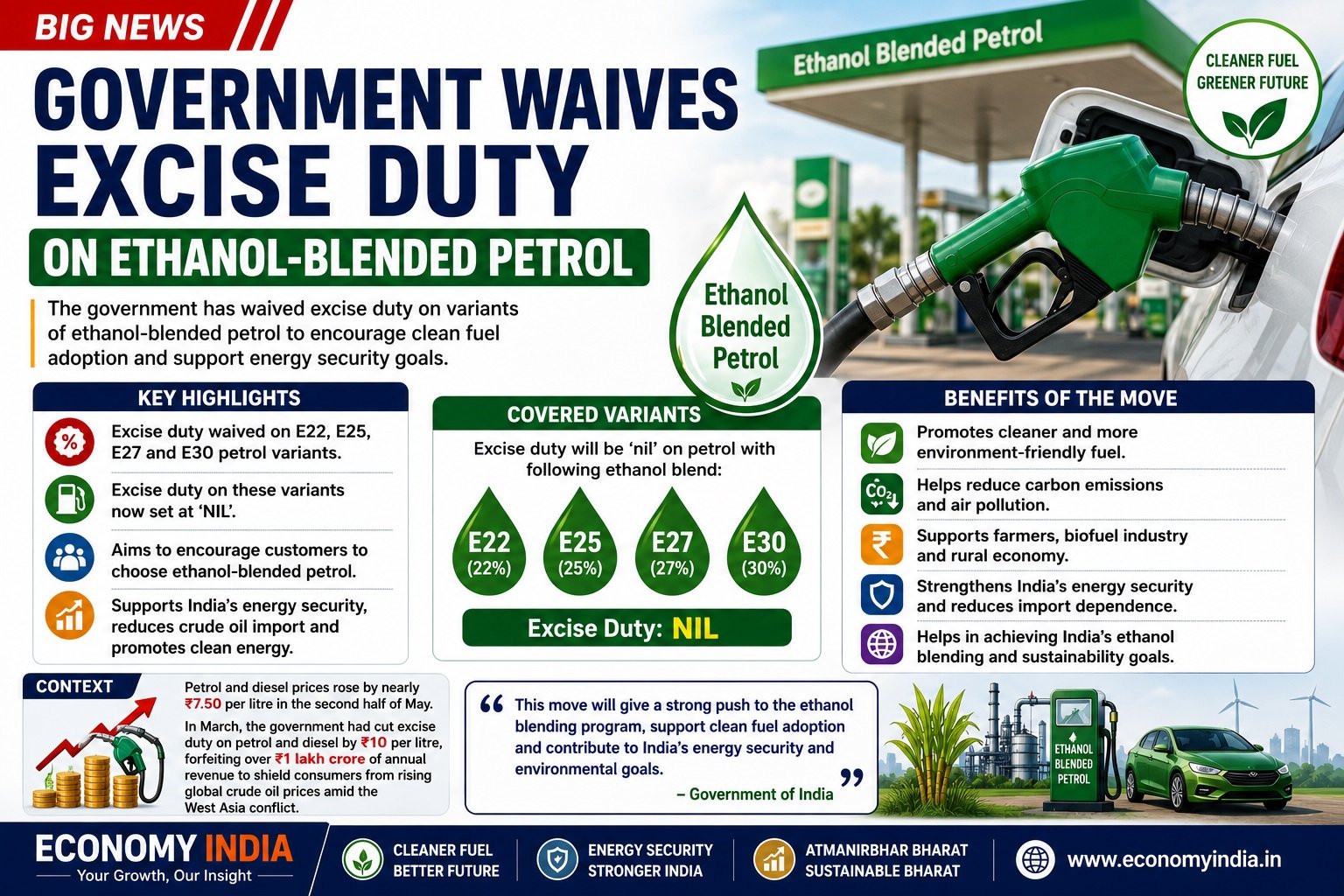
Duty Exemption Covers E22, E25, E27 and E30 Petrol Variants
New Delhi (Economy India): In a significant move aimed at promoting cleaner fuels and reducing dependence on fossil fuels, the Government of India has announced a complete waiver of excise duty on several variants of ethanol-blended petrol.
According to a notification issued by the Ministry of Finance, excise duty has been reduced to ‘nil’ on petrol blended with higher percentages of ethanol, including E22, E25, E27 and E30 fuel variants.
The decision is expected to encourage consumers to shift towards ethanol-based fuel alternatives while supporting India’s long-term energy security and sustainability goals.
Excise Duty Reduced to Zero
Under the latest notification, petrol blended with the following ethanol concentrations will now attract no excise duty:

- E22 (22% ethanol blend)
- E25 (25% ethanol blend)
- E27 (27% ethanol blend)
- E30 (30% ethanol blend)
The exemption is aimed at making ethanol-blended fuels more affordable and attractive for consumers while accelerating the country’s transition towards cleaner energy sources.
Push for Ethanol-Based Fuels
The government’s ethanol blending programme has been a key component of India’s strategy to:
✔ Reduce crude oil imports
✔ Improve energy security
✔ Lower carbon emissions
✔ Support domestic sugar and agriculture sectors
✔ Promote sustainable transportation fuels
India has already achieved significant progress in ethanol blending over the past few years, with blending levels steadily increasing across the country.
Officials believe the latest tax incentive will further boost adoption of higher ethanol blends.
Relief Amid Rising Fuel Prices
The announcement comes at a time when petrol and diesel prices have witnessed a sharp increase.
Fuel prices rose by nearly ₹7.50 per litre during the second half of May, placing additional pressure on household and transportation budgets.
By eliminating excise duty on ethanol-blended petrol, the government hopes to partially offset fuel costs while promoting environmentally friendly alternatives.
Background: Earlier Excise Duty Cuts
The latest measure follows the government’s decision in March to reduce excise duty on petrol and diesel by ₹10 per litre.
That move was aimed at protecting consumers from rising global crude oil prices amid geopolitical tensions and conflict in West Asia.
According to official estimates, the earlier reduction resulted in a revenue sacrifice of more than ₹1 lakh crore annually for the government.
Benefits for Farmers and Industry
The ethanol programme also provides a significant boost to India’s agricultural sector.
Ethanol is primarily produced from sugarcane, maize and other agricultural feedstocks. Increased demand for ethanol creates additional income opportunities for farmers and supports rural economic growth.
Industry experts believe the latest duty exemption could:
🌾 Increase demand for agricultural feedstocks
⛽ Promote cleaner transportation fuels
📉 Reduce dependence on imported crude oil
🌱 Lower greenhouse gas emissions
🏭 Support India’s biofuel industry
Industry
Energy analysts view the decision as another step toward achieving India’s ambitious ethanol blending targets and strengthening the domestic biofuel ecosystem.
The policy is expected to encourage oil marketing companies, automobile manufacturers and consumers to gradually embrace higher ethanol blends in the coming years.
As India continues to pursue cleaner energy solutions and greater energy independence, ethanol-blended fuels are likely to play an increasingly important role in the country’s fuel mix.
(Economy India)


