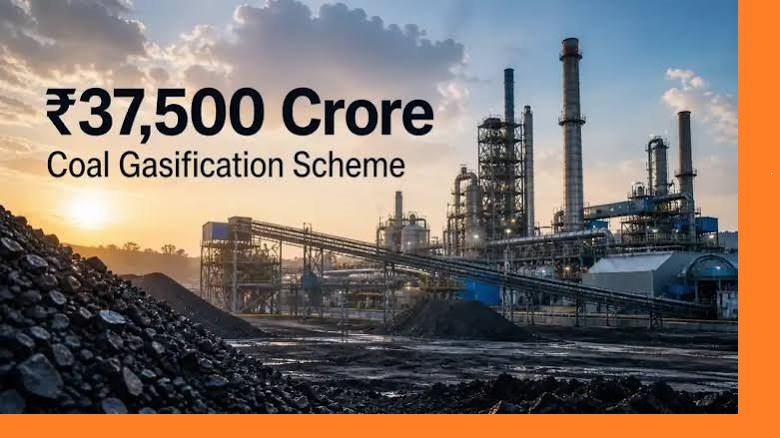

New Delhi (Economy India): The Government of India has invited proposals for setting up surface coal and lignite gasification projects across the country under its ₹37,500 crore incentive scheme, marking a major step toward strengthening domestic energy production and reducing dependence on imported fuels and chemicals.
According to an official statement issued on Wednesday, the Ministry of Coal has opened the application process under the Scheme for Promotion of Surface Coal/Lignite Gasification Projects, which was approved by the Union Government on May 13, 2026.
The initiative is designed to accelerate the adoption of advanced coal gasification technologies, encourage investment in value-added industries and support India’s long-term energy security goals.
What Is the Coal Gasification Scheme?
The ₹37,500 crore incentive scheme was launched in May 2026 to promote the conversion of coal and lignite into synthetic gas (syngas), a versatile fuel that can be used to manufacture a range of industrial products.

Unlike conventional coal combustion, gasification converts coal into a combustible gas mixture through a controlled chemical process. This syngas can then be processed into cleaner fuels and industrial chemicals, helping improve resource efficiency and diversify the country’s energy mix.
The scheme aims to encourage both public and private sector participation in establishing large-scale gasification facilities across India.
Products That Can Be Manufactured
The Ministry said the projects will focus on producing syngas and downstream value-added products, including:
- Synthetic Natural Gas (SNG)
- Urea
- Ammonium Nitrate
- Methanol
- Dimethyl Ether (DME)
- Industrial chemicals
- Other chemical feedstocks
These products are widely used in the fertilizer, petrochemical, pharmaceutical, manufacturing and energy sectors.
Strengthening India’s Energy Security
One of the key objectives of the scheme is to reduce India’s dependence on imported fuels and chemical feedstocks.
India imports significant quantities of natural gas, methanol and fertilizers to meet domestic demand. Expanding coal gasification capacity can help substitute imports with locally produced alternatives, improving energy security and reducing the country’s import bill.
The initiative also aligns with the government’s broader strategy of maximizing the use of domestic coal and lignite resources while promoting cleaner and more efficient technologies.
Better Utilisation of Domestic Coal Resources
India possesses one of the world’s largest coal reserves. However, much of this resource has traditionally been used for power generation.
Coal gasification offers an opportunity to convert these reserves into higher-value industrial products rather than relying solely on direct combustion. This can improve the economic value of domestic coal while supporting the development of downstream manufacturing industries.
Investment Opportunities
The Ministry of Coal has invited eligible applicants to submit project proposals under the incentive scheme.
The financial support is expected to attract investments from:
- Public sector enterprises
- Private companies
- Joint ventures
- Energy companies
- Chemical manufacturers
- Technology providers
Large-scale participation from industry could accelerate the commercialization of coal gasification technologies in India.
Economic Benefits
The incentive scheme is expected to generate several long-term economic benefits:
- Higher industrial investment
- Job creation in mining, engineering and manufacturing
- Reduced import dependence
- Growth of the domestic chemical industry
- Increased value addition to coal resources
- Expansion of ancillary industries
- Strengthening of India’s energy ecosystem
The development of gasification projects may also stimulate investments in infrastructure, logistics, engineering services and research.
Environmental Considerations
Although coal remains a fossil fuel, gasification technology is considered more efficient than conventional combustion for several industrial applications.
Modern gasification systems can facilitate improved emissions management and enable the integration of carbon capture technologies, making them suitable for cleaner industrial processes compared with traditional coal utilization methods.
However, environmental performance will depend on project design, technology selection and compliance with applicable environmental regulations.
Industry Outlook
Coal gasification has been identified as a strategic technology in India’s long-term energy roadmap. Several public sector companies have already announced plans to establish coal-to-chemical and coal-to-methanol facilities.
The new incentive scheme is expected to accelerate commercial deployment by reducing project costs and improving investor confidence.
As demand for fertilizers, chemicals and alternative fuels continues to rise, coal gasification could emerge as an important component of India’s industrial growth strategy.
Looking Ahead
The opening of applications under the ₹37,500 crore incentive scheme represents a significant milestone in India’s efforts to modernize coal utilization and strengthen domestic manufacturing.
If implemented successfully, the initiative could reduce import dependence, create new industrial value chains, enhance energy security and generate employment while supporting the country’s broader vision of self-reliance in critical industrial sectors.
(Economy India)