Four Projects to Add Nearly 410 Km of New Rail Lines Across West Bengal, Odisha, Tamil Nadu and Andhra Pradesh; Expected to Benefit 6,448 Villages
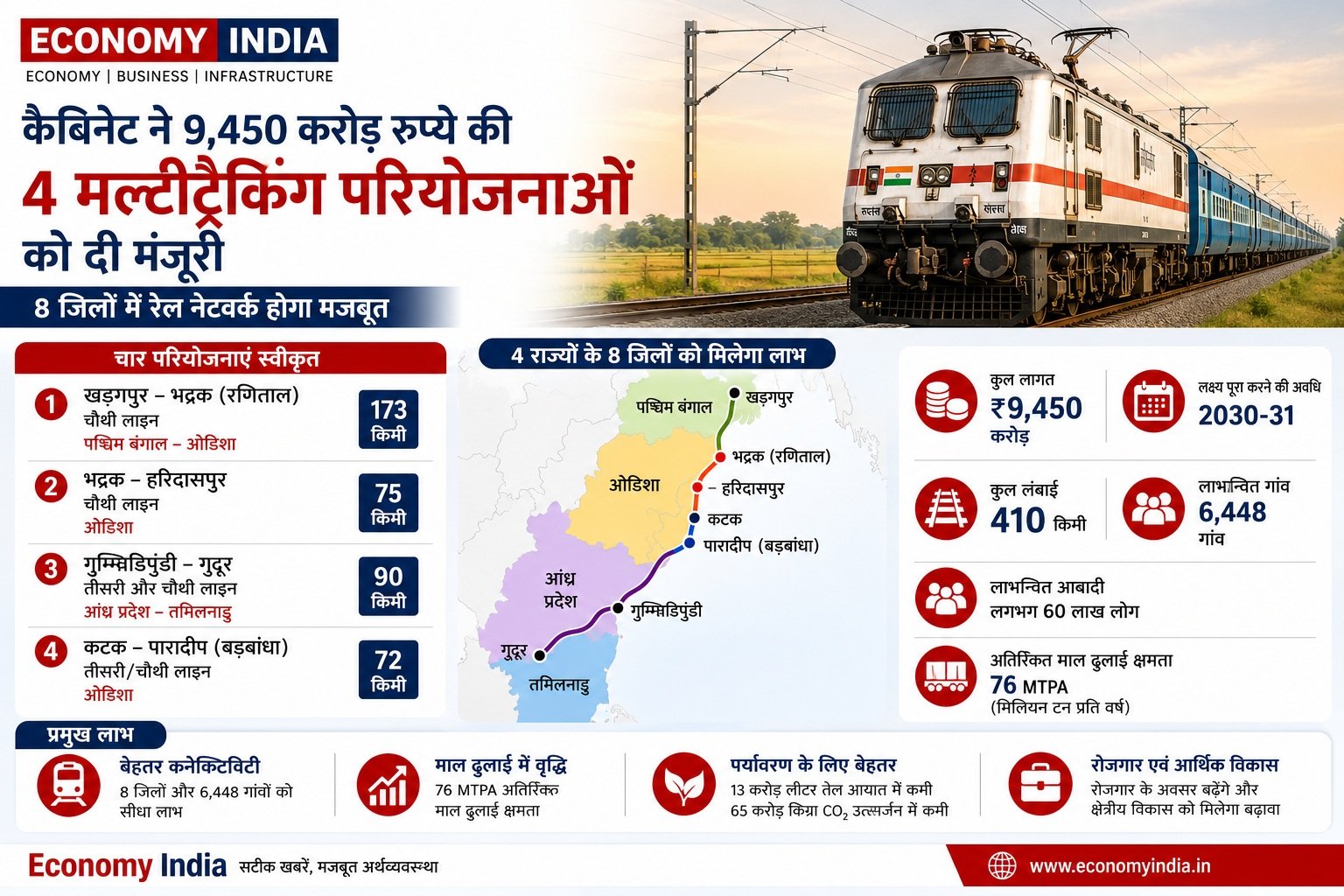
New Delhi (Economy India): The Cabinet Committee on Economic Affairs (CCEA), chaired by Prime Minister Narendra Modi, has approved four major multitracking projects of the Railway Ministry with a combined estimated cost of ₹9,450 crore.
The projects will add approximately 410 km of railway lines across West Bengal, Odisha, Tamil Nadu and Andhra Pradesh and are targeted for completion by 2030-31.
According to the Railway Ministry, the expansion is aimed at increasing rail capacity, reducing congestion, improving operational efficiency and strengthening connectivity for both passengers and freight.

Four Major Railway Projects Approved
The approved projects include the construction of additional railway lines on four important corridors:

| Railway Corridor | State(s) | Length |
|---|---|---|
| Kharagpur–Bhadrak (Ranital) Fourth Line | West Bengal & Odisha | 173 km |
| Bhadrak–Haridaspur Fourth Line | Odisha | 75 km |
| Gummidipundi–Gudur Third & Fourth Lines | Andhra Pradesh & Tamil Nadu | 90 km |
| Cuttack–Paradeep (Badabandha) Third/Fourth Line | Odisha | 72 km |
| Total | 4 States | 410 km |
The projects will substantially increase the capacity of existing railway routes and are expected to improve the movement of trains across some of the country’s important industrial and commercial corridors.
₹9,450 Crore Investment in Rail Infrastructure
The combined investment for the four projects is estimated at approximately ₹9,450 crore.
The projects are scheduled to be completed by 2030-31, according to the government announcement.
The Railway Ministry said increasing line capacity will improve mobility and significantly enhance the operational efficiency and reliability of Indian Railways.
Additional tracks will allow trains to be operated more efficiently while reducing delays caused by congestion on existing routes.
Connectivity to 6,448 Villages
One of the major expected benefits of the projects is improved connectivity for rural and semi-urban areas.
The four projects cover eight districts across the four states and are expected to improve rail connectivity to approximately 6,448 villages.
These villages have a combined population of around 60 lakh people.
Improved railway connectivity could provide residents with better access to employment centres, markets, educational institutions, healthcare facilities and tourism destinations.
Boost to Passenger Mobility
The additional railway lines are expected to improve the movement of passenger trains by creating additional capacity on busy routes.
With greater track availability, railway operations can potentially become more flexible, allowing passenger and freight services to operate with fewer conflicts.
The projects are therefore expected to contribute to better service reliability and smoother train operations.
Major Boost for Freight Transportation
The projects are also strategically important for India’s freight transportation network.
The corridors are used to transport several major commodities, including:
- Coal
- Iron ore
- Cement
- Iron and steel
- Containers
- Automobiles
- Food grains
The Railway Ministry estimates that the capacity enhancement could generate additional freight traffic of approximately 76 million tonnes per annum (MTPA).
This could strengthen the role of railways in India’s logistics network and help shift a greater volume of freight from road to rail.
Lower Logistics Costs
Rail transportation is generally more energy-efficient for large-volume and long-distance freight movement.
By increasing railway capacity on important industrial routes, the projects could help improve logistics efficiency and potentially reduce transportation costs for businesses.
Better rail connectivity can also support faster movement of raw materials and finished goods between industrial centres, ports and markets.
Support for Ports and Industrial Corridors
Several of the approved routes have strategic importance because of their links to industrial areas and ports.
The Cuttack–Paradeep corridor, for instance, strengthens connectivity toward the important Paradeep region, while the other routes support the movement of industrial commodities and goods across eastern and southern India.
Improved rail capacity can help industries transport larger volumes of goods with greater reliability.
Tourism Connectivity to Improve
The Railway Ministry also highlighted the potential tourism benefits of the projects.
The enhanced network is expected to improve connectivity to several prominent tourist and religious destinations.
These include:
- Kuldiha Wildlife Sanctuary
- Bhitarkanika National Park
- Maa Bhadrakali Temple
- Maa Dhamarai Temple
- Panchalingeswar Temple
- Talsari-Udaypur and Chandipur beaches
- Pulicat Lake
- Nelapattu Bird Sanctuary
- Lord Veeraraghava Perumal Temple
- Gada Kujanga Jagannath Temple
- Sarala Temple
- Dhabaleswar Temple
- Lalitgiri Buddhist site
Better rail access to these destinations could support tourism-related businesses and create additional opportunities for local communities.
Employment and Economic Opportunities
The government said the projects are aligned with the broader vision of building a New India and promoting comprehensive regional development.
Large infrastructure projects can generate employment during construction and create longer-term economic opportunities through improved connectivity.
Better access to markets and transportation can also support local businesses, tourism, manufacturing and service-sector activities.
Environmental Benefits
The Railway Ministry has highlighted the environmental advantages of expanding rail transportation.
Railways are considered a relatively energy-efficient and environmentally friendly mode of transport, particularly for bulk freight.
The ministry estimates that the projects could help:
- Reduce oil imports by around 13 crore litres
- Lower CO₂ emissions by approximately 65 crore kg
- Deliver environmental benefits equivalent to planting around 2.60 crore trees
The reduction in fuel consumption could also help lower India’s dependence on imported petroleum.
Strengthening Multimodal Connectivity
The government said the projects have been planned with a focus on multimodal connectivity and logistics efficiency.
Integrated planning and consultation with stakeholders are expected to help create smoother connections for the movement of:
People + Goods + Services
This approach is intended to improve coordination between railways and other modes of transportation and strengthen India’s overall logistics ecosystem.
Four States to Benefit
The projects will cover four major states:
West Bengal, Odisha, Tamil Nadu and Andhra Pradesh.
Odisha will receive a particularly significant share of the infrastructure expansion, with multiple approved corridors located within the state.
The projects are expected to strengthen regional connectivity while supporting industrial and tourism activity.
Key Economic Impact
The ₹9,450-crore investment comes at a time when India is expanding its infrastructure network to support economic growth.
Railway capacity expansion can have a multiplier effect by improving the movement of raw materials, finished goods and passengers.
For industries, greater freight capacity can reduce bottlenecks. For consumers and businesses, better connectivity can improve access to markets and services.
The additional rail capacity could therefore support both economic growth and logistics efficiency over the long term.
Economy India Takeaway
The Cabinet has approved four major railway multitracking projects worth approximately ₹9,450 crore across West Bengal, Odisha, Tamil Nadu and Andhra Pradesh.
The projects will add nearly 410 km of railway lines and are scheduled for completion by 2030-31.
The expansion is expected to benefit approximately 6,448 villages with a combined population of around 60 lakh, while increasing freight capacity by an estimated 76 MTPA.
The projects will also improve connectivity to major industrial, tourist and religious destinations and are expected to reduce logistics pressure on existing railway routes.
According to the Railway Ministry, the infrastructure expansion could also help reduce oil imports by around 13 crore litres and cut CO₂ emissions by approximately 65 crore kg.
Overall, the projects are expected to strengthen India’s railway infrastructure, improve freight and passenger mobility, support regional development and contribute to the country’s broader economic and environmental goals.
(Economy India)