Noida (Economy India): The Uttar Pradesh government is planning a major connectivity upgrade between Greater Noida and the Ganga Expressway, with the proposed road network expected to reduce travel time to around 30–45 minutes.
The Greater Noida Industrial Development Authority (GNIDA) has proposed separating freight and passenger movement in the city and constructing a 105-metre-wide road up to the Hapur bypass, which would provide onward connectivity to the Ganga Expressway.
The proposal was discussed at a meeting chaired by Uttar Pradesh Industrial Development Minister Nand Gopal Gupta in Lucknow on Monday. Additional Chief Secretary, Industrial Development, Alok Kumar, was also present.
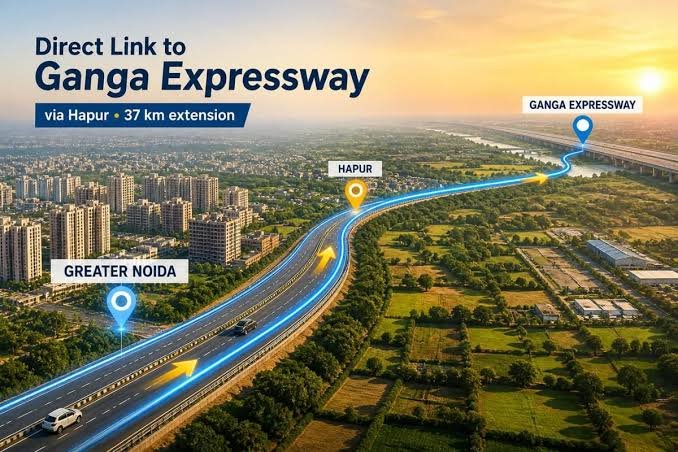
105-Metre-Wide Road to Improve Regional Connectivity
Under the proposal, connectivity from Greater Noida towards the Hapur bypass would be strengthened through the planned 105-metre-wide corridor.

The proposed link is aimed at creating a faster connection between Noida-Greater Noida and the Ganga Expressway. Officials have said that the connectivity could bring the Ganga Expressway within approximately 30 to 45 minutes of Greater Noida.
The project is expected to reduce dependence on congested internal roads and improve movement between Greater Noida and several parts of western Uttar Pradesh.
Earlier in 2026, the Greater Noida authority had approved the extension of a 37-km road towards the Hapur bypass, with a further link planned towards the Ganga Expressway.
Freight and Passenger Traffic to Be Separated
A key component of the proposed plan is the separation of freight and passenger movement within Greater Noida.
The move is aimed at improving traffic management as industrial, logistics and residential activity expands across the region.
Separating heavy freight traffic from passenger movement could help reduce congestion on important urban routes while allowing dedicated corridors to support industrial and logistics operations.
The proposals are part of plans to amend the Greater Noida Master Plan 2041 with a greater focus on efficient freight and passenger mobility.
Six-Lane Elevated Road Proposed for Noida Airport Connectivity
The connectivity plan also includes a proposed six-lane elevated road connecting the Multi Modal Logistics Hub (MMLH) with Noida International Airport in Jewar.
According to the proposal, the elevated road would run parallel to the Western Dedicated Freight Corridor and primarily serve freight movement.
The planned connection is intended to allow goods arriving at the logistics hub to move directly towards the airport’s air-cargo facilities, strengthening the region’s multimodal logistics network.
Boost for Greater Noida’s Logistics and Industrial Potential
The proposed road network could have wider implications for Greater Noida’s industrial and logistics ecosystem.
Greater Noida is emerging as an important manufacturing, warehousing and logistics centre in the National Capital Region. Faster access to the Ganga Expressway, Hapur and western Uttar Pradesh could improve the movement of goods and reduce travel time for businesses.
The Ganga Expressway itself provides a major east-west road corridor across Uttar Pradesh, while the proposed Greater Noida connection would create another important link between the NCR and the expressway network.
Focus on Integrated Infrastructure
The latest proposals indicate a broader shift towards integrated infrastructure planning in Greater Noida, combining road connectivity, logistics hubs, expressways and the airport.
The proposed MMLH-to-airport elevated corridor, along with the Ganga Expressway link, is expected to support more efficient movement of goods and passengers as the region continues to expand.
The projects will, however, require further planning, route alignment, funding arrangements and land-related processes before construction can progress.
Infrastructure Push Could Support Regional Growth
Improved connectivity between Greater Noida and the Ganga Expressway could strengthen economic links between the NCR and western Uttar Pradesh.
For businesses, the proposed network could offer more efficient access to highways and logistics infrastructure. For commuters, the government’s target of reaching the Ganga Expressway in roughly 30–45 minutes could provide an alternative to existing congested routes.
The latest proposals therefore represent an important step in the state’s broader effort to integrate industrial development, logistics infrastructure, passenger mobility and airport connectivity.
(Economy India)