
(Economy India): Foreign borrowing has remained an important part of India’s economic strategy, helping finance infrastructure projects, development programs, and economic growth. However, comparing the amount of foreign debt taken during the tenures of former Prime Minister Dr. Manmohan Singh and Prime Minister Narendra Modi requires careful analysis because India’s total external debt includes borrowings by the government, private companies, banks, and other sectors—not just the central government.
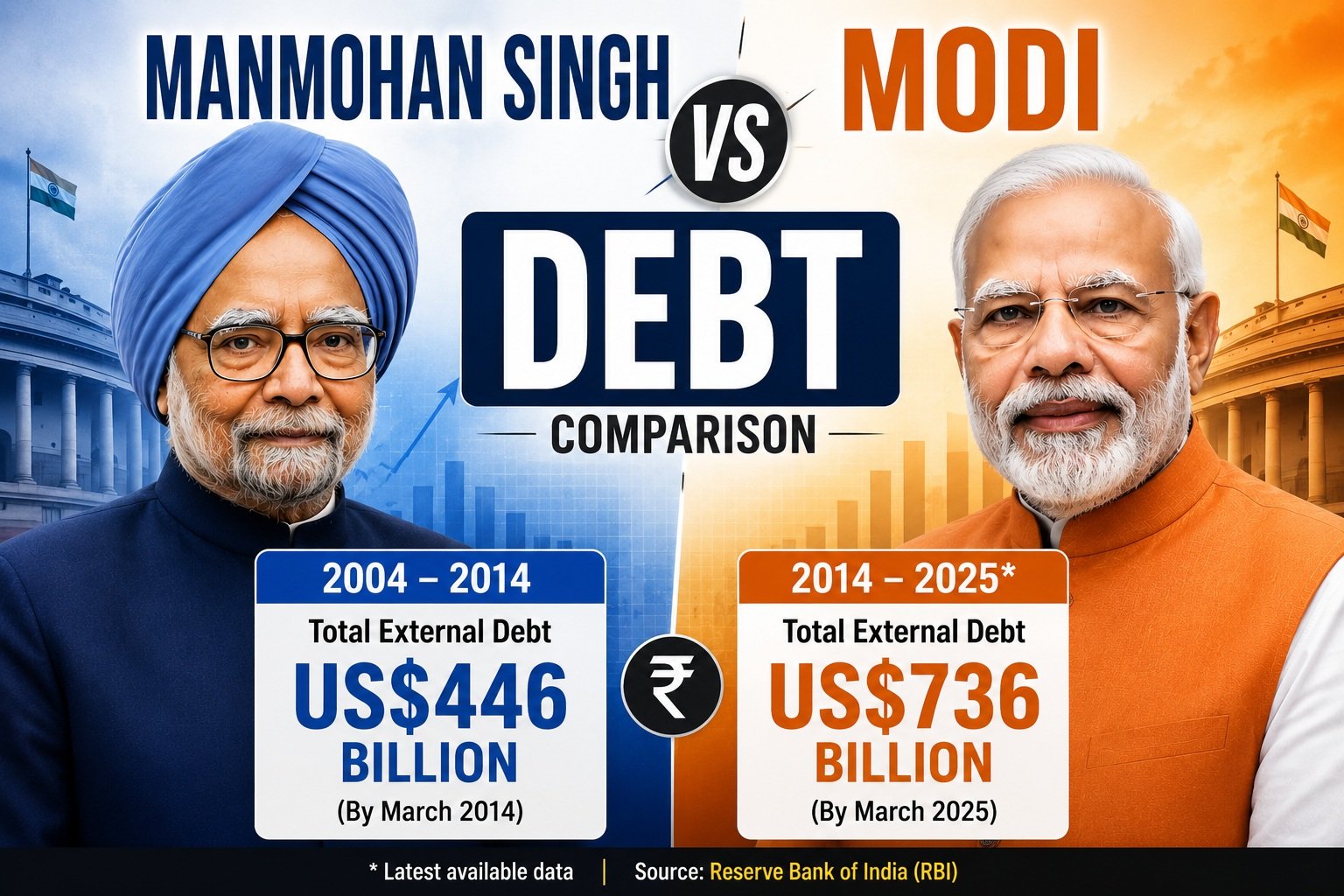
During Dr. Manmohan Singh’s tenure (2004–2014), India’s external debt increased steadily as the economy expanded rapidly. According to Reserve Bank of India (RBI) data, India’s total external debt rose from around US$112 billion in 2004 to approximately US$446 billion by March 2014. The increase was driven by higher infrastructure investment, foreign commercial borrowings, and growing international trade.
Since Narendra Modi took office in 2014, India’s external debt has continued to rise alongside economic growth and increased global financial activity. RBI data shows that India’s total external debt crossed US$736 billion by the end of 2025. The increase reflects higher borrowings by both the public and private sectors, as well as changes in exchange rates and financing needs for development projects.
It is important to note that a rise in external debt does not automatically indicate economic weakness. Economists generally assess debt sustainability by looking at indicators such as the external debt-to-GDP ratio, foreign exchange reserves, and the country’s ability to repay its obligations. India continues to maintain one of the world’s largest foreign exchange reserves, providing a buffer against external financial risks.
Experts also point out that India’s external debt remains moderate compared with many other major economies when measured relative to GDP. The composition of debt, repayment schedules, and foreign exchange reserves are often considered more important than the absolute debt figure.
Overall, both the Manmohan Singh and Narendra Modi governments witnessed increases in India’s external debt, largely reflecting the country’s expanding economy and investment needs. Any direct comparison should therefore be based on official data and economic indicators rather than headline debt figures alone.
(Economy India)