Hike in guideline values sparks political, economic and public backlash across districts; stakeholders warn of rising transaction costs, declining market activity and pressure on farmers and the middle class.
Raipur | Economy India Desk
CHHATTISGARH (Economy India): A significant increase in land guideline rates in Chhattisgarh has ignited a full-fledged political and economic controversy, drawing sharp criticism from citizens, farmers, traders, real estate bodies and political leaders. Senior BJP leader and Member of Parliament Brijmohan Agarwal has emerged as one of the most vocal critics, accusing the state government of acting in “complete confusion” and without any “transparent or data-based process.”
ADVERTISEMENT
According to Agarwal, the sudden revision of guideline rates—used for calculating stamp duty and registration fees—will directly raise land transaction costs across the state, affecting millions of families and thousands of small businesses.
Agarwal Slams the Government: “Decision Taken Without Study, Consultation or Transparency”
In a scathing statement, MP Brijmohan Agarwal said that the government’s move lacked preparation, field study or public consultation. He argued that:
No market valuation analysis was conducted.
No public hearing or stakeholder consultation was held.
No economic or social impact assessment was undertaken.
Agarwal said he had already written a formal letter to Chief Minister Vishnudev Sai, pressing for a reconsideration.
“The government seems utterly confused. This is an ill-prepared and unilateral decision that pushes an additional financial burden on farmers, the middle class and small traders. The land market in several districts is already slow—this hike will worsen the situation,” — Brijmohan Agarwal, MP
Statewide Impact: Farmers, Homebuyers and Small Businesses Under Pressure
Economy India’s assessment shows that the hike in guideline rates could have the following impact:
1. Higher Stamp Duty and Registration Charges
With guideline values rising, the base cost on which stamp duty is charged automatically increases. This will disproportionately affect:
first-time homebuyers,
middle-income families,
small landholders,
and small and mid-size builders.
2. Reduced Land Transactions
Chhattisgarh’s land market has been sluggish for months. Higher guideline rates could further reduce demand, pushing the real estate sector into deeper distress.
3. Rising Financial Stress on Farmers
Farmers looking to sell small parcels of land to manage financial needs may find fewer buyers due to increased transaction costs. Many rural regions have already reported slower land movement.
4. Uncertainty in Rural and Semi-Urban Markets
Economists warn that arbitrary increases in guideline values often create valuation mismatches, resulting in stalled deals, disputes and compliance pressures.
Demand for High-Level Committee to Reassess Rates
To address these concerns, Agarwal has recommended forming a high-level expert committee that includes:
Senior officials from the Revenue Department
Real Estate and Builders’ Association representatives
Farmer organisations and cooperatives
Valuation experts and economists
The committee, he said, should reassess guideline rates based on:
actual market value trends,
district-wise land demand,
socio-economic impact,
and public representation.
He stressed that such a consultative approach would build trust and ensure fairness.
What Agarwal Wrote in His Letter to CM Vishnudev Sai
In his letter to the CM, a copy of which is reviewed by Economy India, Agarwal warned that the new guideline rates:
were introduced without proper evaluation,
ignore ground realities of rural and urban land economies,
violate principles of Ease of Living and Ease of Doing Business,
and could lead to statewide dissatisfaction.
He called the steep hike a “direct blow to the state’s economic backbone.”
The letter also highlights that farmers, micro-entrepreneurs, small realtors and investors have expressed strong objections, calling the hike “neither practical nor justified.”
Public and Political Reactions Intensify Across Districts
Citizens’ Protests
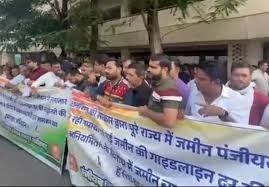
Multiple districts have reported protests by:
small traders,
land buyers and sellers,
real estate agents,
and farmer unions.
Memorandums have been submitted to district collectors seeking immediate rollback.
Real Estate Concerns
Local developers warn that the hike will hurt housing affordability and stall new projects, especially in Tier-2 and Tier-3 towns such as:
Bilaspur
Durg
Rajnandgaon
Raigarh
Korba
Mahasamund
Industry bodies expect a 10–20% drop in transactions if the new rates remain unchanged.
The political opposition has seized the moment to intensify pressure on the government.
Congress
The Chhattisgarh Congress held a press conference on 3 December alleging that the government’s decision was “anti-people and anti-farmer.” They have threatened a mass agitation if the hike is not rolled back immediately.
AAP
The Aam Aadmi Party also staged demonstrations, burning effigies of state leaders and criticising the government for “failing to understand ground reality.”
Both parties have demanded an immediate suspension of the revised guideline values.
Government Silent, Stakeholders Await Clarity
As of now, the state government has not issued a detailed defence of the rate hike or clarified the methodology used for valuation. Revenue officials maintain that guideline revisions are “routine administrative processes,” but political temperature continues to rise.
Stakeholders across sectors await the next step—whether the government will initiate consultations or stick to its current position.
A Policy Decision with Major Economic Ripples
The sudden hike in land guideline rates in Chhattisgarh has quickly turned into a major policy flashpoint.
Economy India analysis concludes that:
The decision has wide economic implications.
Lack of consultation has amplified public distrust.
Farmers, middle-class families and small businesses face increased financial pressure.
Political pressure is mounting daily.
A high-level review committee may be the most practical next step.
All eyes are now on the state government as calls for reconsideration continue to escalate.
Economy India is one of the largest media on the Indian economy. It provides updates on economy, business and corporates and allied affairs of the Indian economy. It features news, views, interviews, articles on various subject matters related to the economy and business world.