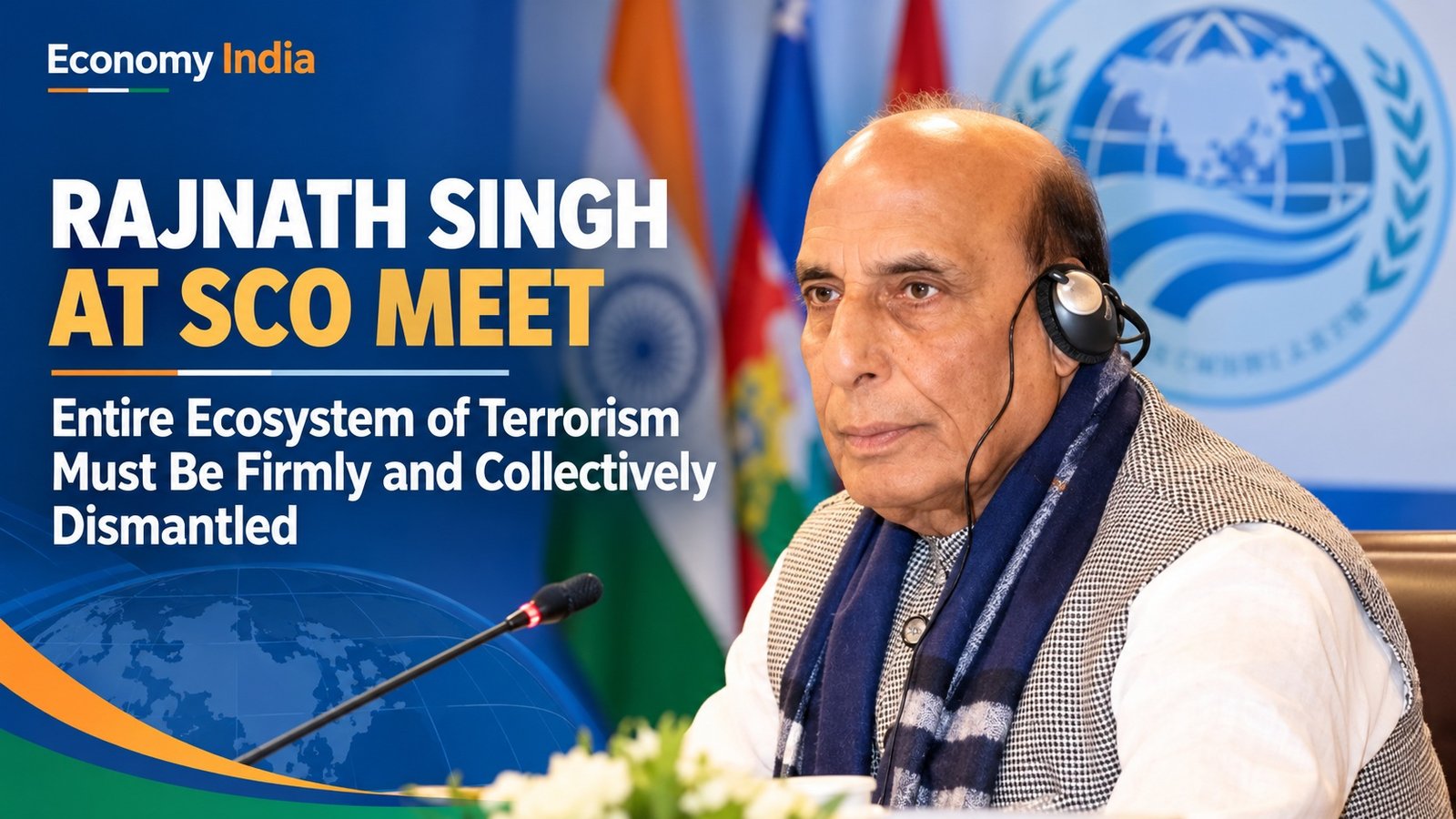
At the SCO Council of Heads of Government meeting in Dushanbe, India’s Defence Minister calls for zero tolerance towards terrorism, terror financing and safe havens while backing a stronger regional trade and economic cooperation framework.
DUSHANBE, (Economy India): Defence Minister Rajnath Singh on Tuesday called for the firm and collective dismantling of the entire ecosystem of terrorism, asserting that there can be no justification for terrorism and no double standards in dealing with the threat.
Addressing the Council of Heads of Government (CHG) meeting of the Shanghai Cooperation Organisation (SCO) in Dushanbe, Tajikistan, Singh stressed that those who finance, support or provide safe havens to terrorists must be held accountable.
His remarks underlined India’s position that counterterrorism efforts must extend beyond eliminating terrorist operatives to addressing the wider networks that sustain extremist activities.

Pakistan’s Deputy Prime Minister Ishaq Dar was also present at the gathering when Singh delivered his remarks.
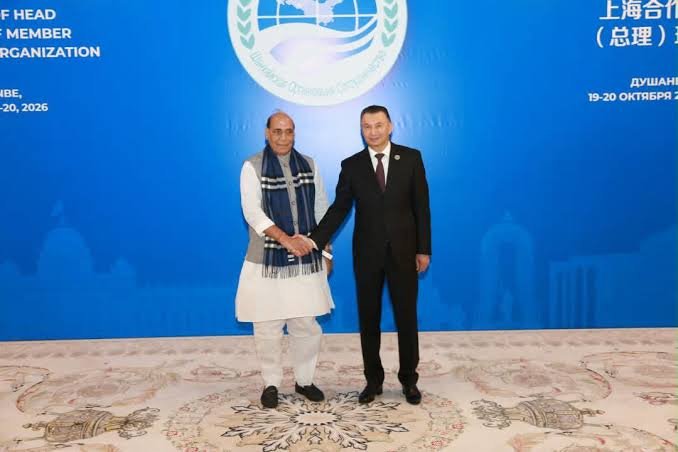
Rajnath Singh Calls for Collective Action Against Terrorism
Describing terrorism as one of the most serious threats to peace and development, Singh said its consequences extend far beyond the immediate loss of innocent lives. Terrorist activities also undermine economic confidence, disrupt commerce and discourage investment.
He warned that terrorism radicalises societies and deprives young people of opportunities essential for their future.
“There can be no justification for terrorism; there can be no double standards in dealing with it,” Singh said, reiterating the need for a consistent and coordinated international response.
“There can be no place for those who provide terrorists with finance, support, or safe havens. The entire ecosystem of terrorism must be firmly and collectively dismantled,” he added.
The Defence Minister’s statement reinforced India’s longstanding demand for stronger international cooperation against terrorism, including action against its financial networks, logistical support systems and entities that provide shelter to terrorist groups.
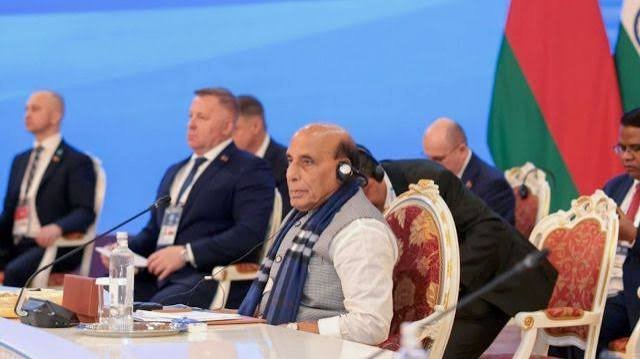
India Signals Strong Response to Terror Threats
Singh’s remarks at the SCO meeting came days after he stated in New Delhi on October 15 that any future terrorist act originating from Pakistan would invite an even stronger response from India.
He had also highlighted the performance of Indian security forces in tackling terrorism, saying that since 2014, the “shelf life” of most terrorists had fallen to less than a year, as security personnel neutralised many of them within a year of their taking up arms against India.
The statements reflect the government’s emphasis on a firm security response alongside efforts to prevent radicalisation and disrupt the support structures that enable terrorist activities.
India Backs SCO Economic Cooperation Plan for 2026–2030
Alongside security concerns, Singh highlighted India’s support for the adoption of the Action Plan for 2026–2030 under the SCO Programme for Multilateral Trade and Economic Cooperation.
He called for stronger regional economic engagement that benefits all member countries and promotes inclusive growth.
“India believes that our economic engagement, along with being inclusive, should be beneficial for each member country. We should work towards building more resilient supply chains, facilitating trade and investment, and using technology for development,” Singh said.
The proposed action plan is intended to strengthen economic engagement among SCO member states by expanding trade, encouraging investment and improving cooperation across key economic sectors.
Singh’s remarks also highlighted the importance of resilient supply chains and technology-driven development at a time when geopolitical tensions and disruptions in global commerce have increased the need for dependable regional economic partnerships.
SCO Programme Focuses on Trade, Investment and Development
The SCO Programme for Multilateral Trade and Economic Cooperation seeks to promote comprehensive development of trade, economic and investment relations among member countries.
Its objectives include creating transparent, predictable and stable conditions for economic engagement, strengthening sectoral cooperation, increasing mutual trade volumes and expanding investment opportunities.
The proposed Action Plan for 2026–2030 is expected to provide a framework for implementing these objectives and advancing practical cooperation among participating countries.
On February 25, 2026, experts from SCO member states met to discuss the draft action plan for the next five-year period.
India’s support for the initiative reflects its interest in strengthening economic connectivity, diversifying supply chains and creating greater opportunities for trade and investment across the region.
India Welcomes Permanent Status for SCO Centres
Singh also welcomed decisions taken in Bishkek to make the Universal Centre in Tashkent and the Anti-Drug Centre in Dushanbe permanent bodies of the SCO.
The move is aimed at strengthening the organisation’s institutional framework and supporting cooperation in areas of shared regional interest.
The anti-drug cooperation mechanism is particularly relevant to efforts to address drug trafficking and related cross-border challenges, while the establishment of permanent institutional structures can help improve coordination among member states.
Security and Economic Cooperation Remain Key SCO Priorities
Singh’s address in Dushanbe placed counterterrorism and regional economic cooperation at the centre of India’s engagement with the SCO.
India called for a united response against terrorism, including action against those who finance, support or shelter terrorist groups. At the same time, it backed stronger economic cooperation through trade facilitation, investment promotion, resilient supply chains and technology-led development.
The two priorities underline India’s broader approach to regional engagement: strengthening collective security while pursuing inclusive economic growth that delivers tangible benefits to the people of SCO member countries.
(Economy India)