
58.77 Crore Jan Dhan Accounts Hold Deposits of ₹3.12 Lakh Crore; Government and RBI Step Up Cyber Security Measures for Digital Payments
New Delhi (Economy India): India has achieved near-universal banking coverage, with 99.92% of inhabited villages now having access to banking services within a 5-kilometre radius, marking a major milestone in the country’s financial inclusion journey.
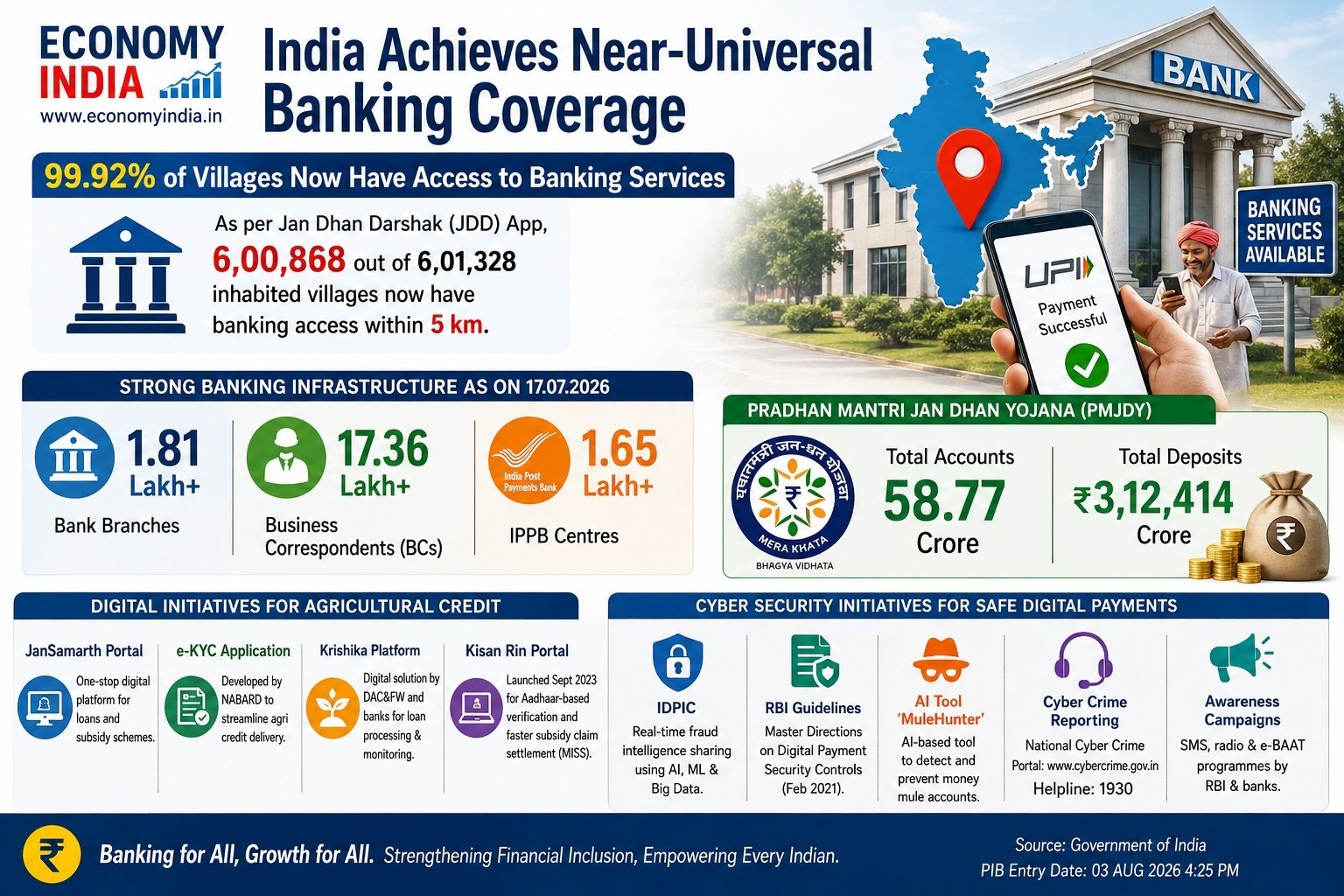
The Ministry of Finance informed Parliament that, according to data uploaded on the Jan Dhan Darshak (JDD) App, 6,00,868 out of 6,01,328 inhabited villages have access to a banking outlet, including bank branches, Business Correspondents (BCs), or India Post Payments Bank (IPPB) centres.
The information was shared by Minister of State for Finance Pankaj Chaudhary in a written reply in the Lok Sabha.

Robust Banking Infrastructure
As of July 17, 2026, India’s banking outreach is supported by an extensive network comprising:
- 1.81 lakh+ Bank Branches
- 17.36 lakh Business Correspondents (BCs)
- 1.65 lakh India Post Payments Bank (IPPB) Centres
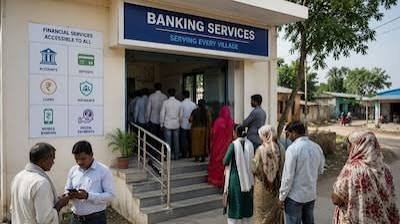
This vast infrastructure has significantly expanded banking accessibility, particularly in rural and remote regions.

Government’s Financial Inclusion Strategy
The Government aims to ensure that every inhabited village has a banking touchpoint within a five-kilometre radius.
To accelerate expansion, the Reserve Bank of India (RBI) has permitted commercial banks, small finance banks, payment banks, local area banks, and regional rural banks to open branches anywhere in the country without prior approval, provided that 25% of new branches are opened in unbanked rural centres.
The RBI also stated that opening banking outlets in underserved areas remains a continuous process, monitored by State Level Bankers’ Committees (SLBCs) and Union Territory Level Bankers’ Committees (UTLBCs) in coordination with state governments and financial institutions.
Jan Dhan Accounts Cross 58.77 Crore
India’s flagship Pradhan Mantri Jan Dhan Yojana (PMJDY) continues to strengthen financial inclusion.
As of July 17, 2026:
- Total PMJDY Accounts: 58.77 crore
- Total Deposits: ₹3,12,414 crore
The scheme has become one of the world’s largest financial inclusion programmes, enabling millions of citizens to access banking services, direct benefit transfers, insurance, pension schemes, and digital payments.
Digital Initiatives Boost Agricultural Credit
The Government has also introduced several digital platforms to improve transparency and efficiency in agricultural lending.
JanSamarth Portal
The JanSamarth Portal serves as a unified digital platform connecting government credit-linked schemes and subsidies. It enables faster loan approvals through digital assessment of applicants.
NABARD e-KYC Application
NABARD has developed an e-KYC application to streamline agricultural credit delivery.

Krishika Platform
The Department of Agriculture & Farmers Welfare has introduced Krishika, while banks have also launched similar digital applications to simplify beneficiary identification, loan processing, and monitoring.
Kisan Rin Portal
Launched in September 2023, the Kisan Rin Portal (KRP) facilitates Aadhaar-based beneficiary verification and enables faster digital settlement of interest subsidy claims under the Modified Interest Subvention Scheme (MISS) for Kisan Credit Card loans.
Stronger Cyber Security for Digital Payments
With digital transactions growing rapidly, the Government and RBI have intensified efforts to strengthen cyber security and prevent financial fraud.
India Digital Payment Intelligence Corporation (IDPIC)
The Government, in consultation with the RBI, has established the India Digital Payment Intelligence Corporation (IDPIC).
The platform uses:
- Artificial Intelligence (AI)
- Machine Learning (ML)
- Big Data Analytics
to share real-time fraud alerts and intelligence with banks and financial institutions.
RBI’s Digital Payment Security Framework
The RBI has implemented Master Directions on Digital Payment Security Controls, requiring banks to maintain minimum security standards across:
- Internet Banking
- Mobile Banking
- Card Payments
- Digital Payment Platforms
AI-Based ‘MuleHunter’
To combat money mule accounts, the RBI has introduced ‘MuleHunter’, an AI-powered solution that helps banks identify suspicious accounts used for fraudulent transactions.
Cyber Crime Reporting Strengthened
The Indian Cyber Crime Coordination Centre (I4C) under the Ministry of Home Affairs is actively monitoring illegal digital lending applications.
Citizens can report cyber fraud through:
- National Cyber Crime Reporting Portal
- Cyber Helpline: 1930
Authorities continue to conduct awareness campaigns through SMS, radio, and public outreach initiatives. The RBI also organises Electronic Banking Awareness and Training (e-BAAT) programmes to educate customers about digital payment safety.
Why It Matters
The achievement of 99.92% banking coverage reflects India’s continued progress towards financial inclusion, ensuring that banking services are accessible to nearly every village in the country.
Coupled with the rapid growth of Jan Dhan accounts, expanding digital infrastructure, and stronger cyber security measures, the initiative is expected to further deepen financial inclusion, support rural economic development, and strengthen India’s digital economy.