
New Delhi Summons US Charge d’Affaires, Condemns Attack on Civilian Shipping in West Asia
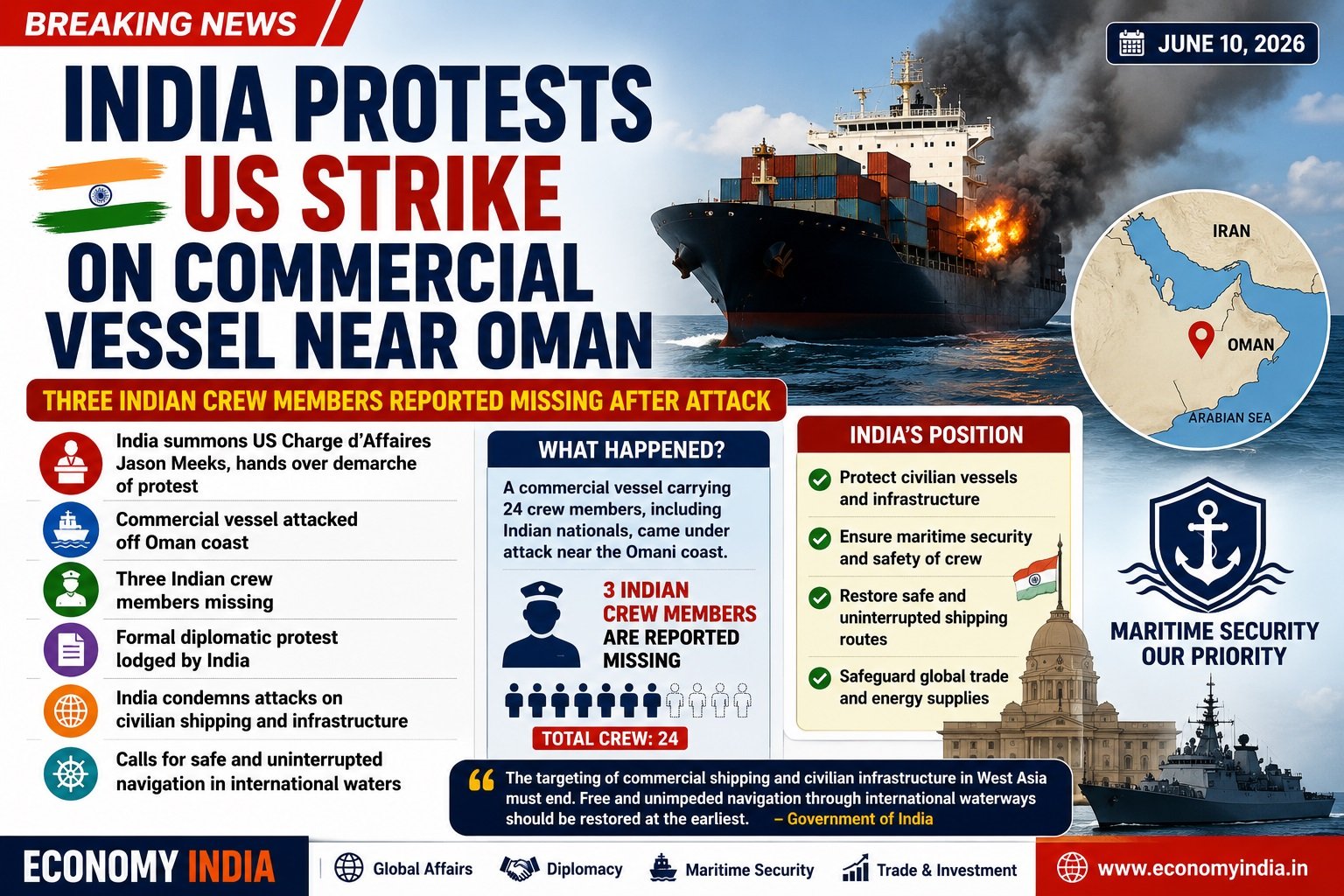
New Delhi (Economy India): India on Wednesday strongly protested a US military strike on a commercial vessel off the coast of Oman that reportedly left three Indian crew members missing, escalating diplomatic concerns over the safety of civilian maritime traffic in the conflict-hit West Asia region.
In response to the incident, the Ministry of External Affairs (MEA) summoned US Charge d’Affaires Jason Meeks and handed over a formal diplomatic protest, known as a demarche, expressing India’s deep concern over the attack and its impact on Indian nationals working aboard the vessel.
The development comes amid growing instability in the Middle East and increasing risks to commercial shipping routes that are vital for global trade and energy supplies.
Three Indian Crew Members Missing
According to official sources, the commercial vessel was carrying a crew of 24 members, including several Indian nationals, when it came under attack near the Omani coast.

The strike has reportedly left three Indian crew members missing, prompting Indian authorities to launch efforts to ascertain their status and ensure the safety of all affected personnel.
Government agencies are closely coordinating with relevant international authorities and maritime organizations to gather information about the incident.
India Lodges Strong Diplomatic Protest
Sources indicated that the Indian government conveyed its concerns directly to the US diplomatic mission in New Delhi.
The demarche handed to Charge d’Affaires Jason Meeks reflects India’s serious view of the incident and underscores the importance of protecting civilian lives and commercial assets operating in international waters.
Diplomatic officials stated that India expects accountability and clarity regarding the circumstances surrounding the strike.
New Delhi Condemns Attack on Commercial Shipping
In its official response, India strongly condemned the targeting of commercial shipping and civilian infrastructure in West Asia.
The government emphasized that merchant vessels operating in international waters must remain protected under international maritime norms and laws.
New Delhi reiterated that attacks on civilian maritime assets not only endanger lives but also threaten global trade, supply chains, and regional stability.
Call for Restoration of Safe Navigation
India urged all parties involved in the regional conflict to exercise restraint and ensure the immediate restoration of safe and uninterrupted navigation through international waterways.
The government highlighted the importance of keeping major maritime corridors open, particularly in a region that handles a significant share of global oil and cargo shipments.
Officials stressed that freedom of navigation remains essential for international commerce and global economic stability.
Growing Concerns Over Maritime Security
The incident has renewed concerns about maritime security in the Gulf region, where rising geopolitical tensions have increasingly affected commercial shipping operations.
Shipping companies and global energy markets have been closely monitoring developments in the area, especially around key routes connecting Asia, Europe, and the Middle East.
Any prolonged disruption to these shipping lanes could have significant implications for global trade flows, energy supplies, and freight costs.
Impact on India
India has substantial economic and strategic interests in the Gulf region, including energy imports, trade routes, and a large expatriate workforce.
Thousands of Indian seafarers serve on international merchant vessels, making maritime security a critical concern for the government.
The latest incident is expected to intensify discussions on the protection of civilian shipping and the safety of Indian nationals working in conflict-prone regions.
(Economy India)