
Rising SDL yields reflect global geopolitical shocks, inflation risks, and tightening financial conditions impacting India’s fiscal stability
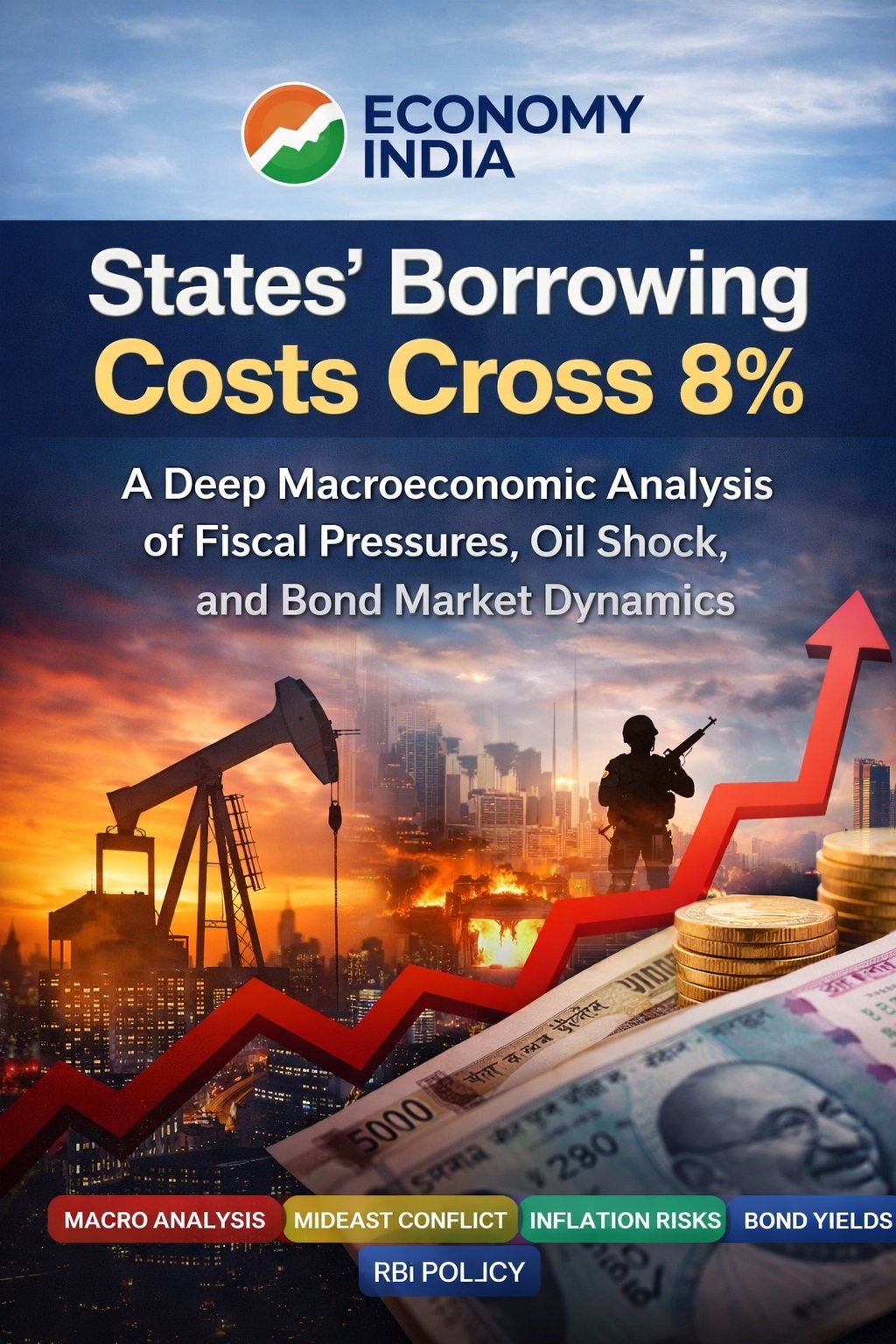
New Delhi/Mumbai (Economy India): India’s financial markets are witnessing a renewed phase of stress as borrowing costs for states have surged past the 8% mark in recent auctions of State Development Loans (SDLs). According to data released by the Reserve Bank of India, yields across long-term state bonds have risen sharply, with increases ranging between 0.15% and 0.30% in a single auction cycle.
This spike is closely linked to escalating geopolitical tensions in West Asia, which have driven global crude oil prices higher and triggered volatility in sovereign bond markets worldwide.
The immediate implication is clear: India’s subnational governments—key drivers of infrastructure spending and welfare schemes—are now facing significantly higher borrowing costs at a time when economic momentum remains sensitive to global developments.

E – Economic Impact: Rising Yields and Fiscal Pressure
The rise in SDL yields is not merely a technical adjustment in financial markets—it has far-reaching economic consequences.
1. Direct Impact on State Finances
States rely heavily on market borrowings to fund their expenditures. With yields crossing 8%:
- Interest payments will rise substantially
- Debt servicing costs will consume a larger share of budgets
- Fiscal deficits may widen beyond targeted levels
This creates a difficult trade-off between maintaining fiscal discipline and sustaining development spending.
2. Capital Expenditure Under Pressure
Capital expenditure (capex) is critical for economic growth, particularly in infrastructure.
However, higher borrowing costs may force states to:
- Delay infrastructure projects
- Scale down investment plans
- Reallocate funds toward interest payments
This could slow down the pace of economic expansion, especially in sectors like construction, logistics, and urban development.
3. Inflationary Spillover Effects
Rising oil prices—one of the primary triggers of the current situation—have a direct impact on inflation.
Higher borrowing costs further compound inflationary pressures by:
- Increasing the cost of public spending
- Raising financing costs across sectors
- Contributing to overall price rigidity
P – Policy Dynamics: RBI’s Balancing Act and Fiscal Constraints
The evolving situation presents a complex policy challenge for the Reserve Bank of India and government authorities.
1. Monetary Policy Constraints
The RBI faces a classic dilemma:
- Control inflation driven by oil price shocks
- Support growth amid tightening financial conditions
Possible policy responses include:
- Liquidity management through open market operations (OMOs)
- Yield curve stabilization measures
- Maintaining a cautious stance on interest rates
However, aggressive intervention could have unintended consequences, including market distortions.
2. Fiscal Policy Challenges
State governments must navigate:
- Rising borrowing costs
- Limited revenue growth
- Increasing expenditure commitments
This may lead to:
- Tighter fiscal policies
- Rationalization of subsidies
- Enhanced focus on revenue mobilization
3. Coordination Between Centre and States
The situation underscores the importance of fiscal coordination between central and state governments.
Potential measures include:
- Enhanced fiscal transfers
- Policy support for infrastructure financing
- Coordinated borrowing strategies
A – Analysis: Structural Vulnerabilities and Market Dynamics
The current episode highlights deeper structural issues within India’s macroeconomic framework.
1. Dependence on Oil Imports
India’s heavy reliance on imported crude oil makes it vulnerable to global shocks.
When oil prices rise:
- Current account deficit widens
- Inflation increases
- Fiscal pressures intensify
Reducing this dependence is critical for long-term stability.
2. Sensitivity of Bond Markets
The rapid rise in yields reflects:
- High sensitivity to global events
- Limited depth in domestic bond markets
- Dependence on institutional investors
Strengthening market depth and liquidity could help reduce volatility.
3. Crowding Out of Private Investment
Higher government borrowing costs can crowd out private sector investment.
Mechanism:
- Government borrows at higher rates
- Financial institutions prefer safer government securities
- Private borrowers face higher interest rates
This could dampen industrial growth and entrepreneurship.
4. Risk Premium and Investor Sentiment
Investors are demanding higher yields due to:
- Increased geopolitical risk
- Inflation uncertainty
- Market volatility
This reflects a broader shift toward risk aversion in global financial markets.
L – Long-Term Outlook: Navigating Uncertainty and Building Resilience
While the current spike in borrowing costs presents immediate challenges, it also offers insights into the future trajectory of India’s economy.
1. Short-Term Outlook
- Continued volatility in bond markets
- Elevated borrowing costs for states
- Close monitoring by policymakers
The situation will largely depend on developments in global oil markets and geopolitical stability.
2. Medium-Term Outlook
If global tensions ease:
- Oil prices may stabilize
- Inflation pressures could moderate
- Bond yields may gradually decline
This would provide relief to state finances and support economic recovery.
3. Long-Term Structural Reforms
To enhance resilience, India must focus on:
a. Energy Security
- Diversification of energy sources
- Increased use of renewables
- Strategic oil reserves
b. Fiscal Discipline
- Strengthening fiscal frameworks
- Improving revenue collection
- Rationalizing expenditure
c. Financial Market Development
- Deepening bond markets
- Encouraging retail participation
- Enhancing transparency and liquidity
Global Context: India in a Volatile World
The current developments must be viewed within the broader global context.
Key Global Trends:
- Rising geopolitical tensions
- Fragmentation of global supply chains
- Tightening monetary policies worldwide
India’s relatively strong macroeconomic fundamentals provide a buffer, but external shocks remain a significant risk.
Economy India Insight
The surge in state borrowing costs above 8% is more than a market event—it is a reflection of the intricate interplay between global geopolitics and domestic economic realities.
While the immediate trigger lies in West Asia’s instability, the broader lesson is clear: economic resilience requires structural strength, policy agility, and strategic foresight.
India’s macroeconomic landscape is at a critical juncture. The rise in SDL yields underscores the challenges of navigating a volatile global environment while maintaining domestic growth momentum.
For policymakers, the task ahead is to strike a delicate balance between:
- Containing inflation
- Supporting growth
- Maintaining fiscal discipline
For states, the focus must be on prudent financial management and efficient resource allocation.
Ultimately, how India responds to this phase will shape not only its short-term economic trajectory but also its long-term position in an increasingly uncertain global economy.
(Economy India)