
‘Jal Sanrakshit Haryana’ Programme to Cover Nearly 49 Lakh Acres Across the State Between 2026 and 2032
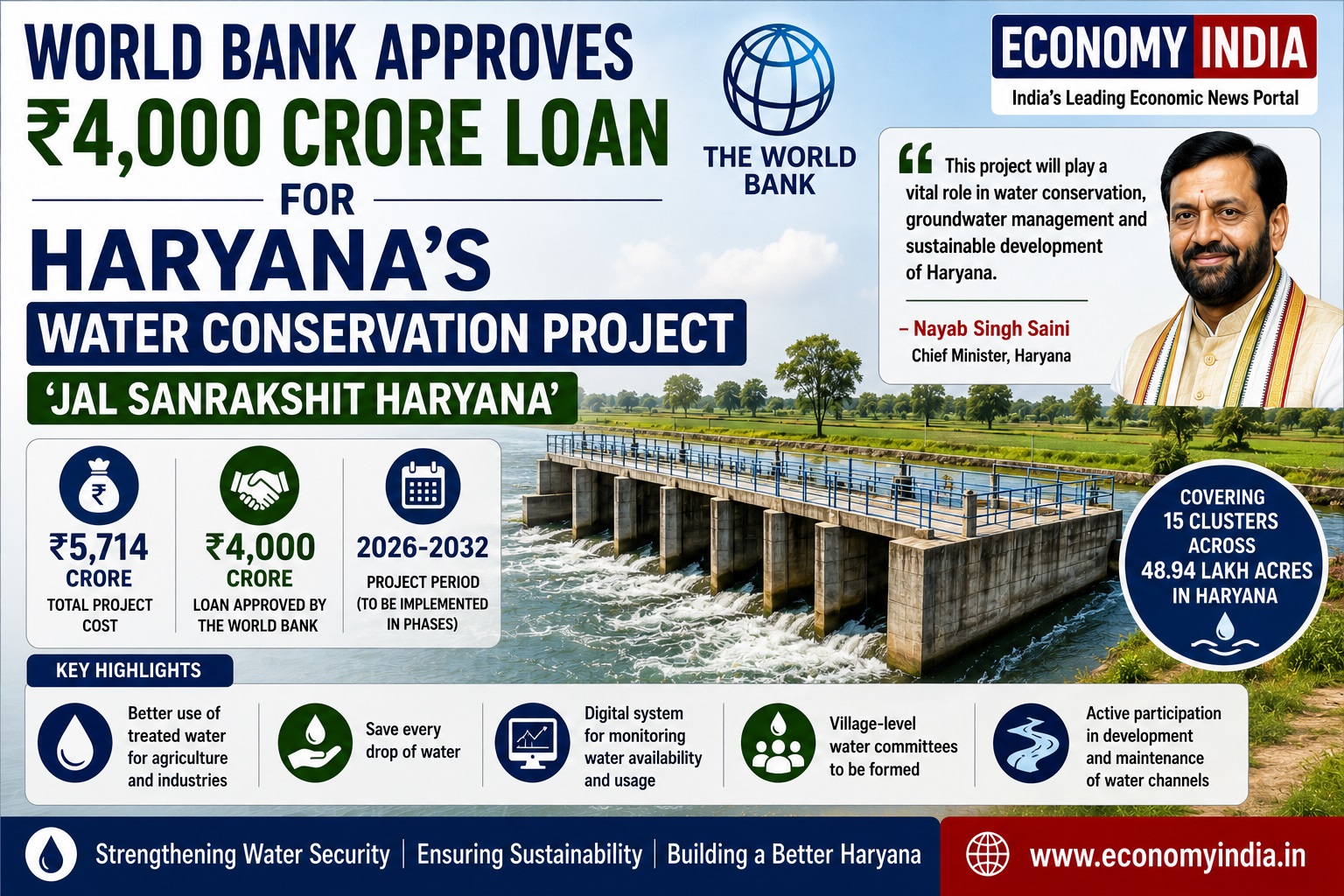
Chandigarh (Economy India): In a major boost to Haryana’s long-term water conservation and sustainable resource management efforts, the World Bank has approved a loan of ₹4,000 crore for the state government’s ambitious ‘Jal Sanrakshit Haryana’ project.
Haryana Chief Minister Nayab Singh Saini announced the development on Saturday and said the project would play a crucial role in improving water security, promoting efficient water use, and strengthening groundwater conservation across the state.
The total cost of the project has been estimated at ₹5,714 crore and it will be implemented in phases between 2026 and 2032.
Large-Scale Water Conservation Initiative
The ‘Jal Sanrakshit Haryana’ programme aims to address growing concerns over declining groundwater levels, increasing water demand, and sustainable water management.

According to officials, the project will cover 15 clusters spread across approximately 48.94 lakh acres throughout Haryana. The initiative is expected to benefit agricultural areas, rural communities, and urban regions by promoting efficient water use and improving water availability.
The state government believes the project will significantly strengthen Haryana’s water infrastructure and ensure long-term sustainability.

World Bank Support
The World Bank’s approval of the ₹4,000 crore loan represents one of the largest international financial supports for a state-level water conservation programme in India.
Officials said the funding will help accelerate infrastructure development, water resource management initiatives, and technology-based monitoring systems.
The remaining project cost will be borne by the state government and other institutional sources.
Chief Minister Reviews Progress
During a review meeting with senior government officials, Chief Minister Nayab Singh Saini directed various departments to prepare a comprehensive water management strategy and ensure its effective implementation at the grassroots level.
He emphasized the need for coordinated action among different departments to maximize the impact of the programme.
The Chief Minister said that water conservation must become a public movement involving government agencies, local institutions, and communities.
Focus on Treated Water and Technology
Saini stressed the importance of increasing the use of treated wastewater for various purposes, particularly in agriculture and industrial applications.
He also highlighted the need to save every drop of water and directed officials to develop a digital monitoring system to track water availability, consumption patterns, and resource utilization across the state.
The proposed digital platform is expected to improve transparency, support data-driven decision-making, and strengthen water management practices.
Village-Level Water Committees
As part of the project, village-level water committees will be established to encourage community participation in water conservation activities.
These committees will actively participate in the development, maintenance, and management of local water channels and related infrastructure.
Officials believe that involving local communities will improve accountability and ensure the long-term sustainability of water conservation efforts.
Addressing Groundwater Challenges
Haryana has witnessed significant pressure on groundwater resources due to intensive agricultural activities, rapid urbanization, and rising water demand.
Experts have repeatedly highlighted the need for efficient irrigation practices, water recycling, and conservation measures to prevent further depletion of groundwater reserves.
The new programme seeks to address these challenges through integrated water management and sustainable resource planning.
Boost for Sustainable Development
The ‘Jal Sanrakshit Haryana’ project aligns with broader national goals related to water conservation, climate resilience, and sustainable development.
The initiative is expected to improve water availability, support agricultural productivity, strengthen rural livelihoods, and enhance environmental sustainability.
With substantial financial support from the World Bank and active participation from local communities, Haryana aims to create a long-term framework for effective water management and resource conservation.
The project is expected to emerge as one of India’s largest state-level water conservation programmes in the coming years.
(Economy India)


