New rural employment framework shifts focus from a rights-based guarantee to a mission-driven model, triggering debate over centralisation, local autonomy and livelihood security
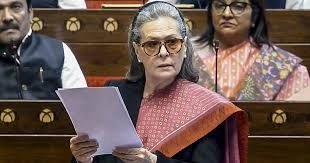
New Delhi (Economy India): Congress leader and Rajya Sabha MP Sonia Gandhi has strongly criticised the government’s newly passed Viksit Bharat Guarantee for Employment and Livelihood Mission (Rural) Bill (VB–G Ram G), alleging that it undermines the rights-based framework of the Mahatma Gandhi National Rural Employment Guarantee Act (MGNREGA) and centralises decision-making on rural employment.

Her remarks come just two days after Parliament cleared the bill amid intense opposition protests in both the Lok Sabha and the Rajya Sabha. The government, however, maintains that the new law aims to modernise rural employment by linking it more closely with livelihood creation, skills and productivity, rather than limiting it to wage-based work.
Sonia Gandhi’s Criticism: ‘A Bulldozer on MGNREGA’
In a video message released on Friday, Sonia Gandhi said the government had effectively “run a bulldozer” over MGNREGA, a scheme she described as a historic milestone in India’s social welfare architecture.
“Now it will be decided in Delhi who will get work, how much work they will get and where they will get it—far removed from ground realities,” she said.
Recalling the passage of MGNREGA nearly two decades ago during the UPA government led by then Prime Minister Manmohan Singh, Gandhi said the law was passed with broad political consensus and provided a legal guarantee of employment to rural households, especially the poorest and most marginalised.
She argued that the new VB–G Ram G law dilutes this guarantee and weakens the role of Gram Panchayats, which were central to MGNREGA’s decentralised and demand-driven design.

MGNREGA vs VB–G Ram G: Key Differences Explained
| Parameter | MGNREGA (2005 Act) | VB–G Ram G (New Law) |
|---|---|---|
| Full Name | Mahatma Gandhi National Rural Employment Guarantee Act | Viksit Bharat Guarantee for Employment & Livelihood Mission (Rural) |
| Nature of Scheme | Rights-based employment guarantee | Mission-based employment & livelihood framework |
| Legal Guarantee | 100 days of wage employment per rural household | Employment tied to mission objectives; guarantee structure debated |
| Decision-Making | Demand-driven, bottom-up | More centrally planned, outcome-driven |
| Role of Panchayats | Central role in planning & execution | Reduced or redefined role (as per opposition concerns) |
| Who Decides Work | Households demand work locally | Centre/state frameworks guide allocation |
| Focus of Employment | Unskilled manual work | Employment + skills + livelihood creation |
| Asset Creation | Local, basic infrastructure assets | Productive, durable assets emphasised |
| Flexibility During Crisis | High (expanded rapidly during COVID-19) | Yet to be tested |
| Transparency Tools | Social audits, muster rolls | Technology-driven monitoring & data systems |
| Fiscal Structure | Open-ended demand-based spending | More budget-controlled, mission-linked |
| Women’s Participation | High (40–50% on average) | Depends on design & implementation |
| Migration Impact | Reduced distress migration | Govt says long-term livelihood focus will curb migration |
| Name & Legacy | Linked to Mahatma Gandhi | Gandhi’s name removed; politically contested |
| Criticism | Leakages, delays, low asset quality | Risk of centralisation, dilution of rights |
| Government’s Claim | Needed reform for efficiency | Modern, outcome-oriented rural employment |
MGNREGA’s Role in Rural India
MGNREGA, enacted in 2005, guarantees 100 days of wage employment in a financial year to rural households willing to do unskilled manual work. Over the years, it has emerged as one of the world’s largest social security programmes, providing income support during agricultural lean seasons and economic shocks.
Economists have often credited MGNREGA with:
- Acting as a safety net during crises, including the COVID-19 pandemic
- Reducing distress-driven migration
- Supporting rural consumption
- Creating a wage floor that indirectly pushed up private-sector rural wages
During the pandemic, demand for work under MGNREGA surged sharply, prompting the government to raise allocations and expand coverage.
What the VB–G Ram G Law Proposes
The government says the VB–G Ram G law seeks to move beyond the limitations of MGNREGA by focusing on livelihood security rather than short-term wage employment.
Responding to the opposition’s criticism in Parliament, Agriculture Minister Shivraj Singh Chouhan said the new law would:
- Link rural employment with skill development
- Promote creation of durable, productive assets
- Improve efficiency through technology and monitoring
- Reduce leakages and improve outcomes
He also dismissed the controversy around the removal of Mahatma Gandhi’s name, stating that the original law was initially called NREGA and that the name was later modified.
“The intention is not to weaken rural employment, but to strengthen it in a more sustainable and outcome-oriented manner,” the minister said.
Opposition Protests and Parliamentary Debate
The passage of the VB–G Ram G bill was marked by high drama in Parliament. Opposition parties staged protests, raised slogans and demanded the withdrawal of the bill, arguing that it had been introduced without adequate consultation.
More than 50 opposition MPs reportedly participated in a protest march within the Parliament complex. The Rajya Sabha debate extended late into the night, while the Lok Sabha had earlier discussed the bill for nearly 14 hours.
Despite the opposition’s objections, the bill was passed by both Houses and will replace the nearly 20-year-old MGNREGA framework.
Centralisation vs Decentralisation: The Core Policy Debate
At the heart of the controversy lies a deeper policy question: Should rural employment be demand-driven and decentralised, or centrally planned and outcome-focused?
MGNREGA empowered local bodies to identify works based on village-level needs. Critics of the scheme, however, have long pointed to issues such as:
- Poor quality of assets created
- Delays in wage payments
- Inefficient monitoring
- Rising fiscal burden
Supporters of the new law argue that a mission-mode approach could improve accountability and productivity. Critics counter that excessive centralisation could weaken local decision-making and reduce access for the poorest households.
Experts Urge Caution on Implementation
Policy experts say the success of VB–G Ram G will depend less on its intent and more on how it is implemented.
Key concerns include:
- Whether the legal guarantee of employment is effectively preserved
- How much autonomy Panchayats will retain
- Whether funding remains flexible during economic downturns
- How women, landless labourers and marginal farmers are covered
“MGNREGA’s strength lay in its flexibility during crises. Any replacement must retain that adaptability,” said a rural development expert.
Political and Economic Implications
Rural employment schemes have always carried significant political weight. While the government projects VB–G Ram G as a reform aligned with its ‘Viksit Bharat’ vision, the opposition sees it as a rollback of a landmark rights-based welfare law.
With rural livelihoods under pressure from climate variability, inflation and uneven job creation, the debate over rural employment policy is likely to intensify in the coming months.
The passage of the VB–G Ram G law marks a turning point in India’s rural employment policy. Sonia Gandhi’s criticism highlights fears of centralisation and dilution of legal guarantees, while the government insists the reform will create more sustainable livelihoods.
As the new law moves from legislation to implementation, its real impact will be judged on a single question: does it provide reliable, accessible and dignified employment to rural households when they need it most?
For rural India, the answer will matter far more than the political rhetoric surrounding it.
Key Takeaway (Economy India Analysis)
- MGNREGA prioritised employment as a legal right, rooted in decentralisation.
- VB–G Ram G aims to shift focus towards livelihood outcomes, skills and productivity, but raises concerns over centralisation and reduced flexibility.
👉 The real impact will depend on how much local autonomy, funding flexibility and legal protection the new framework retains in practice.
(Economy India)