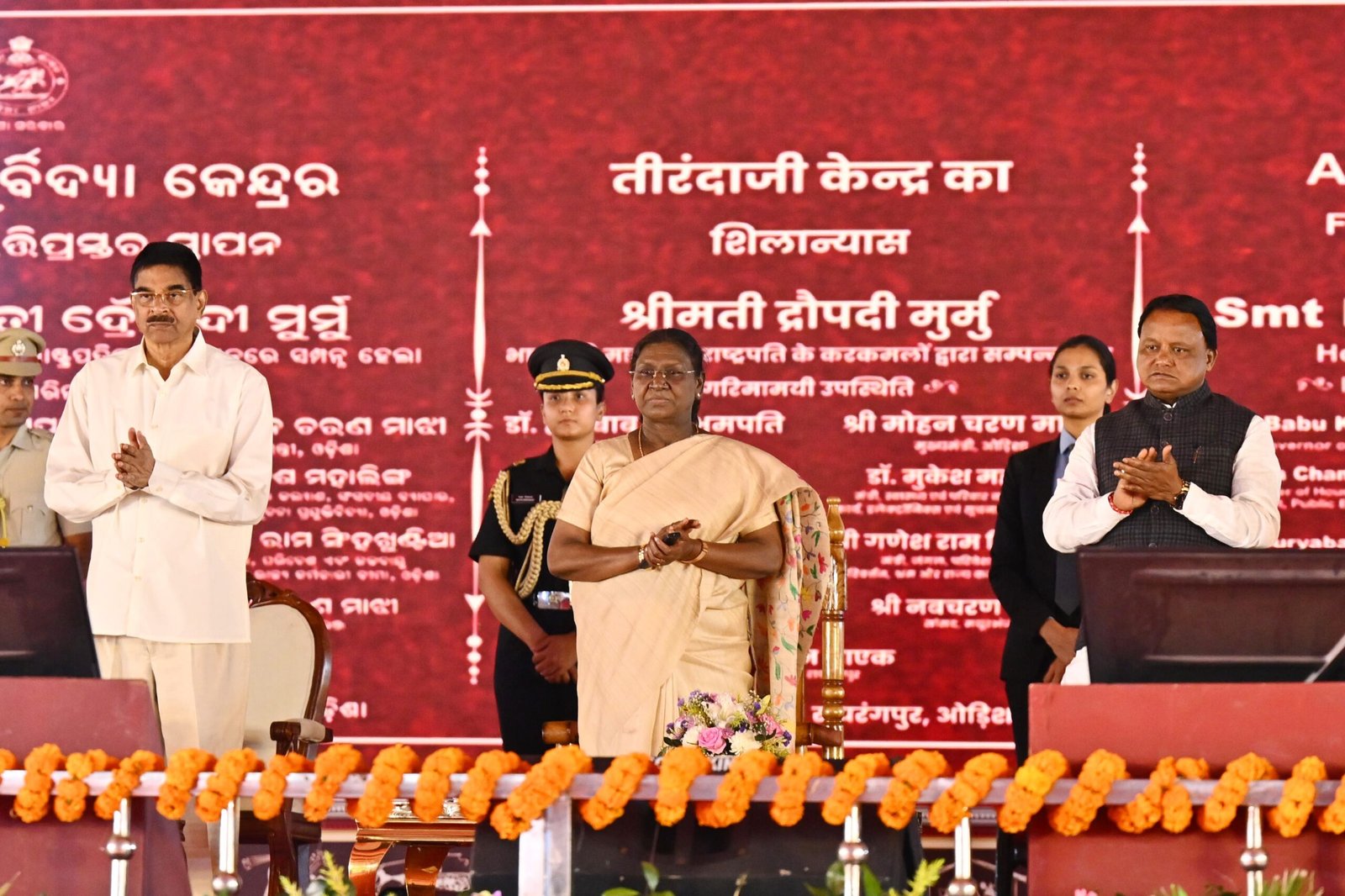
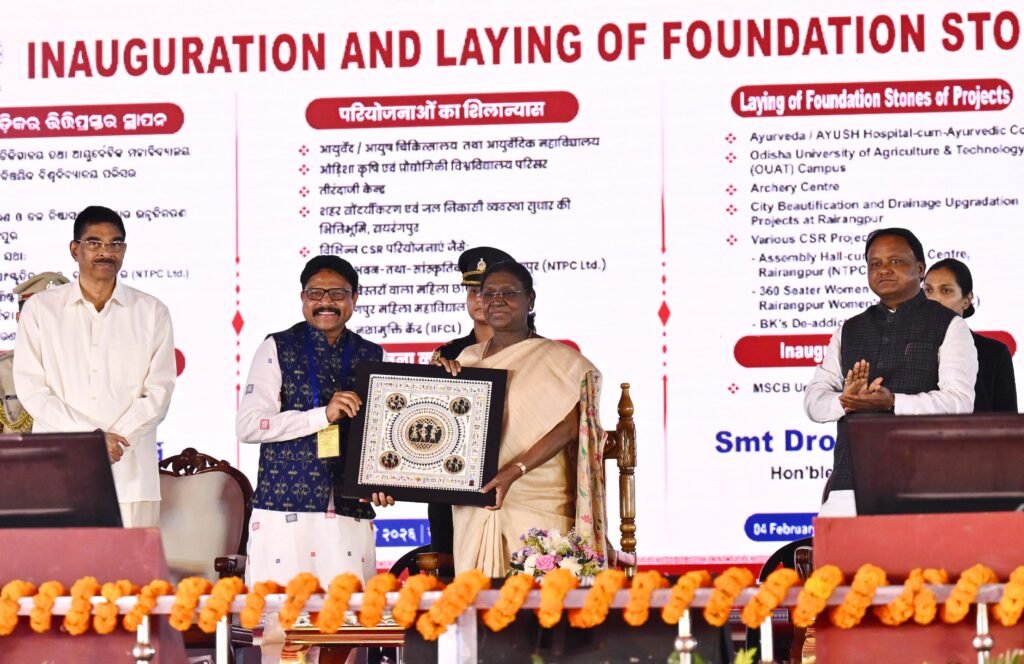
New Delhi / Rairangpur (Economy India): President Droupadi Murmu on Tuesday inaugurated and laid foundation stones for a series of major development projects in Odisha’s Rairangpur region, reinforcing the Centre’s focus on inclusive growth, tribal welfare, and regional development under the Purvodaya vision.
The President inaugurated the Information Technology campus of Maharaja Sriram Chandra Bhanja Deo University and laid foundation stones for multiple projects spanning healthcare, education, sports, urban infrastructure, and social welfare. These include an AYUSH hospital-cum-Ayurvedic college, an Odisha University of Agriculture and Technology campus, an archery centre, city beautification and drainage upgrade works, an auditorium and cultural centre, a girls’ hostel, and a de-addiction centre.


Purvodaya Vision Driving Eastern India’s Growth
Addressing the gathering, President Murmu said the Government of India’s Purvodaya vision places Odisha at the centre of eastern India’s development strategy, with Mayurbhanj district emerging as a key beneficiary. She expressed confidence that the newly inaugurated and announced projects would generate employment, strengthen human capital, and accelerate the region’s socio-economic transformation.
“These development-oriented projects and institutions will benefit the people of the region and create new livelihood opportunities,” the President said.
Strong Push for Tribal Economic Empowerment
Highlighting the government’s focus on tribal welfare, President Murmu outlined several flagship initiatives aimed at improving incomes, access to credit, and social infrastructure for tribal communities. She cited the Prime Minister Van Dhan Yojana, under which minimum support prices (MSP) are being provided for more than 90 minor forest produce items, helping tribal households secure fair returns.
She also referred to microcredit schemes for tribal members of self-help groups and the Tribal Women Empowerment Scheme, which offers low-interest loans to women from Scheduled Tribes. According to the President, these measures reflect the government’s commitment to strengthening grassroots entrepreneurship and financial inclusion among tribal populations.
Investments in Health, Education and Connectivity
The President noted that parallel efforts are underway to improve access to quality healthcare and education in tribal-dominated areas. She pointed to the implementation of the Prime Minister–JANMAN scheme for particularly vulnerable tribal groups, electrification of tribal regions, and the rollout of 4G internet connectivity in remote areas.
“These initiatives are ensuring that development reaches the last mile and that tribal regions are integrated into the mainstream growth process,” she said.
Linking Local Development to National Goals
President Murmu underlined that the upliftment of tribal communities is integral to achieving the broader goal of poverty alleviation. She urged citizens to actively participate in government welfare and development schemes and to spread awareness about them at the community level.
Local development, she said, leads to state-level progress and ultimately contributes to national growth. Emphasising India’s long-term vision, the President reiterated that the goal of building a Viksit Bharat by 2047 can only be realised through collective efforts by both the government and citizens.
Strategic Significance
The projects announced in Rairangpur are expected to strengthen regional infrastructure, enhance skill development, and create sustainable employment opportunities, particularly for youth and tribal communities. Analysts view the initiative as part of a broader strategy to reduce regional disparities while leveraging education, healthcare, and connectivity as key growth enablers.
With Odisha playing an increasingly important role in India’s development roadmap, the President’s visit signals sustained policy attention toward inclusive, regionally balanced economic growth.
(Economy India)