From Record-Breaking Road Building to Green Highways and Lower Logistics Costs, Gadkari’s Vision Aims to Redefine India’s Infrastructure Backbone
New Delhi (Economy India): India’s infrastructure story is entering a decisive phase. With the government setting an ambitious target of constructing 60 kilometres of national highways per day, the country is preparing for a dramatic acceleration in road development—one that could reshape logistics efficiency, regional connectivity, and economic competitiveness.
Union Minister for Road Transport and Highways Nitin Gadkari said the target reflects the government’s determination to scale up infrastructure creation at a pace aligned with India’s rising economic aspirations. Roads, Gadkari has repeatedly argued, are not merely transport assets—they are economic multipliers.

If achieved, the 60 km-per-day benchmark would place India among the fastest highway builders globally, reinforcing infrastructure as a cornerstone of long-term growth.

Why Highway Speed Matters for India
India’s logistics costs remain among the highest in the world—estimated at 13–14% of GDP, compared with 8–9% in developed economies. Poor road connectivity, congestion, and long travel times inflate costs for businesses and consumers alike.
Faster highway construction directly impacts:
- Freight efficiency
- Fuel consumption
- Travel time
- Supply chain reliability
According to infrastructure economists, every ₹1 invested in roads generates ₹3–4 in economic output over time. Highways connect farms to markets, factories to ports, and workers to jobs—making them indispensable for inclusive growth.
From Slow Growth to Rapid Expansion: A Decade of Change
India’s highway construction pace has already improved significantly over the last decade.
Average National Highway Construction (km/day)
- 2013–14: ~12 km/day
- 2018–19: ~28 km/day
- 2022–23: ~37 km/day
- 2023–24: ~40+ km/day
The new 60 km/day target represents not incremental improvement, but a step change.
Officials say this acceleration is possible due to:
- Faster land acquisition
- Digital project monitoring
- Improved contractor capacity
- New financing models
Infrastructure as the Engine of Economic Growth
The government views highways as central to achieving broader national goals:
- Making India a manufacturing hub
- Expanding exports
- Strengthening rural-urban integration
- Supporting MSMEs and agriculture
Road transport carries nearly 65% of India’s freight and 85% of passenger traffic, making it the backbone of mobility.
Better highways reduce vehicle operating costs, lower accident rates, and improve last-mile connectivity—critical for sectors such as:
- Agriculture and food processing
- Steel and cement
- Automobiles and EVs
- E-commerce and logistics
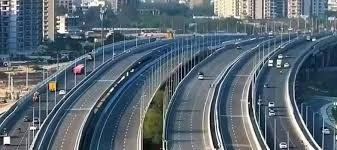
Green Highways and Sustainable Construction
Speed is only one part of the equation. The Ministry of Road Transport and Highways (MoRTH) has also placed strong emphasis on sustainability.
Under Gadkari’s leadership, highway projects increasingly use:
- Plastic waste in road surfacing
- Fly ash from thermal power plants
- Steel slag and construction debris
- Bio-bitumen and recycled materials
India now has over 1,00,000 km of roads built using waste materials, reducing carbon footprint and construction costs.
Green highways with:
- Solar lighting
- Rainwater harvesting
- Tree plantations
are becoming integral to new projects.
Mega Projects Driving the Highway Boom
Several flagship programmes underpin the 60 km/day ambition:
1. Bharatmala Pariyojana
- Target: 34,800 km of highways
- Focus on economic corridors, border roads, and port connectivity
- Key driver of logistics optimisation
2. Expressway Network Expansion
- Delhi–Mumbai Expressway
- Ganga Expressway
- Amritsar–Jamnagar Expressway
- Bengaluru–Chennai Expressway
Expressways reduce travel time by 30–40%, enabling faster freight movement and safer driving.
3. PM Gati Shakti National Master Plan
- Integrated planning across roads, railways, ports, airports
- Avoids duplication and delays
- Improves inter-ministerial coordination
Financing the Highway Surge
Building highways at 60 km per day requires massive capital.
Funding sources include:
- Budgetary allocations
- Toll-Operate-Transfer (TOT) models
- Infrastructure Investment Trusts (InvITs)
- Public-private partnerships (PPPs)
- Multilateral funding agencies
The National Highways Authority of India (NHAI) has increasingly relied on InvITs to monetise operational highways and fund new projects—reducing pressure on public finances.

Employment and Regional Development Impact
Highway construction is one of the largest employment generators in the infrastructure sector.
A faster build-out will:
- Create jobs in construction, engineering, and logistics
- Boost demand for steel, cement, and machinery
- Stimulate local economies along corridors
- Encourage industrial clusters near highways
For rural and semi-urban regions, highways provide:
- Better market access
- Higher land values
- Improved access to healthcare and education
Challenges Ahead: Land, Execution, and Costs
Despite progress, challenges remain.
Key Risks
- Land acquisition delays
- Rising construction costs
- Contractor financial stress
- Environmental clearances
- Traffic management during construction
The government has sought to address these through:
- Digital land acquisition platforms
- Faster dispute resolution
- Performance-linked contracts
- Real-time project dashboards
Safety and Quality: The Other Priority
India continues to record high road accident fatalities. Gadkari has repeatedly stressed that speed without safety is meaningless.
New highways now incorporate:
- Access-controlled designs
- Crash barriers and rumble strips
- Improved signage and lighting
- Black-spot identification and correction
The ministry aims to reduce road accident deaths by 50% by 2030, in line with global commitments.
Global Perspective: How India Compares
Globally, few countries build highways at India’s scale and speed.
- China remains the largest expressway network builder
- India now ranks among the top in annual highway additions
- The 60 km/day target would place India at the frontier of global infrastructure execution
For investors, this signals:
- Long-term policy commitment
- Predictable project pipeline
- Expanding opportunities in construction and logistics
What This Means for India’s Economic Future
If successfully implemented, the 60 km/day target could:
- Cut logistics costs significantly
- Improve export competitiveness
- Support Make in India and Atmanirbhar Bharat
- Accelerate regional development
- Strengthen India’s infrastructure-led growth model
Economists argue that roads are the most democratic infrastructure asset—benefiting farmers, workers, businesses, and consumers alike.
India’s ambition to construct 60 kilometres of highways per day reflects a broader vision: building the physical backbone required for a $5 trillion-plus economy.
While challenges remain, improved execution capability, innovative financing, and integrated planning have laid the groundwork for success. If momentum is sustained, India’s highway push could emerge as one of the most transformative infrastructure stories of the decade—reshaping mobility, markets, and economic opportunity across the country.
(Economy India)