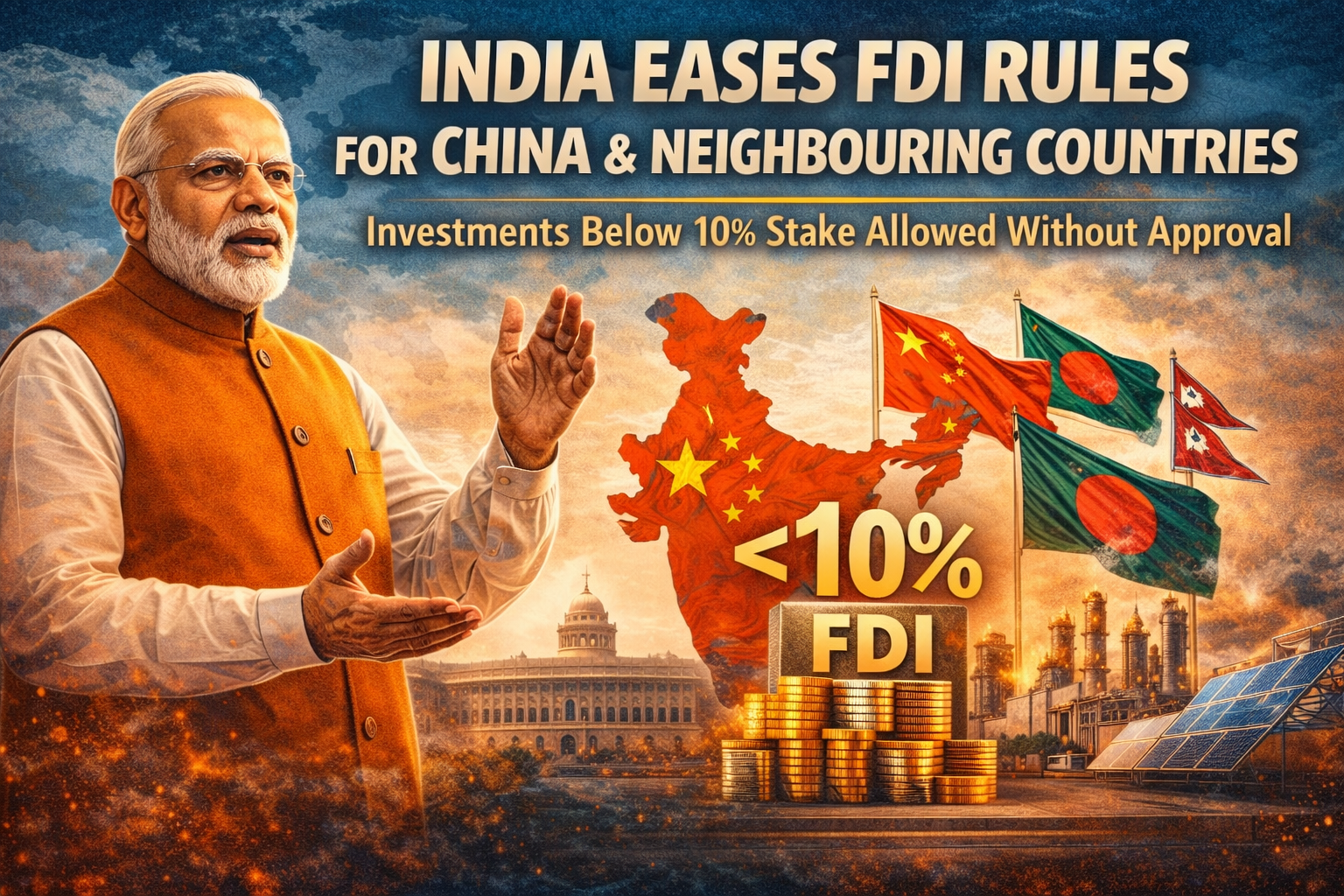

New Delhi (Economy India): The Indian government has relaxed foreign direct investment (FDI) rules for investors from countries sharing land borders with India, including China, in a move aimed at improving capital inflows and boosting ease of doing business.
The decision was approved during a Cabinet meeting chaired by Prime Minister Narendra Modi on March 10. Under the revised policy, foreign investments from neighbouring countries will be allowed through the automatic route if the investor’s stake in an Indian company is below 10% and does not involve control over the company.
The changes modify provisions under Press Note 3, which had previously required government approval for almost all investments from countries sharing land borders with India.

Faster Approvals for Strategic Manufacturing
The government has also introduced a fast-track approval system for investments in strategic manufacturing sectors. Under this mechanism, authorities must decide on investment proposals within 60 days.

Officials said the move is designed to attract global capital, accelerate manufacturing growth, and help India integrate more strongly into global supply chains.
Boost for Startups and Deep-Tech Firms
The policy change is expected to benefit Indian startups and deep-tech companies, which often receive funding from global venture capital and private equity funds.
Previously, many global funds faced regulatory hurdles because they included even small investments from neighbouring countries. By allowing investments below the 10% threshold without government approval, the government aims to simplify funding flows for innovation-driven sectors.
Clear Definition of “Beneficial Owner”
To improve transparency, the government has aligned the definition of beneficial ownership with the rules under the Prevention of Money Laundering Act (PMLA), 2005.
Under the revised rules:
- If an investor from a neighbouring country holds less than 10% stake
- And does not exercise control over the company,
then government approval will not be required. Companies will only need to inform the Department for Promotion of Industry and Internal Trade (DPIIT) about such investments.
Easier Joint Ventures and Technology Partnerships
The new fast-track mechanism will also make it easier for Indian companies to form joint ventures and technology partnerships with foreign firms.
Government officials believe this will encourage collaboration in manufacturing and strengthen India’s position in global supply chains.
Key Sectors Expected to Benefit
The policy changes are expected to particularly benefit three sectors:
- Electronics Components: Production of mobile and laptop components could receive greater foreign investment and technological support.
- Capital Goods: Manufacturing of heavy machinery and industrial equipment may see accelerated growth.
- Solar Cells: Increased investments could strengthen India’s renewable energy manufacturing ecosystem.
Security Safeguards Remain in Place
Despite easing the rules, the government has maintained strict security safeguards. Fast-track approvals in sensitive sectors will be allowed only if majority ownership and control remain with Indian citizens or Indian companies.
Officials emphasized that national security considerations remain a top priority, ensuring that critical sectors remain under Indian control.
(Economy India)