New Delhi (Economy India): India’s bullion market witnessed a strong weekly rally as gold and silver prices moved sharply higher, supported by global geopolitical tensions, expectations of interest rate cuts in the United States, and renewed buying after recent price corrections.
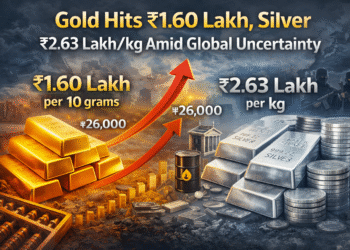
Gold prices rose by ₹4,000 per 10 grams during the week, reaching ₹1.59 lakh per 10 grams, while silver surged by ₹17,000 per kilogram to settle at ₹2.67 lakh per kg, according to market data.
In the previous week ending February 20, gold was trading around ₹1.55 lakh per 10 grams, while silver hovered near ₹2.50 lakh per kg. The latest move reflects renewed investor interest in precious metals as safe-haven assets.
Bullion Prices Show Volatility but Maintain Upward Bias in 2026
Gold and silver prices have seen sharp fluctuations in 2026 so far, but the broader trend remains positive. On a year-to-date basis:

- Gold has gained ₹25,902 per 10 grams
- Silver has risen by ₹36,280 per kilogram
Earlier this year, both metals touched record highs amid global uncertainty:
- Gold hit an all-time high of ₹1.76 lakh per 10 grams on January 29
- Silver peaked at ₹3.86 lakh per kg on the same day
Although prices corrected sharply after these peaks, the latest rebound suggests strong underlying demand.
Three Key Factors Driving the Rally in Gold and Silver
1. Rising Global Geopolitical Tensions
Escalating geopolitical risks have played a major role in pushing investors toward safe-haven assets. Heightened tensions in the Middle East, particularly involving the United States and Iran, along with the failure of peace negotiations between Russia and Ukraine, have increased global uncertainty.
In such an environment, investors typically reduce exposure to risk assets and increase allocations to gold, which is widely regarded as a hedge against geopolitical instability.
2. Expectations of Interest Rate Cuts by the US Federal Reserve
Another major factor supporting bullion prices is growing optimism around monetary easing by the Federal Reserve. Signals from US policymakers have strengthened expectations that interest rates could be cut later this year.
Lower interest rates reduce the opportunity cost of holding non-yielding assets like gold, making the metal more attractive compared to bonds and fixed-income instruments. This has provided significant support to international gold prices, which in turn influences domestic prices in India.
3. Buying at Lower Levels After Recent Corrections
After touching record highs in January, both gold and silver witnessed steep corrections. These declines encouraged:
- Jewellery manufacturers to rebuild inventory
- Long-term investors to enter at relatively attractive levels
This “buy-on-dips” strategy has helped stabilise prices and trigger the latest upward move.
Gold and Silver Gains Reflect Strong Institutional Demand
Institutional demand has also remained robust. According to estimates, central banks around the world continue to increase their gold reserves as part of diversification strategies aimed at reducing dependence on the US dollar.
Gold-backed exchange-traded funds (ETFs) have also seen renewed inflows, reflecting growing investor confidence in the metal’s long-term prospects.
Gold Could Touch ₹1.80 Lakh per 10 Grams: UBS
Global investment banking major UBS remains bullish on gold and expects prices to rise further in 2026.
According to UBS:
- Central banks globally purchased 863 tonnes of gold in 2025
- Gold buying by central banks is projected to increase to around 950 tonnes in 2026
In addition, gold ETF holdings are expected to rise to 825 tonnes this year, further supporting prices.
UBS believes that international gold prices could reach $6,200 per ounce by mid-2026. At that level, and factoring in the rupee-dollar exchange rate, import duties, and domestic taxes, gold prices in India could climb to ₹1.80 lakh per 10 grams.
Silver Outlook: Higher Volatility, Strong Industrial Support
While silver tends to be more volatile than gold, analysts believe it could remain supported by strong industrial demand, particularly from:
- Renewable energy and solar power projects
- Electronics and electrical equipment manufacturing
Silver’s dual role as a precious metal and an industrial input makes it more sensitive to global economic trends, leading to sharper price swings compared to gold.
What This Means for Investors
Market experts suggest that:
- Short-term volatility in gold and silver prices is likely to continue
- Long-term fundamentals remain supportive, especially for gold
Gold continues to be viewed as an effective hedge against inflation, currency volatility, and geopolitical risks, while silver offers higher-risk, higher-reward potential due to its industrial exposure.
Investors are advised to maintain a balanced approach, avoiding aggressive lump-sum buying at elevated levels and instead considering staggered investments.
The strong weekly gains in gold and silver underline the renewed appeal of precious metals amid global uncertainty. With geopolitical risks persisting, expectations of lower interest rates, and robust central bank demand, bullion prices are likely to remain in focus in the coming months.
For Economy India, the current trend highlights how global developments are shaping domestic commodity markets and influencing investment strategies in India.
(Economy India)