“From inclusive welfare to industrial expansion, the Anjor Vision 2047 charts Chhattisgarh’s journey towards a developed state by India@100.”
Economy India | Deep-Dive Feature Analysis
CHHATTISGARH
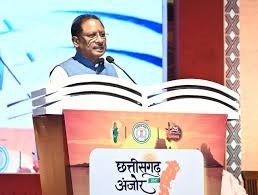
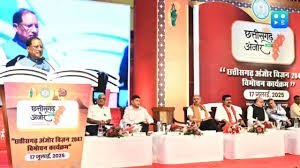
Raipur | As India advances towards its centenary of Independence in 2047, states across the country are aligning their development strategies with the national vision of Viksit Bharat. In this context, Chhattisgarh Chief Minister Shri Vishnu Deo Sai’s articulation of “Chhattisgarh Anjor Vision 2047” in the State Assembly marks a decisive policy moment—one that seeks to transform the mineral-rich yet socio-economically diverse state into a fully developed, inclusive, and future-ready economy.
The Vision 2047 document is not merely a political declaration; it is positioned as a structured, time-bound, and participatory development roadmap that integrates economic growth, social justice, environmental sustainability, and internal security.
A Historic Context: From Statehood to Strategic Vision
Chief Minister Vishnu Deo Sai began his address by recalling December 14, 2000, when the first Assembly session of newly formed Chhattisgarh was held at Jashpur Hall. That moment symbolised democratic aspiration; Vision 2047 symbolises developmental maturity.
Over the past 25 years, Chhattisgarh has evolved from a resource-dependent state to a key contributor in power, steel, mining, and agriculture. Now, the ambition is higher: to move up the value chain, diversify the economy, and ensure equitable prosperity.
India as the World’s Fourth-Largest Economy: A Macro Backdrop
The Vision document draws legitimacy from India’s broader economic rise. CM Sai highlighted that under Prime Minister Narendra Modi’s leadership, India has emerged as the world’s fourth-largest economy.
This macroeconomic strength provides states like Chhattisgarh an opportunity to:
- Attract global and domestic investment
- Integrate with global supply chains
- Build advanced manufacturing and green infrastructure
Vision 2047 positions Chhattisgarh as an active participant, not a passive beneficiary, of India’s growth story.
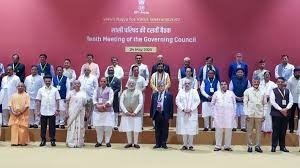
Three-Phase Development Framework: 2030, 2035, 2047
One of the most defining features of Chhattisgarh Anjor Vision 2047 is its clearly demarcated timelines:
🔹 Near-Term Goals (By 2030)
- Infrastructure expansion
- Employment generation
- Agricultural productivity enhancement
- Universal access to basic services
🔹 Mid-Term Goals (By 2035)
- Industrial diversification
- Urban transformation
- Skill-based workforce development
- Export-oriented manufacturing
🔹 Long-Term Goals (By 2047)
- High-income state status
- Carbon-resilient economy
- Global competitiveness in energy, technology, and logistics
- Inclusive social development
This phased approach introduces policy accountability and measurable milestones, often missing in long-term vision documents.
13 Priority Sectors, 10 Mission-Mode Interventions
The Vision identifies 13 core sectors—including education, healthcare, agriculture, infrastructure, industry, energy, and tourism—and proposes 10 mission-mode programmes to accelerate outcomes.
What sets this apart is the participatory formulation process. Inputs were gathered from:
- Farmers
- Youth
- Women
- Entrepreneurs
- Tribal communities
- Industry stakeholders
According to CM Sai, this makes Anjor Vision a “people-owned roadmap” rather than a top-down bureaucratic plan.
Naya Raipur: The Future Growth Engine
Naya Raipur emerges as a central pillar of the Vision. Planned as a next-generation urban hub, the city is envisioned as:
- A medical education hub
- A centre for IT, AI, and digital services
- A textile and skill-development cluster
With integrated urban planning, logistics connectivity, and sustainability norms, Naya Raipur is positioned to become one of India’s fastest-growing planned cities.
Inclusive Growth: Focus on the Poor, Farmers, and Women
The Vision strongly anchors itself in welfare-driven growth.
🏠 Housing
- 18 lakh houses approved under PM Awas Yojana in the first Cabinet decision
👩🦰 Women Empowerment
- Mahtari Vandan Yojana: ₹1,000 monthly assistance to nearly 70 lakh women
- ₹14,306 crore disbursed through 22 DBT instalments
🌾 Tribal & Forest Economy
- Tendu patta remuneration increased from ₹4,000 to ₹5,500
- Benefiting 13 lakh forest-dependent families
These schemes reflect a redistributive development model, ensuring growth translates into household-level security.
Bastar: From Conflict Zone to Cultural & Economic Identity
Perhaps the most transformative narrative in the Vision is Bastar’s reintegration into the mainstream.
🔐 Security & Rehabilitation
- Maoism nearing its “final phase”
- Target to eliminate extremism by March 2026
- Rehabilitation of surrendered militants
🌿 Development Initiatives
- Niyad Nellanar Yojana delivering roads, ration, electricity, Aadhaar, housing
- Revival of schools in remote villages
🎭 Cultural & Eco-Tourism
- Bastar Pandum
- Bastar Olympics
- Eco-tourism circuits
These initiatives aim to replace conflict economics with culture-driven and tourism-led livelihoods.
Investment Push: ₹8 Lakh Crore Proposals Received
Chhattisgarh’s new industrial policy has yielded strong early results:
- ₹8 lakh crore investment proposals
- Logistics parks and industrial corridors
- Air cargo infrastructure
- Local employment prioritisation
Additionally:
- Over 10,000 government jobs provided in two years
- Energy sector alone has attracted ₹3.5 lakh crore investment
This signals renewed investor confidence in the state.
Renewable Energy & Green Transition
Vision 2047 places clean energy at the centre of economic strategy.
☀️ PM Surya Ghar Muft Bijli Yojana
- Dual subsidy:
- ₹30,000 (Centre)
- ₹15,000 (State)
- Total ₹45,000 subsidy for 1 kW rooftop solar
This not only reduces household power bills but also builds distributed energy resilience.
Natural Resources: From Extraction to Value Addition
CM Sai emphasised that 21st-century sovereignty depends on energy systems and natural resources.
The Vision proposes:
- Moving from raw mineral extraction
- To value-added manufacturing
- Metal → Alloy → Finished products
This aligns Chhattisgarh with India’s broader manufacturing and self-reliance agenda.
Expert Perspective: Why Vision 2047 Matters
Policy analysts note that Chhattisgarh’s Vision stands out for:
- Clear timelines
- Security-development convergence
- Strong welfare-investment balance
- Alignment with national growth strategy
If implemented with institutional discipline, Anjor Vision 2047 could reposition Chhattisgarh as a high-growth, socially stable, and green economy.
A Collective Commitment to 2047
In his concluding appeal, CM Vishnu Deo Sai urged legislators and citizens alike to become stakeholders in the Vision, not mere observers.
“Developed Chhattisgarh is not a government project—it is a shared mission,” he said.
As India marches towards 2047, Chhattisgarh Anjor Vision 2047 offers a structured blueprint—grounded in realism, driven by aspiration, and anchored in inclusion.
📌 Economy India Takeaway
If execution matches intent, Chhattisgarh could emerge as one of India’s most balanced growth stories by 2047—combining industry, inclusion, innovation, and internal security into a single development narrative.