
(Economy India):When people hear the word desert, they usually imagine endless sand dunes stretching across the horizon. However, the world’s largest desert is not the Sahara. The title actually belongs to Antarctica, a vast frozen continent covered with ice and snow.
A desert is defined by very low annual rainfall, not by high temperatures. Since Antarctica receives less than 250 mm (10 inches) of precipitation each year, it qualifies as a desert. This makes it the largest desert on Earth.
What Is the Largest Desert in the World?
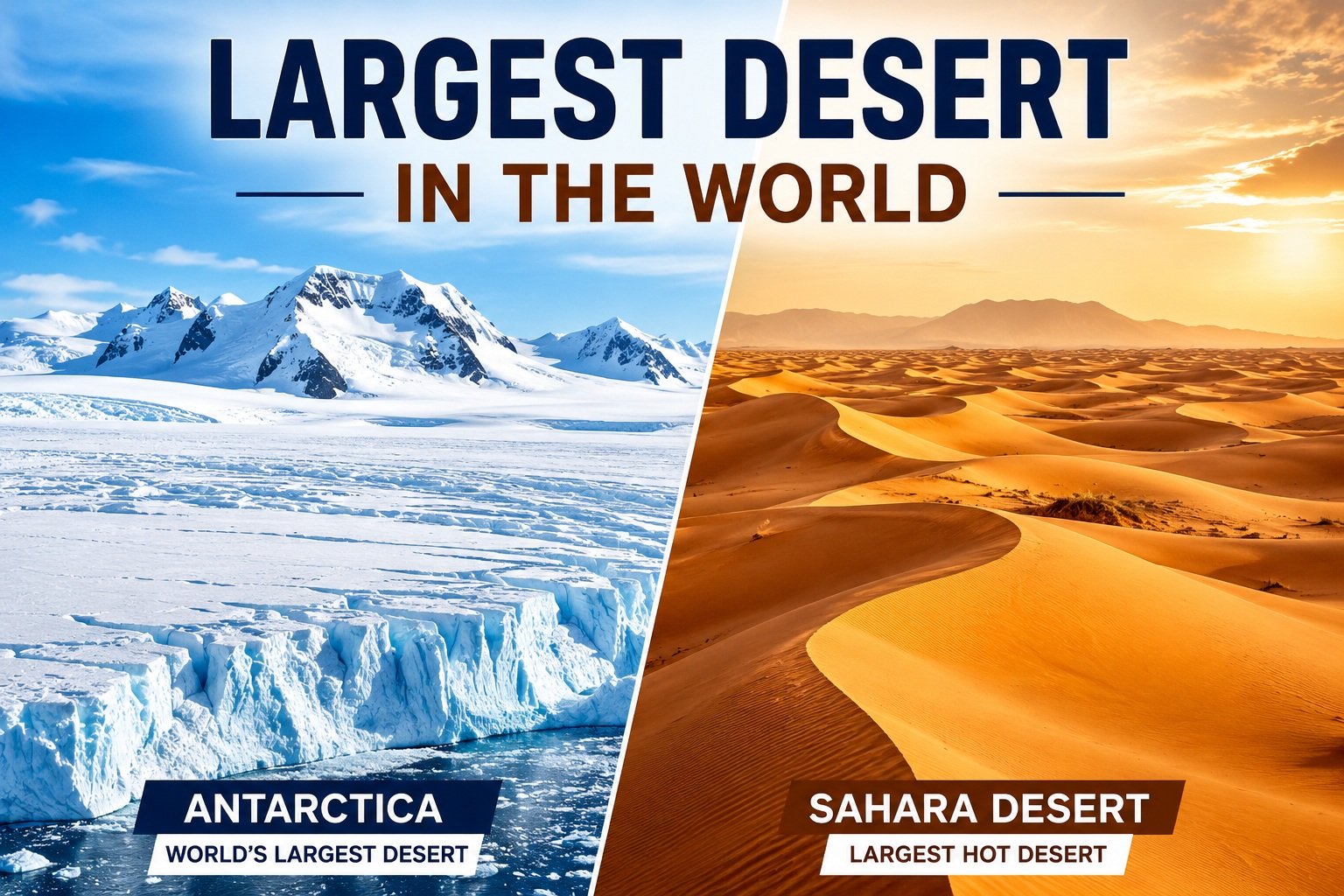
Antarctica is the largest desert in the world, covering approximately 14.2 million square kilometers (5.5 million square miles). Nearly 98% of the continent is covered by ice, making it the coldest, driest, and windiest place on Earth.
Unlike hot deserts, Antarctica is classified as a polar desert, where temperatures can fall below -80°C during winter.

The Sahara: The Largest Hot Desert
Although Antarctica is the world’s largest desert overall, the Sahara Desert is the largest hot desert on Earth.
Located in North Africa, the Sahara covers around 9.2 million square kilometers and stretches across 11 countries, including Algeria, Egypt, Libya, Sudan, Chad, Niger, Mali, Mauritania, Morocco, Tunisia, and Western Sahara.
The Sahara is famous for its massive sand dunes, rocky plateaus, and extreme daytime temperatures that can exceed 50°C (122°F).
Types of Deserts
Deserts are generally divided into four major categories:
1. Polar Deserts
These deserts are extremely cold and receive very little snowfall or rainfall.
- Example: Antarctica and the Arctic.
2. Hot and Dry Deserts
These deserts experience scorching temperatures during the day and very little rainfall.
- Example: Sahara Desert.
3. Coastal Deserts
Located near coastlines, these deserts are influenced by cold ocean currents.
- Example: Atacama Desert in Chile.
4. Semi-Arid Deserts
These receive slightly more rainfall than hot deserts but remain dry throughout the year.
- Example: Great Basin Desert in the United States.
Why Is Antarctica a Desert?
Many people assume Antarctica cannot be a desert because it is covered in ice. However, scientists classify deserts based on precipitation, not temperature.
Antarctica receives extremely little snowfall every year, making it drier than many hot deserts. The snow that does fall remains frozen for thousands of years because temperatures are so low.
Wildlife in Antarctica
Despite its harsh climate, Antarctica supports unique wildlife, including:
- Emperor Penguins
- Adélie Penguins
- Weddell Seals
- Leopard Seals
- Orcas (Killer Whales)
- Blue Whales
- Various seabirds
These animals survive by adapting to one of the harshest environments on Earth.
Interesting Facts About the World’s Largest Desert
- Antarctica is the largest desert on Earth.
- It contains nearly 70% of the world’s freshwater, frozen as ice.
- The continent has no permanent human population.
- Winds in Antarctica can exceed 300 km/h in some areas.
- The Sahara is nearly the size of the United States.
- Less than 1% of Antarctica is ice-free.
- Scientists from many countries conduct research there throughout the year.
Which Is Bigger: Antarctica or the Sahara?
| Desert | Type | Area |
|---|---|---|
| Antarctica | Polar Desert | 14.2 million sq km |
| Sahara | Hot Desert | 9.2 million sq km |
Antarctica is significantly larger than the Sahara, making it the true largest desert in the world.
Conclusion
The world’s largest desert is Antarctica, not the Sahara as many people believe. While the Sahara remains the largest hot desert, Antarctica’s extremely low precipitation qualifies it as a polar desert, giving it the title of Earth’s biggest desert. Understanding this difference helps us appreciate the incredible diversity of deserts, from icy landscapes to scorching sand dunes.
(Economy India)