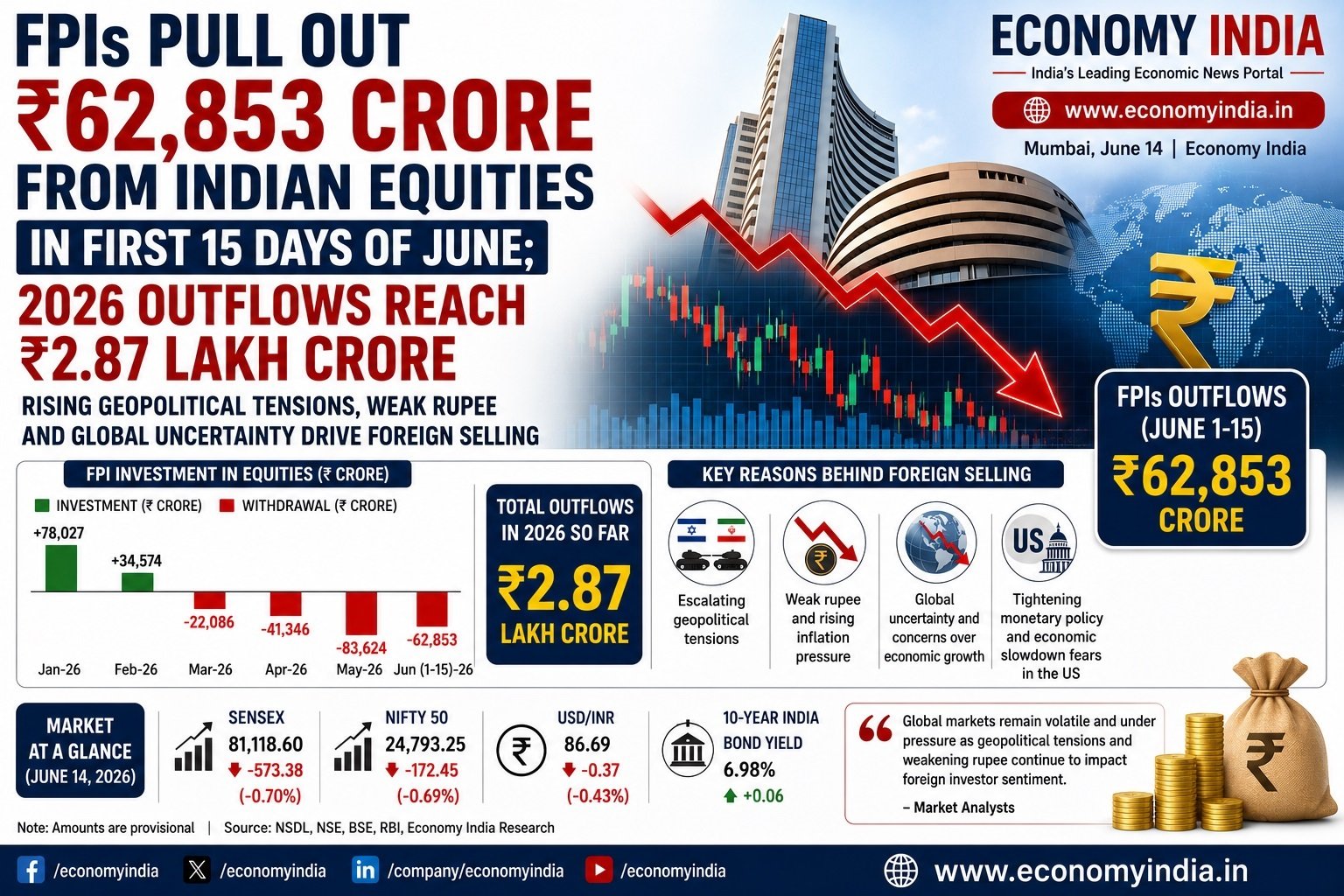

Rising Geopolitical Tensions, Weak Rupee and Global Uncertainty Drive Foreign Selling
Mumbai (Economy India): Foreign Portfolio Investors (FPIs) have withdrawn more than ₹62,853 crore from Indian equities during the first 15 days of June 2026, taking the total foreign outflow from the domestic stock market to ₹2.87 lakh crore so far this year, according to data released by the National Securities Depository Limited (NSDL).
The scale of the outflows has already surpassed the ₹1.66 lakh crore withdrawn during the entire calendar year 2025, highlighting the growing caution among global investors amid geopolitical tensions, global economic uncertainty, and persistent weakness in the Indian rupee.
Why Are FPIs Selling Indian Stocks?
Market experts believe multiple global and domestic factors are influencing foreign investor sentiment.
According to analysts, investors are currently navigating uncertainty surrounding:

🌍 Geopolitical developments in West Asia
🏦 Future interest rate decisions by major central banks
📉 Concerns over global economic growth
💵 Strength of the US dollar
📊 Valuation concerns in emerging markets
Shift Toward Safe-Haven Assets
During periods of heightened uncertainty, foreign investors often reduce exposure to emerging markets and move capital toward developed economies and safer assets such as US Treasuries and gold.
This trend has contributed to continued selling pressure in Indian equities.
India’s Valuations Seen as Expensive
Compared to several other emerging markets, Indian equities continue to trade at relatively premium valuations.
As a result, global investors have become increasingly selective in allocating capital to Indian markets.
Weak Rupee Adds to Investor Concerns
The depreciation of the Indian rupee has emerged as another significant factor behind foreign outflows.
Despite multiple efforts by the Reserve Bank of India (RBI) to stabilize the currency, the rupee has weakened substantially.
📉 Rupee down nearly 6% in 2026
📉 Around 10% decline over the past year
💵 Currency has fallen from the mid-80 levels to around 95 against the US dollar
For foreign investors, a weaker rupee reduces returns when investments are converted back into their home currencies, making Indian assets less attractive.
Selling Pressure Shows Signs of Easing
Despite the large outflows, market participants note that the pace of selling has moderated in recent trading sessions.
On Friday, FPIs sold only ₹1,082 crore worth of shares in the cash market, significantly lower than previous weeks.
This suggests that while risk aversion remains elevated, the intensity of foreign selling may be gradually declining.
Falling Crude Oil Prices Offer Relief
According to market strategists, recent geopolitical developments and optimism surrounding possible progress in US-Iran negotiations have contributed to a decline in crude oil prices.
🛢️ Brent crude has fallen below $87 per barrel
🇮🇳 Lower oil prices benefit India, one of the world’s largest oil importers
📉 Reduced energy import costs can improve macroeconomic stability
Analysts believe lower crude prices could help offset some pressure arising from India’s external sector challenges.
Government and RBI Take Steps to Attract Foreign Capital
Recognizing the importance of foreign capital flows, policymakers have introduced several measures to improve investor confidence and attract overseas investments.
Key Initiatives
🏦 RBI to absorb hedging costs on FCNR deposits raised by commercial banks
🔄 Expansion of forex swap facilities
📜 Easier access to government bonds through the Fully Accessible Route (FAR)
🌍 Higher investment limits for NRIs and Overseas Citizens of India (OCIs) in equities
These measures are aimed at supporting capital inflows and strengthening India’s balance of payments position.
FPIs Continue to Back Indian Debt Markets
While foreign investors have aggressively sold equities, they continue to show confidence in India’s debt market.
During the first half of June:
💰 More than ₹13,200 crore invested in debt securities through the FAR route
📈 Total debt investments through FAR in 2026 have reached nearly ₹28,000 crore
This indicates that global investors still view India’s fixed-income market favorably despite concerns in the equity segment.
Market experts say FPI flows in the coming weeks will depend on:
📌 Developments in US-Iran peace negotiations
📌 US Federal Reserve policy decisions
📌 Bank of Japan interest rate decisions
📌 Commentary from major global central banks
📌 Currency movements and crude oil prices
What is the Fully Accessible Route (FAR)?
The Fully Accessible Route (FAR) is a special RBI framework that allows foreign investors to invest in select Government of India securities without any investment limits.
The mechanism is designed to attract global capital into India’s debt market and help fund economic development while deepening the country’s bond market.
Foreign investor sentiment toward Indian equities remains cautious amid global uncertainties and currency pressures. However, continued confidence in India’s debt market, supportive policy measures, and easing crude oil prices could help stabilize capital flows in the months ahead. The direction of global interest rates, geopolitical developments, and currency movements will remain critical factors influencing FPI activity going forward.
(Economy India)